Leadership, Rights, Affluence
Introduit| English | Sens |
|---|---|
| baby boom/ˈbeɪbi buːm/ | The sharp rise in U.S. births from 1946 to the early 1960s. |
| Sun Belt/sʌn belt/ | The southern and western states that gained people and jobs after mid-century. |
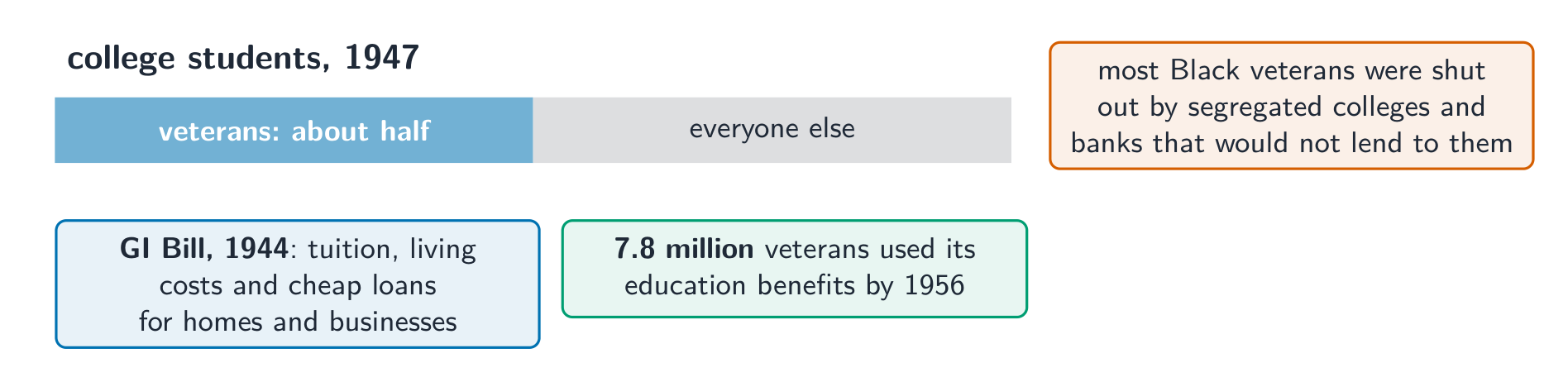
Veterans fill the colleges, 1947
- In 1947, veterans made up about half of all students at American colleges. The GI Bill of 1944 paid their tuition and living costs and offered cheap loans for homes and businesses. By 1956, about 7.8 million veterans had used its education benefits. Many were the first in their families to go to college. Most Black veterans, though, found that segregated colleges and banks shut them out.
- From 1945 to 1980, the United States led the Western world, Americans fought for rights at home, and a long boom changed how they lived.
About how many million veterans used GI Bill education benefits by 1956?
Difficulté 2/5 · 140 pièces + un petit bonus lors de la première réussite aujourd'hui
Many were first in their families at college.
Three claims for the postwar period
- Leadership: the US led a Western alliance against the Soviet Union in the Cold War.
- Rights: African Americans, women, Latinos, Native Americans and others demanded equal rights; affluence: economic growth and the baby boom created a large middle class.
Match each claim to its example.
Difficulté 2/5 · 140 pièces + un petit bonus lors de la première réussite aujourd'hui
Three claims.
Leadership as a response
- Americans did not plan a global role in 1945. Soviet control of Eastern Europe and fear of communism led the US to build alliances and bases worldwide.
- This leadership brought wars in Korea and Vietnam and a nuclear arms race.
Which of unit 8's threads?
Sort each statement into its thread.
Worked example: movements and responses
- Movement: the civil rights movement used boycotts, marches and court cases from the 1950s.
- Response: Congress passed the Civil Rights Act (1964) and the Voting Rights Act (1965).
- Reaction: by the late 1960s, a conservative backlash grew, and in 1980 Ronald Reagan was elected promising smaller government.
Put these in order.
Difficulté 3/5 · 200 pièces + un petit bonus lors de la première réussite aujourd'hui
Movement, response, reaction.
Economy and population together
- About 76 million babies were born in the baby boom 婴儿潮 of 1946–64. Families moved to suburbs and to the growing Sun Belt 阳光地带 of the South and West.
- Real family incomes roughly doubled between 1945 and 1973.
About how many million babies were born in the baby boom of 1946–64?
Difficulté 2/5 · 140 pièces + un petit bonus lors de la première réussite aujourd'hui
The baby boom.
The boom ends
- In the 1970s, oil shocks, inflation and competition from Japan and Europe slowed growth.
- Faith in government fell after Vietnam and the Watergate scandal.
What ended the postwar boom in the 1970s?
Difficulté 2/5 · 140 pièces + un petit bonus lors de la première réussite aujourd'hui
Slower growth.
Affluence was not shared by everyone. In 1962, Michael Harrington's The Other America showed that about 40 million Americans still lived in poverty.
Postwar affluence reached every American.
Difficulté 1/5 · 100 pièces + un petit bonus lors de la première réussite aujourd'hui
About 40 million were still poor in 1962.
From 1945 to 1980, the US led the West in the Cold War, civil rights and other movements won new laws and provoked a backlash, and the GI Bill, the baby boom and economic growth created a broad middle class — until the 1970s brought slower growth and less trust in government.
Explain how the GI Bill helped create postwar affluence, and its limits.
Two-sided effect.