The Most Powerful Nation
Introduit| English | Sens |
|---|---|
| Bretton Woods | The 1944 conference that set up the postwar money system and created the IMF and the World Bank. |
| United Nations/juːˈnaɪtɪd ˈneɪʃnz/ | The international organisation founded in 1945 to keep peace, with the United States as a leading member. |
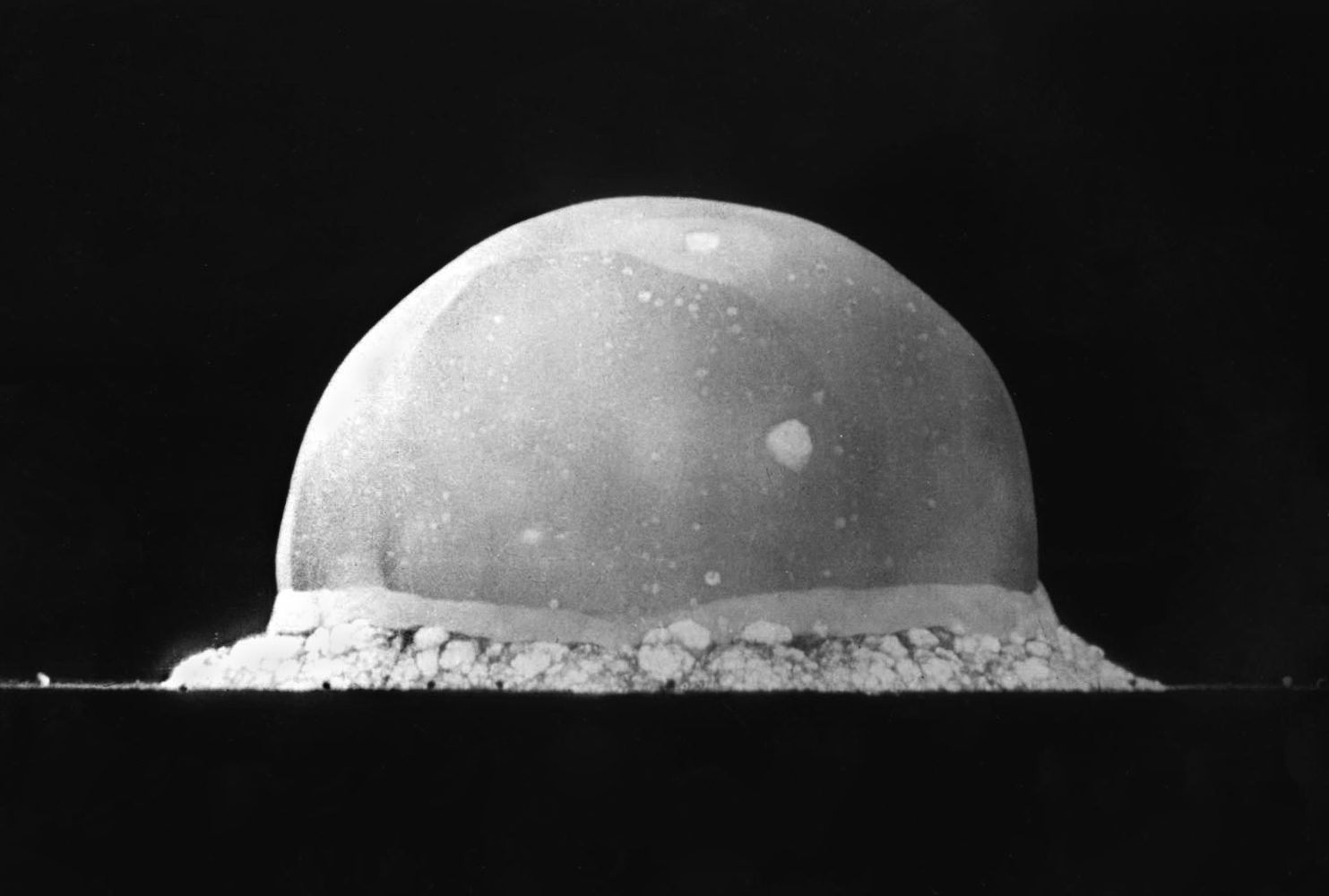
A light brighter than the sun, July 1945
- At 5:29 a.m. on 16 July 1945, scientists in the New Mexico desert tested the world's first atomic bomb, code-named Trinity. The flash was seen 300 km away; the explosion equalled about 20 000 tons of TNT. Three weeks later, atomic bombs destroyed Hiroshima and Nagasaki. The United States alone had the weapon.
- By 1945, the United States had become the most powerful nation in the world — economically, militarily and diplomatically.
Why was the Trinity test important for American power?
Difficulté 1/5 · 100 pièces + un petit bonus lors de la première réussite aujourd'hui
The US alone had the bomb until 1949.
Three reasons
- Economic: the US produced about half of the world's manufactured goods in 1945, and its economy had nearly doubled during the war.
- Military: it had the largest navy and air force and a monopoly on the atomic bomb; diplomatic: it led the creation of the postwar international system.
About what percentage of the world's manufactured goods did the US produce in 1945?
Difficulté 2/5 · 140 pièces + un petit bonus lors de la première réussite aujourd'hui
About half.
Relative power
- America's homeland was untouched by bombing. About 400 000 Americans died in the war — a terrible loss, but far fewer than the roughly 27 million Soviet dead.
- Britain, France, Germany, Japan and the Soviet Union were exhausted or ruined.
A relative reason, an American role, or a caveat?
Sort each element of postwar power.
Far fewer Americans than Soviet citizens died in the war.
Difficulté 1/5 · 100 pièces + un petit bonus lors de la première réussite aujourd'hui
About 400 000 against about 27 million.
Worked example: shaping the settlement
- Money: at Bretton Woods 布雷顿森林会议 (July 1944), 44 nations created the International Monetary Fund and the World Bank, with the dollar at the centre of world finance.
- Peace: the United Nations 联合国 was founded at San Francisco in 1945, with the US as one of five permanent members of the Security Council with a veto.
- The result: the US designed the institutions that would govern the postwar world.
Match each institution to its purpose.
Difficulté 2/5 · 140 pièces + un petit bonus lors de la première réussite aujourd'hui
Shaping the settlement.
What "most powerful" meant
- It did not mean the US could control everything: the Soviet army occupied Eastern Europe, and China's civil war was beyond American control.
- The Soviet Union tested its own atomic bomb in 1949.
Which showed the limits of American power?
Difficulté 2/5 · 140 pièces + un petit bonus lors de la première réussite aujourd'hui
Bretton Woods showed its strength.
Consequences
- The US abandoned its interwar avoidance of commitments and became the leader of a Western alliance.
- Its new power led directly to rivalry with the Soviet Union in the Cold War.
American power in 1945 was relative. It was so great partly because other powers were devastated. It was not unlimited, as Soviet control of Eastern Europe showed.
American power in 1945 was unlimited.
Difficulté 1/5 · 100 pièces + un petit bonus lors de la première réussite aujourd'hui
It was relative.
By 1945, the US produced half the world's manufactured goods, had the strongest military and the only atomic bomb, and suffered far less than other powers. It shaped the postwar world through Bretton Woods and the United Nations — but its power had limits, and rivalry with the Soviet Union followed.
Explain why the United States was the most powerful nation in 1945.
Causation.