Winning the War
Introduit| English | Sens |
|---|---|
| Holocaust/ˈhɒləkɔːst/ | The murder of about six million European Jews, and millions of others, by Nazi Germany. |
| Manhattan Project | The secret U.S. programme that built the first atomic bombs during the Second World War. |
| island hopping | The US strategy in the Pacific War of capturing selected islands to move closer to Japan. |
Hiroshima, 6 August 1945
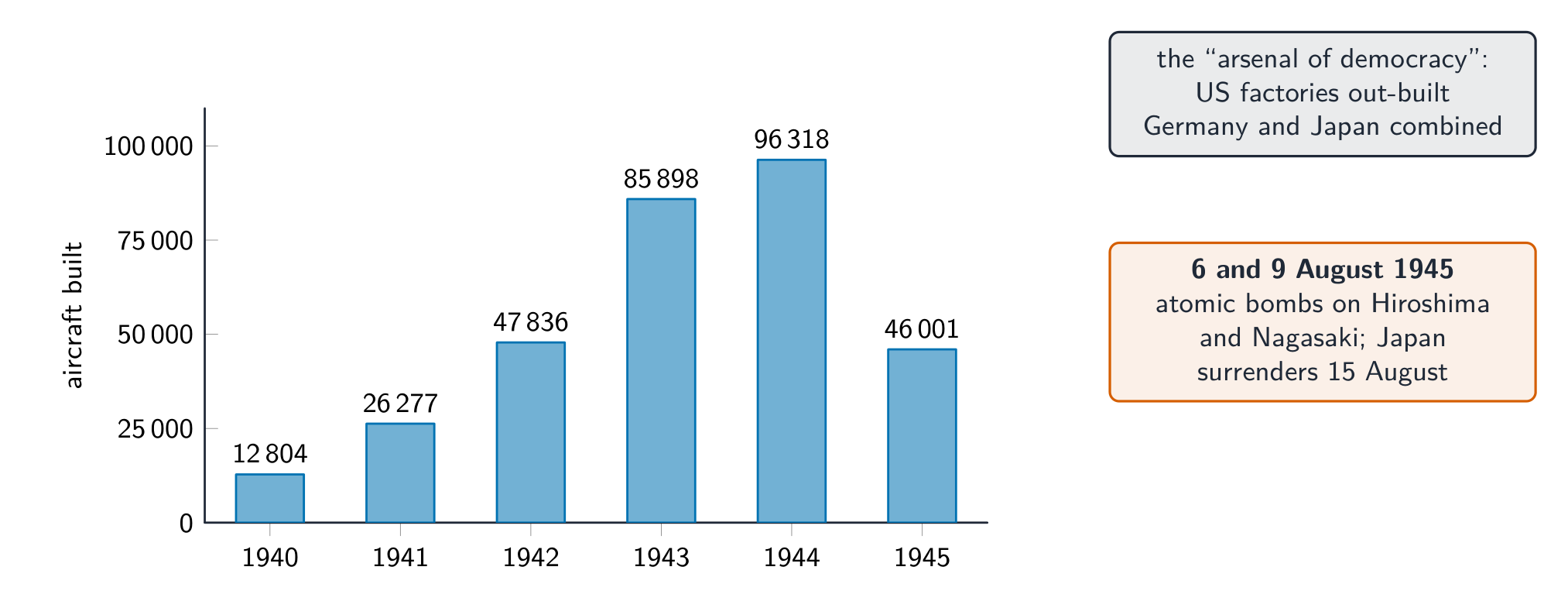
- At 8:15 in the morning, an American B-29 dropped an atomic bomb on Hiroshima. About 70 000 people died at once, and many more later. Three days later a second bomb hit Nagasaki, and on 15 August Japan announced its surrender.
- How did the Allies win, and how did Americans understand the war?
A war for freedom
- In 1941 Roosevelt described "Four Freedoms" worth fighting for: of speech, of worship, from want and from fear.
- When Allied troops reached Nazi camps in 1945, the Holocaust 纳粹大屠杀 — the murder of about 6 million Jews — confirmed for many Americans what the war was against.
Which were among Roosevelt's Four Freedoms?
Difficulté 2/5 · 140 pièces + un petit bonus lors de la première réussite aujourd'hui
The fourth was freedom from want.
Who served
- About 16 million Americans served. Black soldiers served in segregated units, such as the Tuskegee Airmen; Navajo code talkers sent messages the Japanese could not break.
- Japanese American soldiers of the 442nd Regiment fought in Europe while their families were interned.
Match each group to its role.
Difficulté 2/5 · 140 pièces + un petit bonus lors de la première réussite aujourd'hui
Who served.
Worked example: causes of Allied victory
- Cooperation: Britain, the Soviet Union and the US coordinated strategy; the Soviet army destroyed most of Germany's forces in the East.
- Production and science: US factories out-produced the Axis; radar and the Manhattan Project 曼哈顿计划 gave technological advantages.
- Strategy: D-Day (6 June 1944) opened a second front in France; in the Pacific, victory at Midway (June 1942) and island hopping 跳岛战术 brought US forces within bombing range of Japan.
How the war was understood, a cause of victory, or a consequence?
Sort each element of the Allied victory.
What was island hopping?
Difficulté 1/5 · 100 pièces + un petit bonus lors de la première réussite aujourd'hui
Pacific strategy.
Two campaigns
- In Europe, the Allies invaded North Africa (1942), Italy (1943) and France (1944); Germany surrendered on 8 May 1945.
- In the Pacific, battles such as Iwo Jima and Okinawa (1945) were extremely costly, shaping fears about invading Japan.
Put these events in order.
Difficulté 3/5 · 200 pièces + un petit bonus lors de la première réussite aujourd'hui
1942, 1944, May 1945, August 1945.
The debate over the bomb
- Supporters argued the bombs ended the war quickly and saved the lives of soldiers who would have died invading Japan.
- Critics argued Japan was close to surrender, and that the bombs were also meant to impress the Soviet Union. Historians still debate this.
Historians still debate whether the atomic bombs were necessary.
Difficulté 1/5 · 100 pièces + un petit bonus lors de la première réussite aujourd'hui
Arguments on both sides.
The US did not win the war alone. The Soviet Union fought most of Germany's army, and Britain held out from 1940. American production and troops were decisive, but within an alliance.
The United States defeated Germany largely on its own.
Difficulté 1/5 · 100 pièces + un petit bonus lors de la première réussite aujourd'hui
The Soviet Union fought most of Germany's army.
Americans saw the war as a fight for freedom, confirmed by the Holocaust, though their own armed forces were segregated. Allied cooperation, American production, new technology and strategies such as D-Day and island hopping won the war. The atomic bombs ended it and opened a lasting debate.
Evaluate the arguments for and against the decision to use atomic bombs on Japan in 1945.
Argumentation.