Consumer Goods and Mass Media
Introduit| English | Sens |
|---|---|
| installment plan | A way of buying goods by paying part of the price now and the rest in regular payments later. |
| mass culture/mæs ˈkʌltʃə/ | Entertainment and goods shared by a wide public, such as radio and film. |
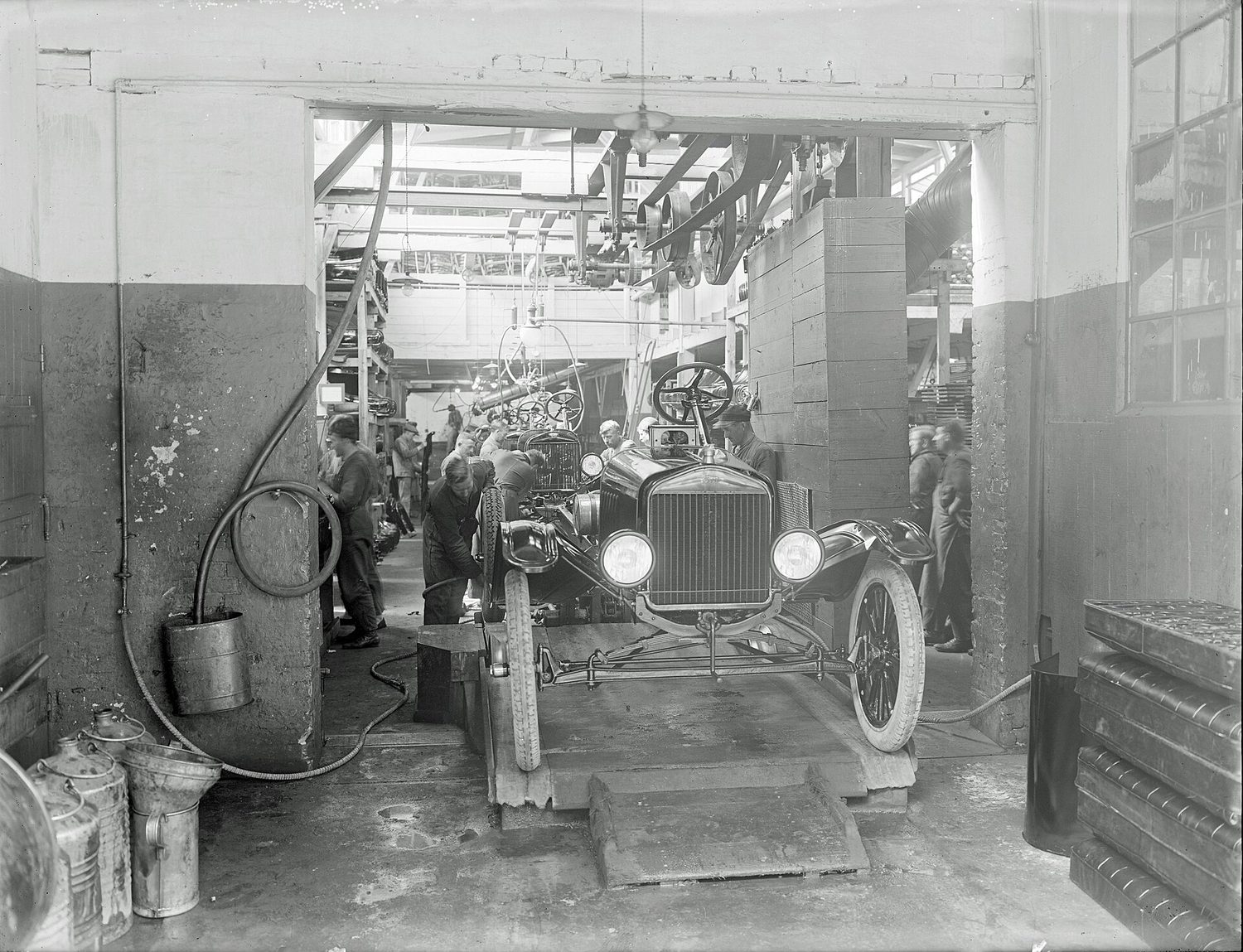
| assembly line | A line of workers and machines where a product moves from one station to the next and each worker does one task. |
Election results by radio, November 1920
- On the evening of 2 November 1920, a Westinghouse station in Pittsburgh called KDKA broadcast the results of the presidential election as they came in: Warren Harding had defeated James Cox. Perhaps a thousand people heard it on home-built sets. By 1930, about 12 million American households — around 40% — owned a radio.
- In the 1920s, mass production and mass media created a consumer society and a shared national culture.
Why is KDKA's 1920 broadcast important?
Difficulté 1/5 · 100 pièces + un petit bonus lors de la première réussite aujourd'hui
Election results, 1920.
About what percentage of households owned a radio by 1930?
Difficulté 2/5 · 140 pièces + un petit bonus lors de la première réussite aujourd'hui
About 12 million households.
An economy focused on consumers
- Factories made cars, radios, refrigerators and vacuum cleaners for ordinary families. Advertising persuaded people to want them.
- Families bought them with installment plans 分期付款 — paying a little each month — so consumer debt grew rapidly.
How did many families pay for new consumer goods?
Difficulté 1/5 · 100 pièces + un petit bonus lors de la première réussite aujourd'hui
Consumer debt grew.
Radio and cinema did two things
- They spread the same news, music, sports and advertisements across the country, creating a mass culture 大众文化.
- Millions went to the movies each week; The Jazz Singer (1927) was the first feature film with synchronized speech.
An economic result, a media effect, or a change in living?
Sort each element of the consumer economy.
Worked example: the Model T
- Production: Ford's moving assembly line 流水线 (1913) cut the time to build a car from about 12 hours to about 90 minutes.
- Price: a Model T cost about 850 dollars in 1908 and about 260 dollars by 1925, so many workers could afford one.
- Result: by 1929, about 23 million cars were registered in the United States.
A Model T cost about 850 dollars in 1908 and 260 dollars in 1925. By how many dollars did the price fall?
Difficulté 2/5 · 140 pièces + un petit bonus lors de la première réussite aujourd'hui
850 − 260.
Mobility changed life
- Cars let families live in suburbs, take holidays and travel to new jobs; roads, petrol stations and motels spread.
- Young people gained freedom from their parents' watch.
Match each innovation to its effect.
Difficulté 2/5 · 140 pièces + un petit bonus lors de la première réussite aujourd'hui
Mass culture.
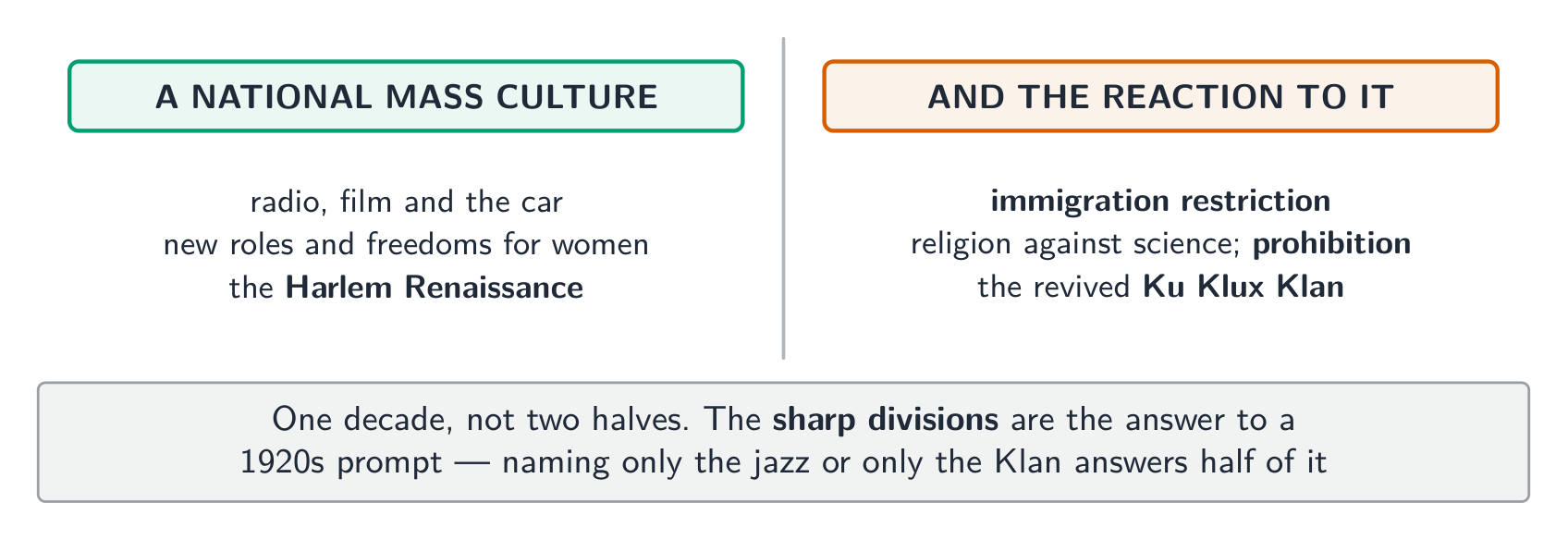
Two faces of one decade
- Many Americans enjoyed the new culture; others saw it as a threat to religion, family and small-town life.
- The same decade saw jazz and movies — and the revival of the Ku Klux Klan and fights over teaching evolution.
Prosperity was not shared by everyone. Farmers suffered from low prices throughout the 1920s, and many workers could buy goods only on credit.
All Americans shared equally in 1920s prosperity.
Difficulté 1/5 · 100 pièces + un petit bonus lors de la première réussite aujourd'hui
Farmers suffered.
In the 1920s, assembly-line production made cars and appliances affordable, advertising and installment credit encouraged buying, and radio and cinema created a national mass culture. Cars changed where and how people lived, while many Americans reacted against the new ways.
Explain how mass production and mass media changed American life in the 1920s.
Effects.