The Mexican-American War
Introduit| English | Sens |
|---|---|
| Wilmot Proviso | A 1846 proposal to ban slavery in all land taken from Mexico; it passed the House but never the Senate. |
"Show me the spot", December 1847
- In December 1847, a new congressman from Illinois named Abraham Lincoln introduced a series of resolutions in the House. President Polk had said the war with Mexico began when Mexico "shed American blood upon American soil". Lincoln demanded that Polk show the exact spot — because he believed it was Mexican soil. Voters at home called him "Spotty Lincoln".
- The Mexican-American War (1846–48) added huge territory to the United States and raised questions it could not answer.
Why did Lincoln introduce his "spot resolutions"?
Difficulté 1/5 · 100 pièces + un petit bonus lors de la première réussite aujourd'hui
December 1847.
Territory gained
- In 1846, Polk sent troops into land between the Nueces River and the Rio Grande that both nations claimed. After fighting began, US armies took California and, in 1847, Mexico City.
- In the Treaty of Guadalupe Hidalgo (1848), Mexico gave up about half its territory — California, Nevada, Utah and most of Arizona and New Mexico — for 15 million dollars.
Which lands did Mexico give up in 1848?
Difficulté 2/5 · 140 pièces + un petit bonus lors de la première réussite aujourd'hui
Florida came from Spain in 1819.
The people already there
- About 80 000 Mexicans living in the ceded lands were promised citizenship and property rights, but many lost their land in courts and to settlers.
- In California, Native peoples were killed by settlers and militias and died from disease; their population fell from about 150 000 in 1848 to about 30 000 by 1870.
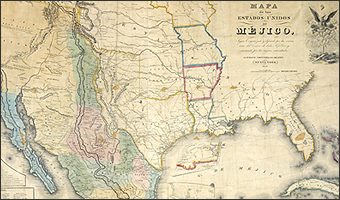
Follow expansion into the crisis it created
Acquiring land forced the question that could not be avoided: would slavery expand into it?
California's Native population fell from about 150 000 to about 30 000. By what percentage did it fall?
Difficulté 2/5 · 140 pièces + un petit bonus lors de la première réussite aujourd'hui
120 000 ÷ 150 000.
Worked example: the slavery question
- The proposal: in 1846, Congressman David Wilmot proposed that slavery be banned in any land taken from Mexico — the Wilmot Proviso 威尔莫特附文.
- The vote: it passed the House, where the North had more seats, but failed in the Senate, where North and South were equal.
- The effect: the vote split Congress by section rather than by party — a warning sign for the Union.
Why did the Wilmot Proviso fail?
Difficulté 1/5 · 100 pièces + un petit bonus lors de la première réussite aujourd'hui
It passed the House.
Three groups, three questions
- Mexicans: would their rights be respected? Native Americans: would they keep their lands?
- The nation: would the new lands be slave or free? This last question dominated politics.
Gold and growth
- Gold was found in California in January 1848; about 300 000 people arrived by 1855.
- California asked to join the Union as a free state in 1849, upsetting the balance in the Senate.
California asked to join the Union as a free state in 1849.
Difficulté 1/5 · 100 pièces + un petit bonus lors de la première réussite aujourd'hui
After the Gold Rush.
The war was controversial at the time. Many Northern Whigs, abolitionists and writers such as Henry David Thoreau opposed it as a war to spread slavery.
All Americans supported the Mexican-American War.
Difficulté 1/5 · 100 pièces + un petit bonus lors de la première réussite aujourd'hui
Many Whigs and abolitionists opposed it.
The Mexican-American War gave the US about half of Mexico's territory. Mexicans in the ceded lands lost property, California's Native peoples were devastated, and the Wilmot Proviso showed that the question of slavery in the new lands divided Congress by section.
Explain the effects of the Mexican-American War on the United States.
Effects.