The First Experiments
Introduit| English | Sens |
|---|---|
| Articles of Confederation/ˈɑːtɪklz ɒv kənˌfedəˈreɪʃn/ | The first US constitution, which created a weak central government. |
| Northwest Ordinance/nɔːˈθwest ˈɔːdɪnəns/ | The 1787 law that set rules for western territories to become states and banned slavery north of the Ohio River. |
Farmers march on an armoury, January 1787
- In January 1787, about 1500 armed farmers led by Daniel Shays, a former Continental Army captain, marched on the federal armoury at Springfield, Massachusetts. They were losing their farms because they could not pay high state taxes and debts. The state militia fired cannon and scattered them. The national government had no army to send.
- After independence, Americans experimented with new governments — first giving little power to the centre.
Why did Shays' Rebellion worry national leaders?
Difficulté 1/5 · 100 pièces + un petit bonus lors de la première réussite aujourd'hui
A sign of weak government.
State constitutions
- After 1776, states wrote constitutions that gave most power to elected legislatures and kept governors weak, out of fear of another king.
- Pennsylvania's 1776 constitution had a one-house legislature and no governor at all.
State constitutions kept governors weak out of fear of another king.
Difficulté 1/5 · 100 pièces + un petit bonus lors de la première réussite aujourd'hui
Legislatures held most power.
The Articles of Confederation
- The Articles of Confederation 邦联条例 (in force 1781) created a Congress where each state had one vote.
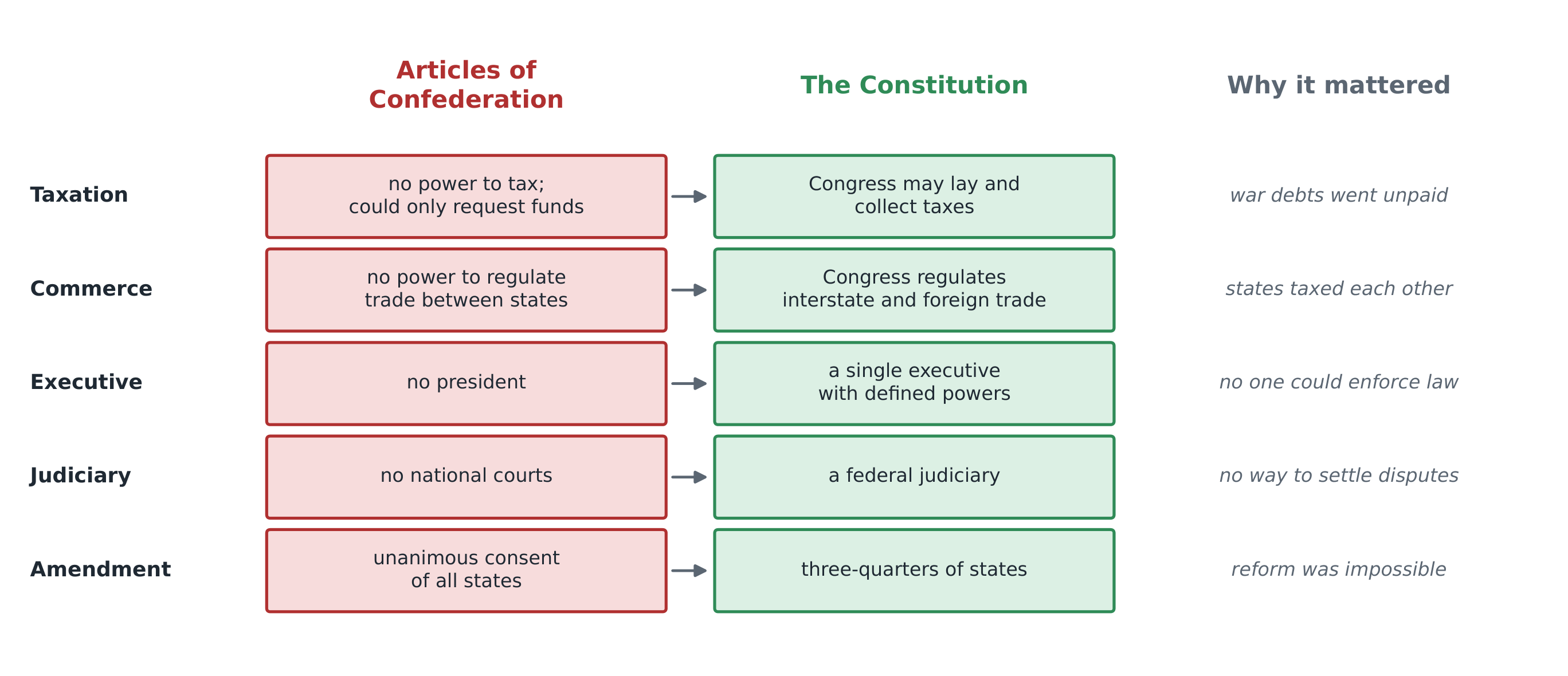
- Congress could make war and treaties but could not tax, control trade or force states to obey; laws needed 9 of 13 states, and amendments needed all 13.
State constitutions, the Articles, or the Northwest Ordinance?
Sort each element of the first experiments.
What could Congress NOT do under the Articles?
Difficulté 2/5 · 140 pièces + un petit bonus lors de la première réussite aujourd'hui
It could make treaties.
How many of the 13 states had to agree to pass a law under the Articles?
Difficulté 2/5 · 140 pièces + un petit bonus lors de la première réussite aujourd'hui
Amendments needed all 13.
Worked example: the Northwest Ordinance
- Statehood: the Northwest Ordinance 西北条例 (1787) set out how western territories could become new states equal to the original thirteen.
- Slavery: it banned slavery in the Northwest Territory, north of the Ohio River.
- Schools: following the Land Ordinance of 1785, land in each township was set aside for public schools. These were the Articles' greatest success.
Match each part of the Northwest Ordinance to its effect.
Difficulté 2/5 · 140 pièces + un petit bonus lors de la première réussite aujourd'hui
The Articles' success.
Weaknesses revealed
- Without the power to tax, Congress could not pay its war debts or soldiers. States printed their own money and taxed each other's goods.
- Shays' Rebellion convinced many leaders that the nation needed a stronger government.
An experiment, not just a failure
- The Articles won the war, signed the peace treaty of 1783 and organized the West.
- Their problems taught Americans what a stronger government needed — lessons used in Philadelphia in 1787.
The Articles were not a complete failure. They kept the states together through the war and created the Northwest Ordinance. Their weaknesses came from a deliberate fear of central power.
The Articles of Confederation achieved nothing.
Difficulté 1/5 · 100 pièces + un petit bonus lors de la première réussite aujourd'hui
War, peace and the Northwest Ordinance.
The first state constitutions favoured legislatures, and the Articles of Confederation created a weak Congress that could not tax or control trade. The Northwest Ordinance organized the West and banned slavery there, but Shays' Rebellion convinced leaders to write a stronger constitution in 1787.
Evaluate the Articles of Confederation.
Evaluation.