What the Revolution Changed at Home and Abroad
Introduit| English | Sens |
|---|---|
| gradual emancipation | Ending slavery step by step over years, for example by freeing only children born after a certain date. |
| republican motherhood/rɪˈpʌblɪkən ˈmʌðəhʊd/ | The idea that women served the republic by raising virtuous sons to be good citizens. |
An enslaved woman goes to court, 1781
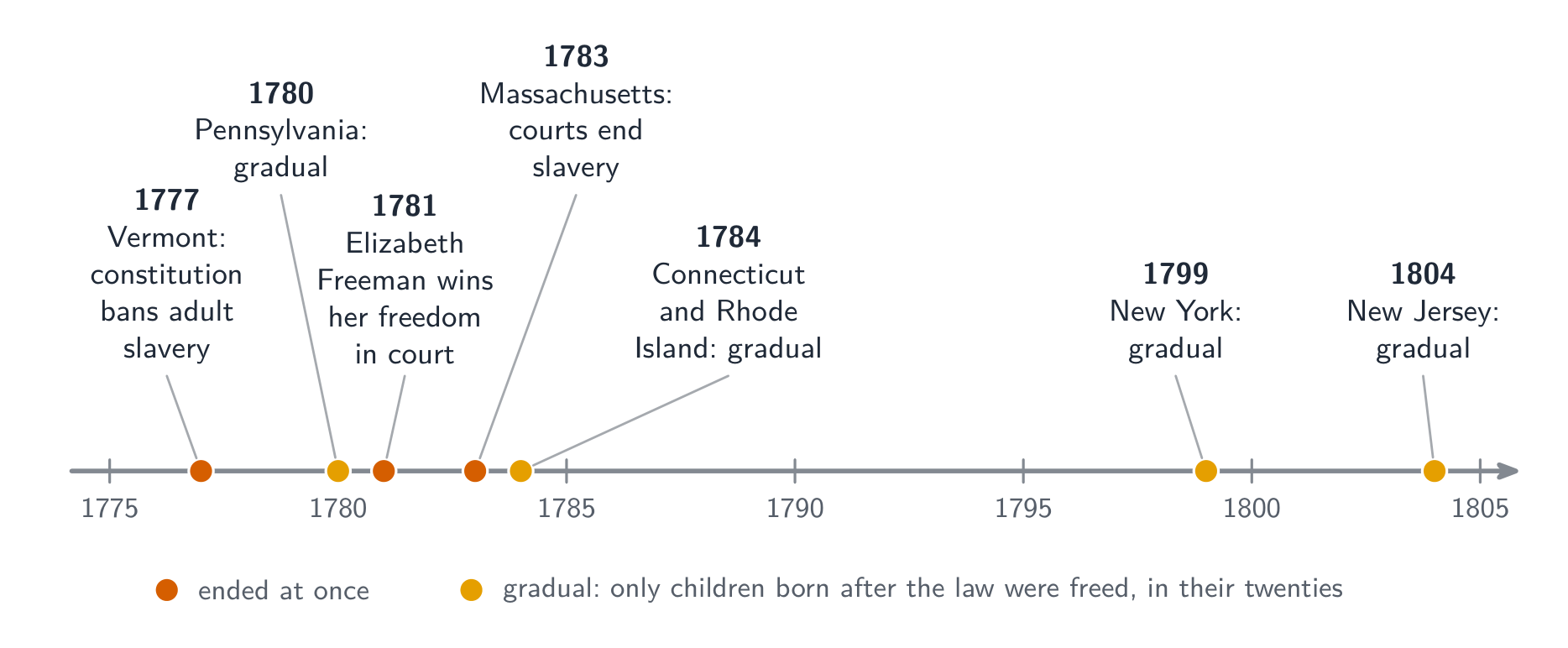
- In 1781, Elizabeth Freeman, an enslaved woman in Massachusetts known as "Mum Bett", heard the new state constitution read aloud: "all men are born free and equal". She asked a lawyer to sue for her freedom. The jury agreed, and she was freed. Two years later, a court ruling in another case ended slavery in Massachusetts.
- The Revolution's ideals of liberty and equality spread further than many of its leaders intended — but often stopped at a boundary.
How did Elizabeth Freeman win her freedom?
Difficulté 1/5 · 100 pièces + un petit bonus lors de la première réussite aujourd'hui
1781.0
Awareness of inequality
- Enslaved people petitioned for freedom using revolutionary language. Northern states began to end slavery: Pennsylvania's gradual emancipation 逐步解放 law (1780) freed children born to enslaved mothers at age 28.
- In the South, slavery continued and grew.
What did Pennsylvania's 1780 law do?
Difficulté 1/5 · 100 pièces + un petit bonus lors de la première réussite aujourd'hui
Gradual emancipation.
Women's demands
- In March 1776, Abigail Adams wrote to her husband John: "Remember the ladies... Do not put such unlimited power into the hands of the husbands." He treated it as a joke.
- New Jersey allowed property-owning women to vote from 1776 — until a law removed the right in 1807.
A domestic demand, republican motherhood, or global reach?
Sort each effect of the Revolution.
New Jersey let property-owning women vote from 1776 to 1807.
Difficulté 1/5 · 100 pièces + un petit bonus lors de la première réussite aujourd'hui
Then the right was removed.
Worked example: republican motherhood
- The idea: republican motherhood 共和母性 said that women had a political role as mothers — raising virtuous sons to be good citizens.
- The gain: it justified better education for girls; new female academies opened in the 1780s and 1790s.
- The boundary: women's role stayed in the home. They still could not vote (outside New Jersey), hold office or, if married, own property.
Match each part of republican motherhood to its meaning.
Difficulté 2/5 · 140 pièces + un petit bonus lors de la première réussite aujourd'hui
An advance with limits.
The Revolution travelled
- French officers who fought in America, such as Lafayette, took its ideas home; the French Revolution began in 1789.
- In 1791, enslaved people in the French colony of Saint-Domingue rose up, and in 1804 they created Haiti, the second independent republic in the Americas.
In what year did Haiti become independent?
Difficulté 2/5 · 140 pièces + un petit bonus lors de la première réussite aujourd'hui
After the 1791 uprising.
An advance with limits
- Property requirements for voting were lowered in several states, so more white men could vote.
- But Native Americans lost their British ally and faced settlers pushing west.
The Revolution did not bring equality for all. It inspired demands by women and enslaved people and ended slavery in the North, but most women, enslaved people and Native Americans gained little.
The Revolution brought equality for women and enslaved people.
Difficulté 1/5 · 100 pièces + un petit bonus lors de la première réussite aujourd'hui
Gains were limited.
Revolutionary ideals led Elizabeth Freeman and others to win freedom, and northern states began to end slavery. Abigail Adams and republican motherhood expanded women's role, but only within the home. Abroad, the Revolution inspired France and Haiti; at home, its gains had clear limits.
To what extent did the American Revolution change the lives of women and enslaved people?
Extent.