Accommodation and Conflict
Introduit| English | Sens |
|---|---|
| indentured servant | A person who agreed to work for a master for several years, usually in return for the cost of passage to the colonies. |
| accommodation/əˌkɒməˈdeɪʃn/ | Adjusting to the needs or customs of another group to keep peace or cooperation. |
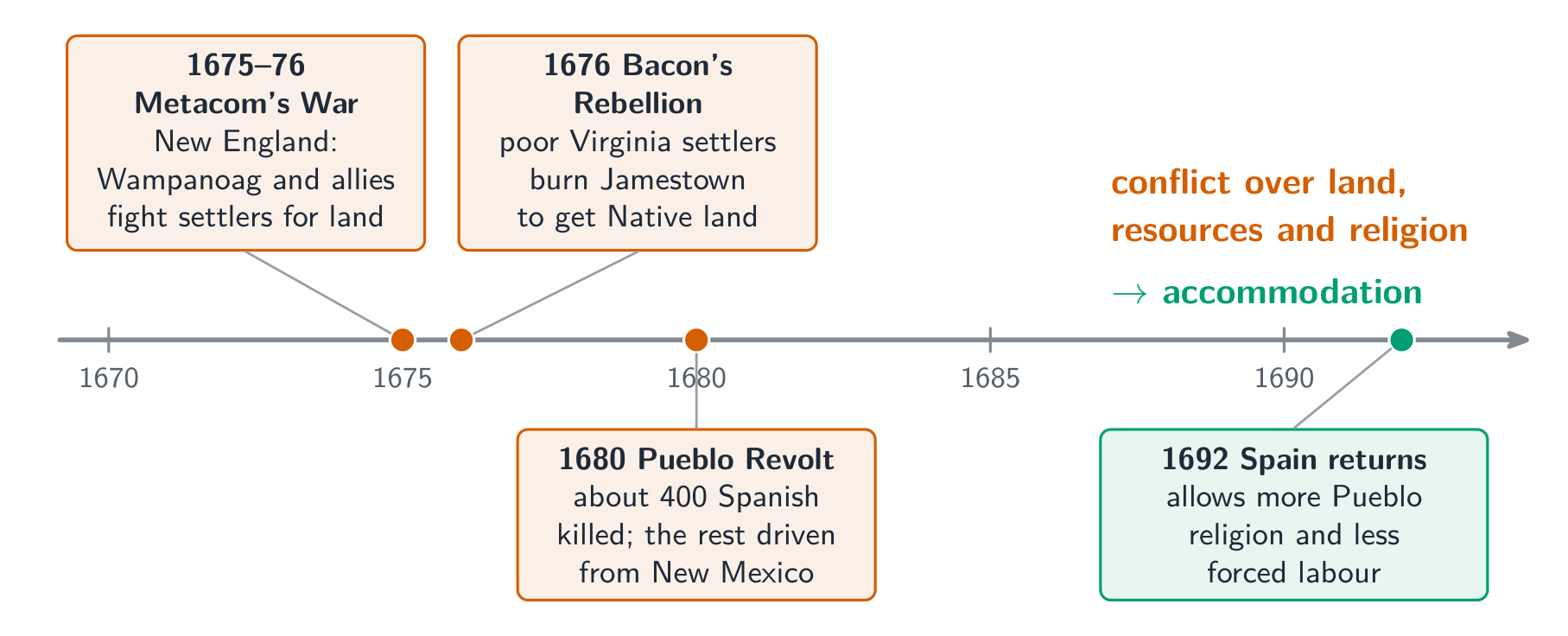
Jamestown burns, September 1676
- In September 1676, Nathaniel Bacon and his followers burned Jamestown, the capital of Virginia. Bacon led poor white farmers and indentured servants — and some enslaved Africans — who were angry that Governor Berkeley would not let them attack Native peoples and take their land. After Bacon died of disease that October, the rebellion collapsed.
- In the colonial period, Europeans and Native Americans both accommodated each other and fought — often within the same relationship.
Why did Bacon's followers rebel?
Difficulté 1/5 · 100 pièces + un petit bonus lors de la première réussite aujourd'hui
Land and Native policy.
Two outcomes from one rivalry
- When Europeans needed Native trade or allies, they accommodated: they negotiated, gave gifts and respected Native customs.
- When they wanted Native land, conflict followed. The same colony could do both at different times.
Conflict over three things
- Land: settlers pushed onto Native hunting and farming grounds. Resources: furs, deerskins and captives.
- Religion: Spanish missionaries attacked Native religion; in 1680 the Pueblo Revolt killed about 400 Spanish and drove the rest from New Mexico.
Alliance, conflict, or accommodation?
Sort each interaction.
Which caused conflict between Europeans and Native peoples?
Difficulté 2/5 · 140 pièces + un petit bonus lors de la première réussite aujourd'hui
Three named things.
Worked example: resistance changed the colonizer
- The revolt: the Pueblo Revolt (1680) destroyed churches and expelled the Spanish for twelve years.
- The change: when Spain returned in 1692, it allowed more Pueblo religious practice alongside Catholicism and reduced forced labour.
- The lesson: Native resistance forced accommodation 迁就, changing how the colonizer ruled.
How did Spain change after the Pueblo Revolt?
Difficulté 1/5 · 100 pièces + un petit bonus lors de la première réussite aujourd'hui
Resistance forced accommodation.
Alliances and wars together
- European rivalries let Native nations choose allies. The Yamasee War (1715) nearly destroyed South Carolina before the Cherokee sided with the colonists.
- Bacon's Rebellion showed that colonists themselves disagreed about whether to keep peace with Native nations.
Put these events in order.
Difficulté 3/5 · 200 pièces + un petit bonus lors de la première réussite aujourd'hui
1676, 1680, 1692, 1715.
Consequences of Bacon's Rebellion
- Virginia's elites feared poor whites and Black servants uniting. They turned more to enslaved Africans instead of indentured servants 契约佣工.
- Laws separating white and Black Virginians became harsher.
After Bacon's Rebellion, Virginia relied more on enslaved Africans.
Difficulté 1/5 · 100 pièces + un petit bonus lors de la première réussite aujourd'hui
Elites feared poor whites.
Accommodation and conflict were not separate periods. They existed side by side and changed with circumstances. Show how the same relationship moved between them.
Accommodation and conflict happened in completely separate periods.
Difficulté 1/5 · 100 pièces + un petit bonus lors de la première réussite aujourd'hui
They existed side by side.
Europeans accommodated Native nations when they needed trade and allies, and fought them over land, resources and religion. The Pueblo Revolt forced Spain to accommodate, the Yamasee War shows alliances shifting, and Bacon's Rebellion revealed colonists' divisions and pushed Virginia toward slavery.
Explain how Native resistance changed European colonial policies.
Causation.