Modélisation avec des fonctions exponentielles
Introduit| English | Sens |
|---|---|
| exponential model/ˌekspəˈnenʃl ˈmɒdl/ | modèle exponentiel |
| initial value/ɪˈnɪʃl ˈvæljuː/ | valeur initiale |
| growth factor/ɡrəʊθ ˈfæktə/ | facteur de croissance |
| decay factor/dɪˈkeɪ ˈfæktə/ | facteur de décroissance |
| baseline/ˈbeɪslaɪn/ | valeur de référence |
| natural base/ˈnætʃərəl beɪs/ | base naturelle |
| exponential regression/ˌekspəˈnenʃl rɪˈɡreʃn/ | régression exponentielle |
| residuals/rɪˈsɪdʒuːəlz/ | résidus |
The first measurement is not always the start
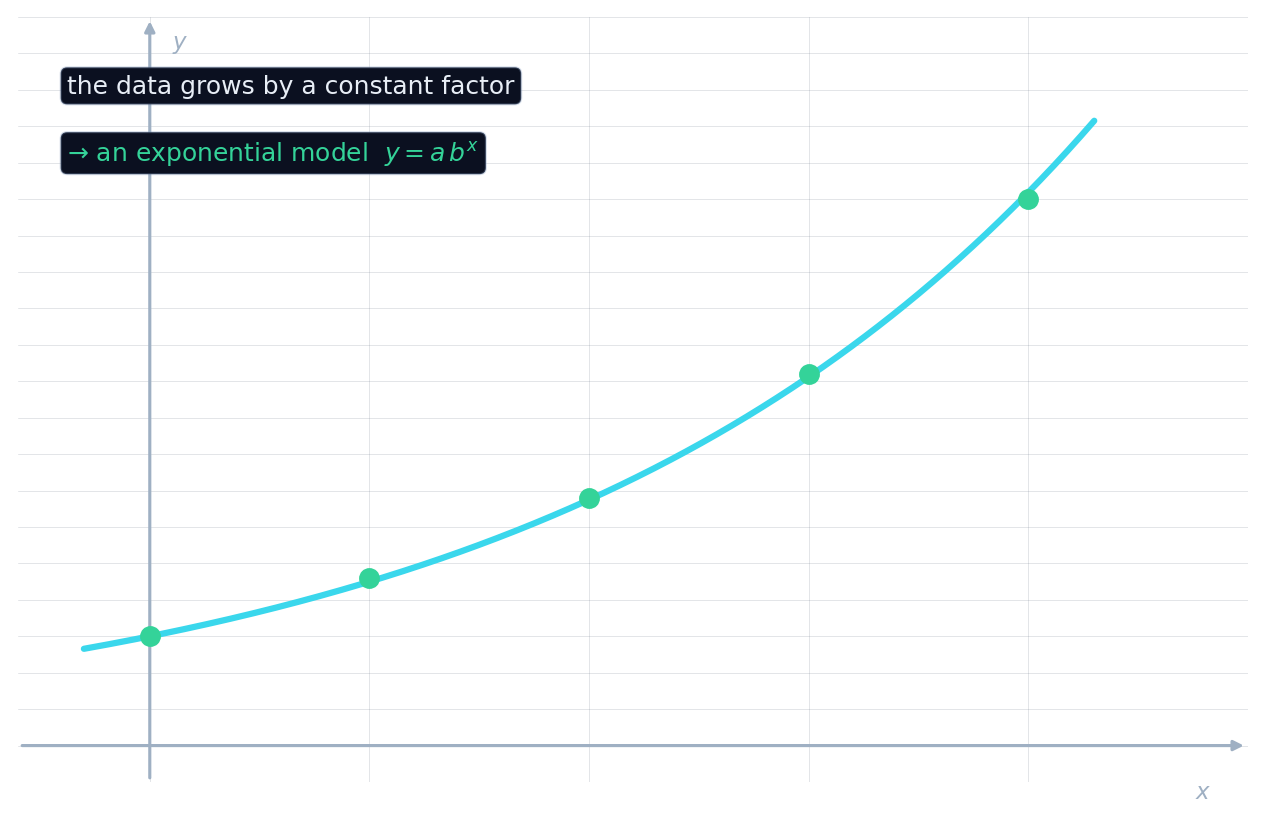
- A culture has $180$ cells at $t=2$ hours and $1440$ cells at $t=5$ hours. If an exponential model 指数模型 is appropriate, what happens in one hour, and what does it predict at $t=0$?
- The count multiplies by $8$ between the measurements, but that change takes three hours. A model must connect the multiplier to the length of its time interval.
Say what the parameters mean
- In $N(t)=ab^t$, the initial value 初始值 is $N(0)=a$. It is the value at the chosen time origin, not automatically the first recorded observation. Here $N(2)=180$, so $a$ is still unknown.
- For positive counts, use $a>0$ and $b>0$. Two positive observations at distinct times determine one model of this form; they do not prove that exponential growth is the right description of the situation.
Dans le modèle non décalé $y=ab^t$, le coefficient $a$ est la sortie lorsque…
Difficulté 1/5 · 100 pièces + un petit bonus lors de la première réussite aujourd'hui
À $t=0$, $b^0=1$, donc $y=a$ dans ce modèle non décalé. Le premier temps observé n'a pas nécessairement été zéro.
Divide the two equations
- Substitute the two observations into $N(t)=ab^t$, then divide the later equation by the earlier one. The coefficient $a$ cancels, leaving the multiplier for the whole time gap.
- Take the positive cube root to obtain the multiplier per hour. Then substitute back into either equation to find $a$.
The model is $N(t)=45(2)^t$. It reproduces both measurements: $45(2)^2=180$ and $45(2)^5=1440$.
Une culture passe de 180 à 1440 cellules en trois heures. Quel est le multiplicateur sur toute la période de trois heures ?
Difficulté 2/5 · 140 pièces + un petit bonus lors de la première réussite aujourd'hui
Le multiplicateur de la période complète est $1440/180=8$. Ce n'est pas le multiplicateur d'une heure.
Attach each factor to its interval
- The growth factor 增长因子 is $2$ per hour, so the count increases by $100\%$ each hour. Across three hours the factor is $2^3=8$, an increase of $700\%$, not $800\%$.
- If $s$ counts three-hour periods from the same origin, then $t=3s$ and $N=45(8)^s$. Changing the input unit changes the base; it does not change the predicted count at the same instant.
Une population exponentielle positive multiplie par 8 sur trois heures. Quel est son multiplicateur horaire ?
Difficulté 2/5 · 140 pièces + un petit bonus lors de la première réussite aujourd'hui
$b^3=8$, donc le facteur horaire positif est $b=2$.
Predict and check the time origin
- At $t=4$ hours, $N(4)=45(2)^4=720$ cells. Equivalently, start at the first observation: $N(t)=180(2)^{t-2}$. Both formulas describe the same model.
- The model's $45$ cells at $t=0$ are inferred, not measured. For a different culture modeled by $P(t)=100(3)^t$, the count at $t=2$ is $900$; each coefficient refers to its own chosen start.
Une colonie suit $P = 100 \cdot 2^{\,t}$ (avec $t$ en heures). Quelle est $P$ à $t = 3$ ?
Difficulté 2/5 · 140 pièces + un petit bonus lors de la première réussite aujourd'hui
$P = 100 \cdot 2^3 = 100 \cdot 8 = 800$. Insérez l'entrée dans le modèle pour prédire.
Un modèle exponentiel double chaque heure et donne 180 cellules à l'heure 2. Quelle prédiction fait-il à l'heure 0 ?
Difficulté 2/5 · 140 pièces + un petit bonus lors de la première réussite aujourd'hui
Inverse deux doubles horaires : $180/2^2=45$. C'est une valeur inférée à l'origine choisie.
Convert percentages into factors
- For a positive quantity, a fractional increase $r$ per period gives $b=1+r$. Thus $20\%$ growth gives $b=1.20$; a $15\%$ loss gives the decay factor 衰减因子 $b=1-0.15=0.85$.
- A positive base below $1$ represents decay toward zero in $ab^t$; a base above $1$ represents growth when $a>0$. A negative base does not define a real-valued exponential for every real time.
Si une quantité augmente de $20\%$ à chaque période, le facteur de ____ (la base $b$) est $1.2$.
Difficulté 1/5 · 100 pièces + un petit bonus lors de la première réussite aujourd'hui
Une augmentation de $20\%$ multiplie par $1 + 0.20 = 1.2$ — ce multiplicateur est le facteur de croissance.
Une quantité qui perd $15\%$ à chaque période a un facteur de décroissance (base) de…
Difficulté 1/5 · 100 pièces + un petit bonus lors de la première réussite aujourd'hui
Perdre $15\%$ laisse $85\%$, donc vous multipliez par $1 - 0.15 = 0.85$ à chaque période — le facteur de décroissance.
Remove the background before taking ratios
- A room stays at 20°C while a drink cools. At hours $0,1,2,3$, the drink's temperatures are 100°C, 60°C, 40°C and 30°C. The raw temperature ratios are not constant.
- Subtract the baseline 基准值 of $20$: the temperature differences are $80,40,20,10$. These halve each hour, so the model is $T(t)=20+80(0.5)^t$, approaching room temperature rather than zero.
Using the readings at $t=0$ and $t=2$, the ratio of differences is
For the shifted model $c+ab^t$, the initial output is $c+a$, not $a$. The baseline must be known or separately estimated; two readings alone do not determine all three parameters $c,a,b$.
Construisez la courbe à partir de ses observations
La culture a 180 cellules à l'heure 2 et 1440 à l'heure 5. Comparez son facteur tri-horaire avec son facteur horaire, puis examinez le refroidissement au-dessus d'une ligne de base.
Un modèle de refroidissement est $T(t)=18+62(0.5)^t$. Quelle température en degrés Celsius donne-t-il à $t=0$ ?
Difficulté 2/5 · 140 pièces + un petit bonus lors de la première réussite aujourd'hui
$T(0)=18+62=80$. Dans $c+ab^t$, la sortie initiale est $c+a$, pas seulement $a$.
Shift the input as well as the output
- Count elapsed time from the $t=2$ cooling reading by setting $u=t-2$. At $u=0$ the drink is $40^\circ\mathrm{C}$, which is $20^\circ\mathrm{C}$ above the room.
- The same physical model becomes $T=20+20(0.5)^u$. Check: $u=1$ means original time $t=3$, giving $30^\circ\mathrm{C}$. Track the time origin, input unit and baseline when changing a formula.
Write the same model with base e
- The natural base 自然底数 is $e\approx2.718$. Since $b=e^{\ln b}$, the forms $ab^t$ and $ae^{kt}$ agree when $k=\ln b$; an added baseline stays outside the exponential.
- The culture model is $N=45e^{(\ln2)t}$. Here $k\approx0.693$ per hour, while the ordinary one-hour percentage increase is $100\%$. The exponent coefficient $k$ and the fractional increase $b-1$ are different quantities.
Le modèle $N(t)=10e^{(\ln1.2)t}$ présente quel pourcentage d'augmentation ordinaire sur une unité de temps ?
Difficulté 1/5 · 100 pièces + un petit bonus lors de la première réussite aujourd'hui
$e^{\ln1.2}=1.2$. L'augmentation fractionnaire d'une unité est $1.2-1=0.2$, soit 20%; ce n'est pas le coefficient exponentiel $\ln1.2$.
Use more observations to test the model
- With noisy measurements, use an exponential regression 指数回归 to fit the data with technology. Some observations may lie on the fitted curve; others may not. Check the resulting predictions against all the measurements.
- A log-linear fit regresses $\ln y$ against time when $y>0$, then converts back. For a known baseline $c$, apply this to $\ln(y-c)$ only when $y-c>0$. Compare observed minus predicted values, called residuals 残差, rather than trusting the equation alone. The next lesson compares their sizes and patterns.
Passer exactement par deux observations positives prouve que l'exponentielle est le meilleur modèle pour tous les temps ultérieurs.
Difficulté 1/5 · 100 pièces + un petit bonus lors de la première réussite aujourd'hui
Deux points déterminent un candidat exponentiel non décalé, mais ne peuvent établir sa pertinence contextuelle ou sa fiabilité à long terme. Utilise des observations supplémentaires et le contexte.
State where the prediction is useful
- Exponential population growth can be a short-range model while nutrients and space are available. A fixed-room-temperature cooling model assumes that the room stays at the stated baseline and that the cooling conditions remain similar.
- Earlier or later inputs are not automatically meaningless, but predictions outside the observed interval need extra justification. In particular, fitting two points exactly does not establish that a distant forecast is reliable.
The first culture measurement is at hour $2$. A model can estimate hour $0$, but that estimate depends on the same growth pattern applying before the measurements. Label an inferred starting value clearly.
Find the factor over the full input gap, convert it to a factor per input unit, and solve for the starting coefficient. For $c+ab^t$, first work with the difference $y-c$. Check both observations, additional data and the contextual limits of the model.
Pour le modèle à quantité positive $y=ab^t$, avec $a>0$ et $b>0$, sélectionnez tous les énoncés vrais.
Difficulté 2/5 · 140 pièces + un petit bonus lors de la première réussite aujourd'hui
Les trois premiers énoncés sont valables pour ce modèle positif non décalé. Les prédictions au-delà des observations nécessitent une justification contextuelle ; une formule seule n'établit pas la fiabilité.
Write a prediction with its assumption
- A colony follows $P(t)=50(3)^t$, with $t$ measured in hours from the model's start. Calculate $P(3)$ and explain how the coefficient and the factor are used.
- State one assumption needed to use this formula for a later forecast. Distinguish a model prediction from an observation.
Une colonie suit $P(t)=50(3)^t$, avec $t$ en heures depuis le début du modèle. Trouvez $P(3)$, expliquez les rôles de 50 et 3, et énoncez une hypothèse nécessaire pour une prédiction ultérieure.
Calcule à partir de l'origine temporelle spécifiée, identifie l'intervalle associé à la base et nomme une condition nécessaire pour étendre le modèle.
En utilisant $P(t)=50(3)^t$, quelle population le modèle prédit-il à $t=3$ heures ?
Difficulté 1/5 · 100 pièces + un petit bonus lors de la première réussite aujourd'hui
Utilise le modèle de cette question : $50(3)^3=50(27)=1350$. Une prédiction issue d'une formule différente ne répond pas à la question.