Changement en tandem
Introduit| English | Sens |
|---|---|
| input/ˈɪnpʊt/ | entrée |
| output/ˈaʊtpʊt/ | sortie |
| increasing/ɪnˈkriːsɪŋ/ | croissant |
| decreasing/ˈdiːkriːsɪŋ/ | décroissant |
| constant/ˈkɒnstənt/ | constante |
| interval/ˈɪntəvl/ | intervalle |
| concavity/kənˈkævɪti/ | concavité |
| rate of change/reɪt ɒv tʃeɪndʒ/ | taux de variation |
| concave up/kɒnˈkeɪv ʌp/ | concave vers le haut |
| concave down/kɒnˈkeɪv daʊn/ | concave vers le bas |
| turning point/ˈtɜːnɪŋ pɔɪnt/ | point d'inflexion |
| local maximum/ˈləʊkl ˈmæksɪməm/ | maximum local |
| local minimum/ˈləʊkl ˈmɪnɪməm/ | minimum local |
Watch the water climb
- Pour water into a glass at a steady rate and watch the level rise.
- In a straight glass the level climbs steadily; in a curvy vase it speeds up and slows down.
- Two quantities — the water poured and the height — change together, in tandem.
- Precalculus starts by describing exactly how one quantity changes as another one does.
A function links an input to an output
- A function takes an input 输入 (a value of $x$) and returns exactly one output 输出 (written $f(x)$).
- As the input changes, the output changes with it — that is change in tandem.
- We write $f(2)$ to mean "the output when the input is $2$".
- So the whole story of a function is one question: as $x$ moves, where does $f(x)$ go?
Increasing, decreasing, or constant
- Pick an interval 区间 — a stretch of the input axis — and follow the output from left to right.
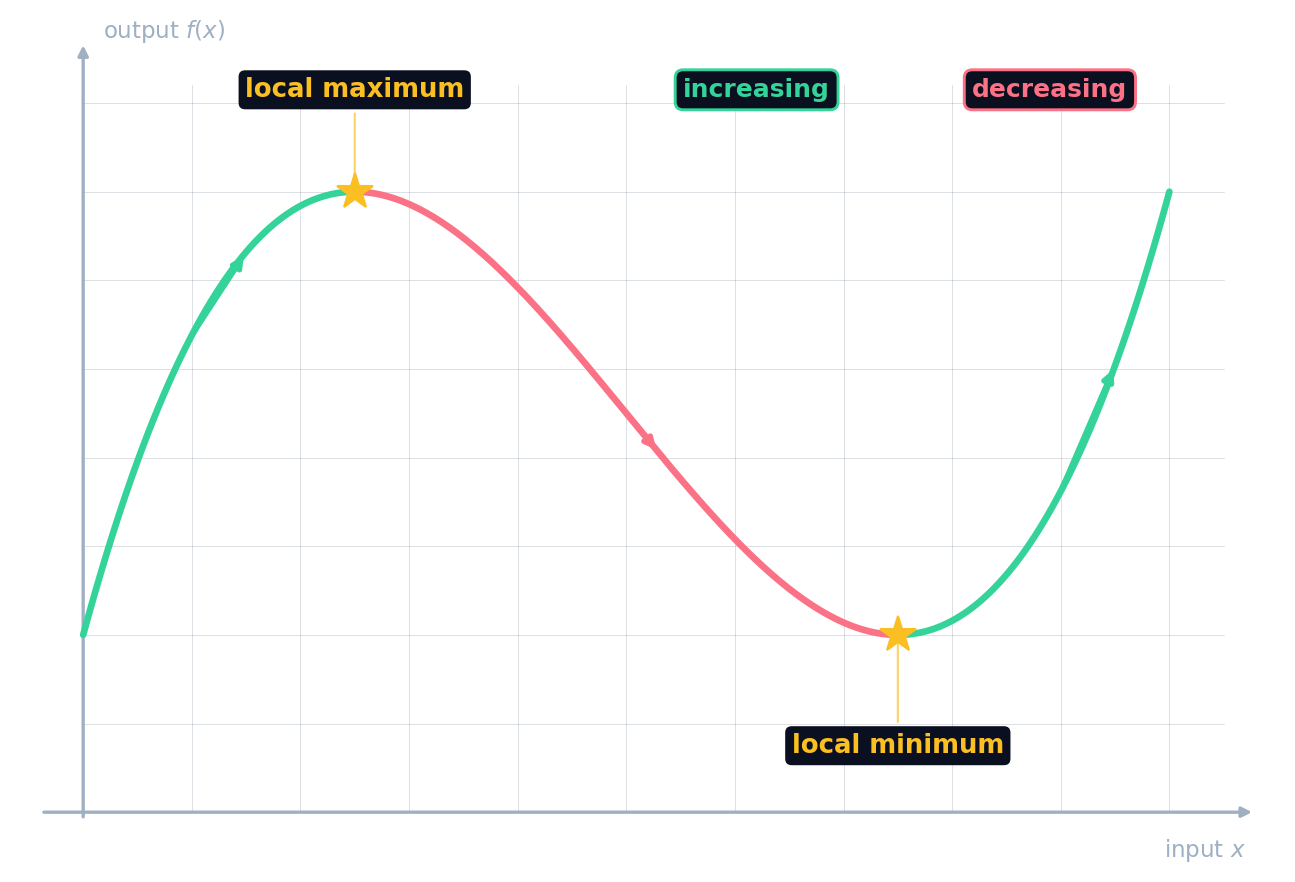
- The function is increasing 递增 where the output rises as the input moves right.
- It is decreasing 递减 where the output falls as the input moves right.
- It is constant 常数 where the output stays level.
- You can read this straight off a graph: uphill is increasing, downhill is decreasing.
Une fonction est croissante sur un intervalle quand…
Difficulté 1/5 · 100 pièces + un petit bonus lors de la première réussite aujourd'hui
Croissant concerne la direction, pas la taille : déplacez-vous vers la droite sur l'entrée et la sortie grimpe. Elle peut être croissante alors que ses valeurs sont encore négatives.
Si un graphique est parfaitement plat (horizontal) sur un intervalle, la fonction est constante là.
Difficulté 1/5 · 100 pièces + un petit bonus lors de la première réussite aujourd'hui
Un graphique plat signifie que la sortie ne change pas quand l'entrée change — c'est exactement ce que constant signifie.
Concavity: is the change speeding up or slowing down?
- Even while a curve keeps increasing, its rate of change 变化率 (how fast the output moves) can itself change.
- Concavity 凹凸性 describes which way the curve bends.
- Concave up 凹 — the curve bends upward like a cup, so the rate of change is increasing.
- Concave down 凸 — the curve bends downward like a dome, so the rate of change is decreasing.
- The curvy vase again: where it narrows, the height climbs faster and faster (concave up).
Dire qu'une courbe est concave vers le haut vous dit que…
Difficulté 1/5 · 100 pièces + un petit bonus lors de la première réussite aujourd'hui
Concave vers le haut se courbe comme une tasse : la taux de variation lui-même augmente. Une courbe peut être concave vers le haut tout en descendant — pensez à une glissade qui s'aplatit au fond.
Turning points: local maxima and minima
- Where a curve stops increasing and starts decreasing, it reaches a local maximum 极大值 — a peak.
- Where it stops decreasing and starts increasing, it reaches a local minimum 极小值 — a valley.
- Each such peak or valley is a turning point 转折点.
- "Local" means highest or lowest nearby — not necessarily over the whole graph.
La pente de la tangente EST le taux de variation
f(x) = x³ − 3x
Glissez le point pour lire la pente de la tangente — positive où la courbe monte, négative où elle descend, et nulle à un point d'inflexion.
Un point où un graphique cesse d'augmenter et commence à diminuer est un ____ local.
Difficulté 1/5 · 100 pièces + un petit bonus lors de la première réussite aujourd'hui
À un maximum local, la courbe passe de montante à descendante — un sommet qui est le plus élevé comparé aux points voisins.
Regardez la courbe dans la figure. Sélectionnez tous les énoncés vrais.
Difficulté 2/5 · 140 pièces + un petit bonus lors de la première réussite aujourd'hui
La courbe monte, s'infléchit à un sommet, descend jusqu'à un creux, puis remonte à nouveau. Elle n'est pas concave vers le haut partout — elle s'infléchit vers le bas près du sommet et vers le haut près du creux.
"Increasing" and "concave up" are different ideas. Increasing is about the output going up; concave up is about the rate of change going up. A curve can be decreasing and concave up at the same time — falling, but flattening out as it falls.
Comparing two outputs
- To compare a function at two inputs $a$ and $b$, compare their outputs $f(a)$ and $f(b)$.
- If $b > a$ and $f(b) > f(a)$, the output grew as the input grew.
- The net change in output from $a$ to $b$ is simply $f(b) - f(a)$.
- If the function returns to the same value, the net change is zero — even if it rose and fell along the way.
Une fonction a $f(2) = 5$ et $f(6) = 5$. Quel est le changement net en sortie de $x = 2$ à $x = 6$ ?
Difficulté 2/5 · 140 pièces + un petit bonus lors de la première réussite aujourd'hui
Changement net $= f(6) - f(2) = 5 - 5 = 0$. La sortie s'est terminée là où elle avait commencé — même si elle a pu augmenter et diminuer entre les deux.
Reliez chaque terme à ce qu'il décrit.
Difficulté 2/5 · 140 pièces + un petit bonus lors de la première réussite aujourd'hui
Croissant/décroissant décrit la direction de la sortie ; la concavité décrit comment le taux de variation lui-même évolue ; un maximum local est où la direction s'inverse.
A cup of tea cools from 90°C to room temperature.
- Temperature (output) is decreasing the whole time — it never goes back up.
- But it falls fast at first, then slowly: the curve is concave up.
- There is no local maximum or minimum in between — the direction never flips.
A function's behaviour is read from its graph: it is increasing or decreasing on intervals, its concavity tells you whether the rate of change is speeding up or slowing down, and its turning points are the local maxima and minima where the direction flips.
Write from the data: find the change
- f of 1 is 4 and f of 5 is 12.
- Find the change in output.
Une fonction vérifie f(1) = 4 et f(5) = 12. Quel est le changement de sortie ?
12 moins 4 est égal à 8.
Quel est le changement de sortie ?
Difficulté 1/5 · 100 pièces + un petit bonus lors de la première réussite aujourd'hui
Les sorties diffèrent de 8. Les autres options — 0 (le changement de la leçon) ; 2 (le changement divisé par l'écart entre les entrées).