Loi d'Ampère
Introduit| English | Sens |
|---|---|
| Ampère's law/ˈæmpeəz lɔː/ | loi d'Ampère |
| Amperian loop/æmˈpɪərɪən luːp/ | boucle ampérienne |
Gauss's law has a magnetic cousin — a shortcut for B
- Adding up Biot–Savart pieces for a whole coil is hard work.
- When the field is symmetric, there is a one-line shortcut.
- Ampère's law 安培定律 links the field around a loop to the current through it.
- It plays the same role for $B$ that Gauss's law plays for $E$.
Ampère's law plays the same role for the magnetic field that ____ plays for the electric field.
Difficulté 1/5 · 100 pièces + un petit bonus lors de la première réussite aujourd'hui
Both are symmetry shortcuts: Gauss for E, Ampère for B.
The law itself
- For steady currents in vacuum, around any closed loop: $\oint \vec B \cdot d\vec\ell = \mu_0 I_{\text{enc}}$.
- The left side sums the field along the loop; the right is the enclosed current.
- Count the signed net current threading a surface bounded by the loop; use the right-hand rule to link the positive current direction to traversal.
- Choose the loop cleverly and $B$ pops right out.
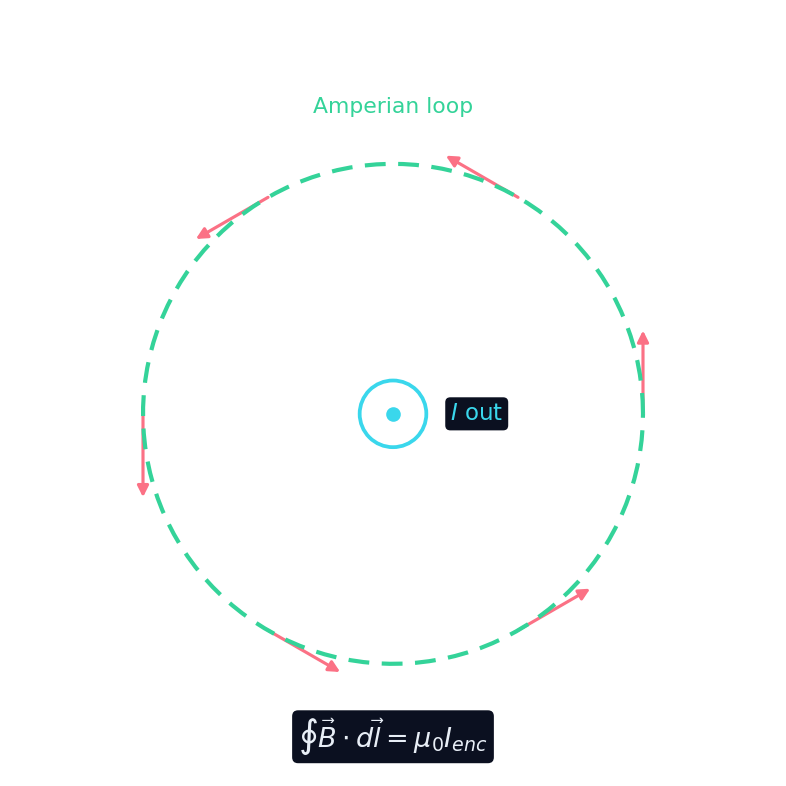
In Ampère's law, the field summed around a loop equals:
Difficulté 1/5 · 100 pièces + un petit bonus lors de la première réussite aujourd'hui
$\oint \vec B \cdot d\vec\ell = \mu_0 I_{\text{enc}}$.
Only enclosed current matters
- A current outside the loop adds nothing to the line integral.
- Its field goes around one side of the loop and back on the other — it cancels.
- So the right side counts only $I_{\text{enc}}$, the current passing through.
- Same idea as Gauss's law, with current in place of charge.
A current outside an Amperian loop contributes nothing to the line integral of B.
Difficulté 1/5 · 100 pièces + un petit bonus lors de la première réussite aujourd'hui
Only the enclosed current counts; outside current cancels around the loop.
Pick an Amperian loop with the symmetry
- Straight wire → a circular Amperian loop 安培环路 around it.
- Solenoid → a rectangular loop through its side.
- Choose it so $B$ is constant and along (or across) each part of the loop.
- Then $\oint \vec B \cdot d\vec\ell$ becomes a simple $B \times (\text{length})$.
Which current is enclosed?
Ampère's law uses only the current threading the loop. Sort each wire.
The closed path you integrate B around is called an ____ loop.
Difficulté 1/5 · 100 pièces + un petit bonus lors de la première réussite aujourd'hui
It is an Amperian loop, chosen to match the symmetry.
Select tout true statements about Ampère's law.
Difficulté 2/5 · 140 pièces + un petit bonus lors de la première réussite aujourd'hui
For steady currents in vacuum, the line integral equals mu0 times the signed enclosed current. Symmetry helps determine B. Changing electric flux requires a displacement-current term.
Fast, clean results
- Around a straight wire: $B = \dfrac{\mu_0 I}{2\pi r}$ — recovered in one line.
- Inside a long air-core solenoid, far from its ends: $B = \mu_0 n I$, where $n$ is turns per metre.
- For an ideal tightly wound toroid, the field is confined to the ring; real toroids have leakage fields.
- Each drops out of Ampère's law with almost no algebra.
Ampère's law gives the field inside a long solenoid as:
Difficulté 1/5 · 100 pièces + un petit bonus lors de la première réussite aujourd'hui
Inside a solenoid $B = \mu_0 n I$ ($n$ = turns per metre).
Use a circular Amperian loop of radius $r$ around a straight wire carrying $I$.
- Symmetry: $\oint B\,d\ell = B(2\pi r)$.
- Set equal to $\mu_0 I$: $B = \dfrac{\mu_0 I}{2\pi r}$ — the straight-wire result.
Like Gauss's law, this form of Ampère's law holds for steady currents. For changing electric flux, the displacement-current term is also needed. Symmetry makes it useful for finding $B$. And only the enclosed current counts — a nearby wire outside the loop changes $B$ but adds nothing to $\oint \vec B \cdot d\vec\ell$.
Ampère's law says $\oint \vec B \cdot d\vec\ell = \mu_0 I_{\text{enc}}$ — the line integral of the field around a loop is set by the signed enclosed current for steady currents; outside currents can still change the local field. Pick an Amperian loop matching the symmetry to read $B$ off in one step (straight wire $\mu_0 I/2\pi r$, solenoid $\mu_0 n I$).
Write from the data given
- A long air-core solenoid has 500 turns per metre and carries 2 amperes. Use $\mu_0=4\pi\times10^{-7}\ \dfrac{\text{T}\cdot\text{m}}{\text{A}}$.
- Find the field inside. Say the ideal field outside.
A long air-core solenoid has 500 turns per metre and carries 2 amperes. Use mu0 = 4 pi times 10 to the minus 7 tesla metres per ampere. Find the field inside far from the ends, and the ideal outside field.
B = mu0 n I = (4 pi times 10 to the minus 7)(500)(2) = 4 pi times 10 to the minus 4 T. nI = 1000 amperes per metre is current per axial length, not volume current density.
A long air-core solenoid has 500 turns per metre and carries 2 amperes. With mu0 = 4 pi times 10 to the minus 7 tesla metres per ampere, what is its ideal field inside and outside?
Difficulté 1/5 · 100 pièces + un petit bonus lors de la première réussite aujourd'hui
mu0 times 500 times 2 is 4 pi times 10 to the minus 4 tesla inside an ideal solenoid.