Aggregate Demand (AD)
Introduit| English | Sens |
|---|---|
| aggregate demand/ˈæɡrɪɡeɪt dɪˈmænd/ | demande agrégée |
| wealth effect/welθ ɪˈfekt/ | effet de richesse |
| interest rate effect/ˈɪntrest reɪt ɪˈfekt/ | effet des taux d'intérêt |
| exchange rate effect/eksˈtʃeɪndʒ reɪt ɪˈfekt/ | effet du taux de change |
| shift/ʃɪft/ | déplacement |
| consumer confidence/kənˈsuːmə ˈkɒnfɪdəns/ | confiance des consommateurs |
What the whole economy wants to buy
- Unit 2 measured the economy with real GDP and the price level.
- Now we ask what sets those two numbers.
- The first half of the answer is the total demand of everyone at once.
- It is called aggregate demand 总需求 (AD).
Why AD slopes down
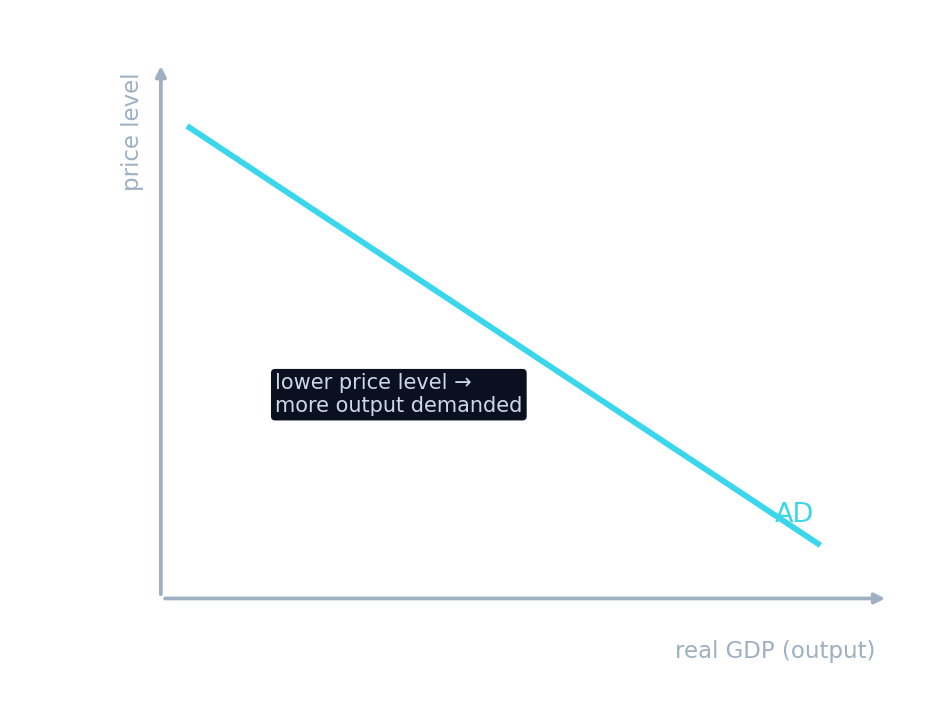
- Aggregate demand is the total real output all buyers want at each price level, and it slopes downward.
- But not for the usual reason — there is no "substitute" for everything. Three economy-wide effects explain it:
- The wealth effect 财富效应: a lower price level makes savings worth more, so people buy more.
- The interest rate effect 利率效应 and exchange rate effect 汇率效应: a lower price level cuts interest rates (lifting investment) and weakens the currency (lifting net exports).
The AD-AS model
Aggregate demand slopes down and shifts right when consumption, investment, government spending, or net exports rise.
The aggregate demand curve slopes downward mainly because of the wealth, interest rate, and:
Difficulté 1/5 · 100 pièces + un petit bonus lors de la première réussite aujourd'hui
AD covers every good, so there is no substitution — the three macro effects explain the slope.
The wealth effect says a lower price level:
Difficulté 1/5 · 100 pièces + un petit bonus lors de la première réussite aujourd'hui
With a lower price level, the money people already hold buys more, so they feel richer.
AD's four spending components
- AD is built from the same four parts as GDP: $AD = C + I + G + (X - M)$.
- $C$ consumption, $I$ investment, $G$ government spending, $(X - M)$ net exports.
- A movement along AD happens only when the price level changes.
- A shift 移动 happens when something else changes a component — a rise in any of them shifts AD right.
Aggregate demand equals C + I + G + (X − ______).
Difficulté 1/5 · 100 pièces + un petit bonus lors de la première réussite aujourd'hui
AD = C + I + G + net exports (X − M).
A rise in consumer confidence causes:
Difficulté 1/5 · 100 pièces + un petit bonus lors de la première réussite aujourd'hui
Higher confidence raises C at every price level, shifting the whole curve right.
A change in the price level shifts the AD curve.
Difficulté 1/5 · 100 pièces + un petit bonus lors de la première réussite aujourd'hui
False. A change in the price level causes a movement along AD. Only a change in a spending component (C, I, G or NX) shifts AD.
What shifts AD
- Consumer confidence 消费者信心 or expected higher incomes raise $C$ → AD right.
- Lower interest rates raise $I$ → AD right.
- Worked idea. A wave of optimism lifts confidence, so households plan 100b more spending at every price level — AD shifts right by 100b (and further once the multiplier acts).
Select tout that shift AD to the juste.
Difficulté 2/5 · 140 pièces + un petit bonus lors de la première réussite aujourd'hui
Higher C, I, or G shift AD right; a price-level change is only a movement along it.
Worked example: shift or movement?
For each event, say whether AD shifts or the economy moves along AD, and which component changes: (a) the price level falls; (b) a recession in Europe cuts its demand for US goods; (c) firms expect strong future sales.
- (a) Only the price level changes: a movement along AD (through the wealth, interest-rate and exchange-rate effects), not a shift.
- (b) US exports fall, so net exports $(X - M)$ fall: AD shifts left. (c) Firms build more factories now, so investment $I$ rises: AD shifts right.
Household wealth falls sharply when house prices crash. AD:
Difficulté 1/5 · 100 pièces + un petit bonus lors de la première réussite aujourd'hui
Lower wealth cuts consumer spending at every price level.
If the US dollar appreciates for reasons other than the price level, US net exports fall and AD shifts left.
Difficulté 1/5 · 100 pièces + un petit bonus lors de la première réussite aujourd'hui
A stronger dollar makes US goods dearer abroad and imports cheaper at home.
Aggregate demand slopes down via the wealth, interest rate, and exchange rate effects. It is $AD = C + I + G + (X - M)$. The price level moves you along AD; a change in any component shifts it — up shifts AD right, down shifts it left.
Write from output demanded of 460
- At price level 100, a rise in confidence lifts the output demanded from 400 to 460.
- Say whether AD shifted.
At the same price level of 100, higher consumer confidence raises the output people want to buy from 400 to 460. Did aggregate demand shift, and by how much output?
460 minus 400 is 60, at the same price level.
What happens to aggregate demand?
Difficulté 1/5 · 100 pièces + un petit bonus lors de la première réussite aujourd'hui
Confidence raises spending at every price level, including 100.