Business Cycles
Introduit| English | Sens |
|---|---|
| business cycle/ˈbɪznəs ˈsaɪkl/ | cycle économique |
| expansion/ekˈspænʃn/ | expansion |
| peak/piːk/ | sommet |
| contraction/kənˈtrækʃn/ | contraction |
| recession/rɪˈseʃn/ | récession |
| trough/trɒf/ | creux |
| output gap/ˈaʊtpʊt ɡæp/ | écart de production |
| potential output/pəˈtenʃl ˈaʊtpʊt/ | production potentielle |
| recessionary gap/rɪˈseʃənəri ɡæp/ | écart de récession |
| inflationary gap/ɪnˈfleɪʃənəri ɡæp/ | écart inflationniste |
| stabilization policy/ˌsteɪbɪlaɪˈzeɪʃn ˈpɒlɪsi/ | politique de stabilisation |
Booms and busts
- Real GDP does not climb in a smooth straight line.
- It rises and falls in a repeating up-and-down pattern.
- Booms feel great; busts throw people out of work.
- This rhythm is the business cycle 经济周期.
The four phases
- Expansion 扩张 — real GDP rises, jobs grow, unemployment falls.
- Peak 顶峰 — the highest point of output, where expansion ends.
- Contraction 收缩 — real GDP falls for a sustained period; unemployment rises. A recession 经济衰退 is often two straight quarters of falling real GDP.
- Trough 谷底 — the lowest point, where the fall stops and recovery begins.
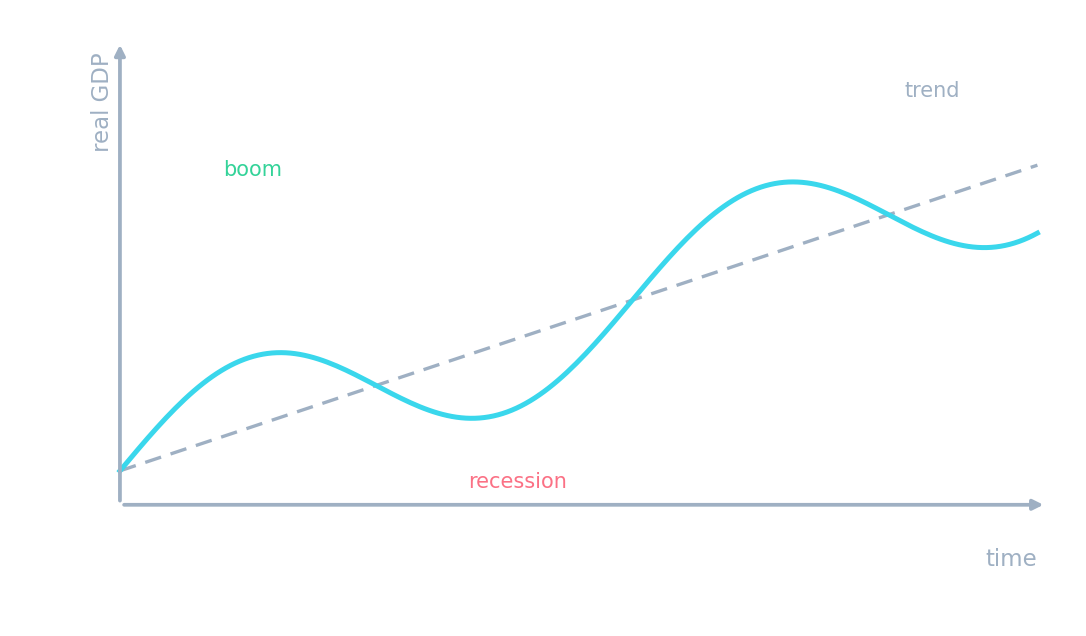
Which phase of the cycle?
The business cycle runs expansion → peak → contraction → trough. Each phase has a distinct pattern of output and unemployment.
A recession is often defined as:
Difficulté 1/5 · 100 pièces + un petit bonus lors de la première réussite aujourd'hui
A contraction where real GDP falls for a sustained period — often two quarters — is a recession.
Put the four phases of the business cycle in order, starting from an expansion.
Difficulté 3/5 · 200 pièces + un petit bonus lors de la première réussite aujourd'hui
The cycle runs expansion → peak → contraction → trough, then repeats.
During an expansion, cyclical unemployment usually:
Difficulté 1/5 · 100 pièces + un petit bonus lors de la première réussite aujourd'hui
Rising output means firms hire more, so cyclical unemployment falls.
The output gap
- Potential output 潜在产出 is the real GDP an economy would make at full employment.
- The output gap 产出缺口 = actual real GDP − potential real GDP.
- A recessionary gap 衰退缺口 (actual below potential): running cold, high unemployment.
- An inflationary gap 通货膨胀缺口 (actual above potential): running hot, rising prices.
When actual real GDP is below potential, the economy has a ______ gap.
Difficulté 1/5 · 100 pièces + un petit bonus lors de la première réussite aujourd'hui
A recessionary gap means the economy runs cold, with high unemployment.
Why we measure it
- Worked idea. Potential real GDP is 1,200b; in a slump actual real GDP is 1,140b, so the output gap is $1{,}140 - 1{,}200 = -60$b — a recessionary gap.
- A negative gap signals idle workers and factories.
- Governments try to smooth the swings with stabilization policy 稳定政策 — adjusting spending, taxes, or interest rates.
- The whole point of measuring GDP, unemployment, and inflation is to spot which gap we are in.
Potential real GDP is 1,200 and actual real GDP is 1,140. What is the output gap? (keep the sign)
Difficulté 2/5 · 140 pièces + un petit bonus lors de la première réussite aujourd'hui
Output gap = actual − potential = 1,140 − 1,200 = −60 — a recessionary gap.
Governments use stabilization policy to try to smooth the swings of the business cycle.
Difficulté 1/5 · 100 pièces + un petit bonus lors de la première réussite aujourd'hui
By adjusting spending, taxes, or interest rates, policy pushes output back toward potential.
Worked example: naming the gap and the phase
Potential real GDP is $\$2{,}000$b. Actual real GDP is $\$2{,}080$b, unemployment is below its natural rate and prices are rising fast. Identify the gap and the likely phase.
- Output gap = 2,080 − 2,000 = +$\$80$b: actual is above potential, so this is an inflationary gap. Workers and factories are used beyond normal levels, which pushes up wages and prices.
- The economy is near a peak of the business cycle. Stabilization policy would aim to slow spending (for example, higher interest rates) to bring output back toward potential.
Potential real GDP is $\$500$b and actual real GDP is $\$470$b. What is the output gap, in billions? (Give the sign.)
Difficulté 2/5 · 140 pièces + un petit bonus lors de la première réussite aujourd'hui
470 − 500 = −30: a recessionary gap.
Real GDP stops falling and starts to rise. This turning point is the:
Difficulté 1/5 · 100 pièces + un petit bonus lors de la première réussite aujourd'hui
The trough is the lowest point, where recovery begins.
The business cycle has four phases: expansion, peak, contraction (recession), and trough. Compare actual to potential output: a recessionary gap (below) means the economy runs cold, an inflationary gap (above) means it runs hot. Stabilization policy aims to close the gap.
Write from the data given
- Potential real GDP is 500. Actual real GDP is 470.
- Find the output gap.
Potential real GDP is 500 and actual real GDP is 470. What is the output gap, including its sign?
470 is 30 below 500.
What is the output gap?
Difficulté 1/5 · 100 pièces + un petit bonus lors de la première réussite aujourd'hui
Actual output is 30 below potential, so the gap is minus 30.