Claim and Evidence in One Paragraph
Introduit| English | Sens |
|---|---|
| claim/kleɪm/ | affirmation |
| Evidence/ˈevɪdəns/ | The words from the text that support it. |
| Commentary/ˈkɒməntri/ | your explanation of how the evidence supports a claim |
"A little water clears us of this deed", c. 1606
- In Shakespeare's Macbeth, just after the murder of King Duncan, Lady Macbeth tells her husband: "A little water clears us of this deed."
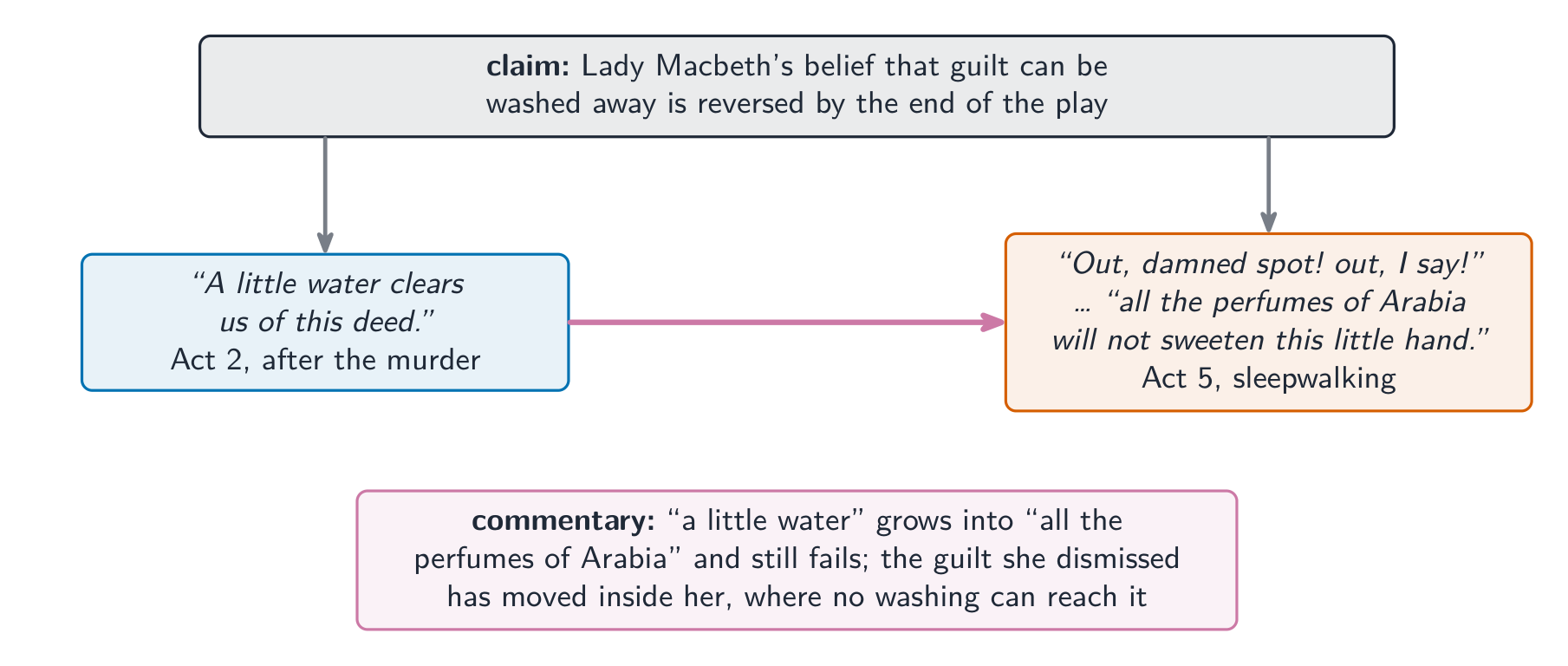
- In Act 5 she walks in her sleep, rubbing her hands: "Out, damned spot! out, I say!" and "all the perfumes of Arabia will not sweeten this little hand." Two quotations, far apart, make one argument.
What does Lady Macbeth say just after the murder of Duncan?
Difficulté 1/5 · 100 pièces + un petit bonus lors de la première réussite aujourd'hui
She believes guilt can be washed off.
A claim needs evidence
- A claim 主张 is a statement about the text that a reader could disagree with. Evidence 证据 is the words from the text that support it.
- Claim: "Lady Macbeth's confidence that guilt can be washed away is reversed by the end of the play." Both quotations are needed: one shows the confidence, the other its collapse.
A claim is a statement about the text that a reader could disagree with.
Difficulté 1/5 · 100 pièces + un petit bonus lors de la première réussite aujourd'hui
Facts that nobody disputes are not claims.
Commentary joins them
- Commentary 评论 explains how the evidence supports the claim. Without it, two quotations are just placed side by side.
- The link here is the image of washing: "a little water" in Act 2 becomes "all the perfumes of Arabia" in Act 5. The amount needed grows from almost nothing to more than the world holds.
Build one paragraph of literary argument
Claim, evidence, commentary — and in literature the commentary is about the CHOICE, not the content.
Which image links the two quotations?
Difficulté 1/5 · 100 pièces + un petit bonus lors de la première réussite aujourd'hui
A little water becomes all the perfumes of Arabia.
Worked example: one paragraph
Lady Macbeth believes that guilt is a stain on the skin, not on the mind: after the murder she assures her husband that "a little water clears us of this deed". By Act 5 the same hands cannot be cleaned. Sleepwalking, she cries "Out, damned spot!" and admits that "all the perfumes of Arabia will not sweeten this little hand". The small, practical "little water" has become the wealth of a whole country, and still it fails. Shakespeare repeats the image to show that the guilt she dismissed has moved inside her, where no washing can reach it.
Match each part of the paragraph to its job.
Difficulté 2/5 · 140 pièces + un petit bonus lors de la première réussite aujourd'hui
Claim, evidence, commentary.
Quote short, comment long
- Use the shortest words that carry the point: "a little water", "this little hand". Then spend your sentences on what they show.
- Commentary should usually be longer than the quotations.
The quotations in a paragraph should usually be longer than the commentary.
Difficulté 1/5 · 100 pièces + un petit bonus lors de la première réussite aujourd'hui
Quote short, comment long.
Put the quotations in conversation
- Two quotations work best when the second changes how we read the first: a repeated word, a reversed image, a promise broken.
- Say what changed between them, and why that change supports your claim.
Do not let a quotation end a paragraph. A paragraph that stops on a quotation leaves the reader to do the analysis. Finish with commentary that links back to the claim.
What should the last sentence of an analytical paragraph usually be?
Difficulté 1/5 · 100 pièces + un petit bonus lors de la première réussite aujourd'hui
Do not leave the analysis to the reader.
A paragraph makes one claim, supports it with short pieces of evidence, and uses commentary to explain how the evidence proves the claim. Two quotations become an argument when your commentary shows how the second changes the first.
Write one paragraph that makes a claim and uses two short quotations from different parts of a text you know.
Claim, evidence, commentary.