How Catalysts Speed Things Up
Introduit| English | Sens |
|---|---|
| catalyst/ˈkætəlɪst/ | Catalyseur |
A shortcut over the mountain
- Some reactions crawl until you add a magic helper.
- That helper opens a lower pass through the energy mountain.
- It emerges unchanged, ready to help again.
- A tiny amount can transform a sluggish reaction.
A lower activation energy
- A catalyst 催化剂 provides an alternate path with a lower activation energy.
- More collisions can now clear the smaller barrier.
- So the reaction goes much faster.
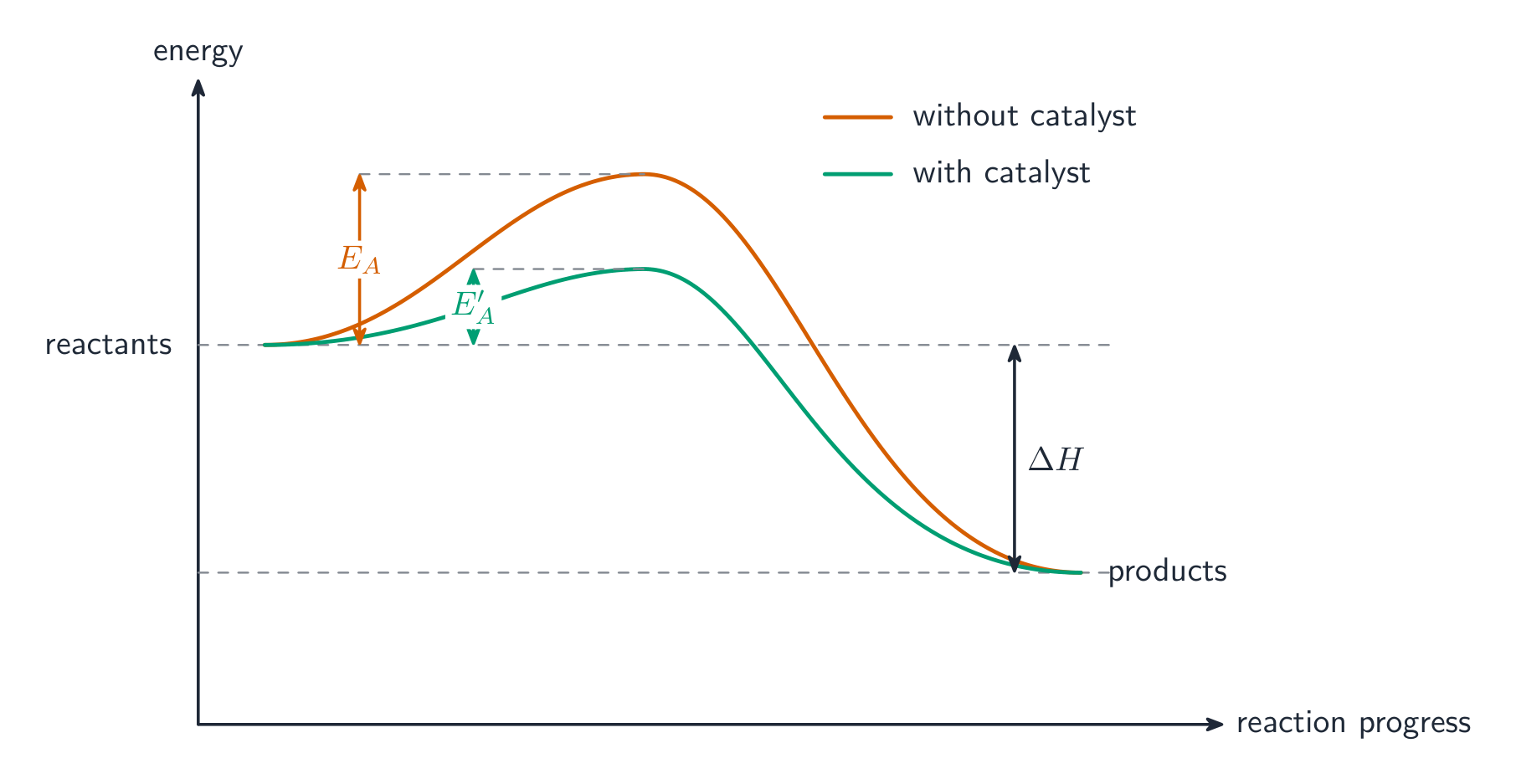
A catalyst gives a route with lower activation energy; the enthalpy change is unchanged
A catalyst speeds a reaction by...
Difficulté 1/5 · 100 pièces + un petit bonus lors de la première réussite aujourd'hui
An alternate path with a lower barrier lets more collisions succeed.
A catalyst offers an alternate pathway with a lower ____ energy.
Difficulté 1/5 · 100 pièces + un petit bonus lors de la première réussite aujourd'hui
The lower activation energy is what speeds the reaction.
Used but not used up
- A catalyst is not consumed — it is regenerated each cycle.
- It appears as a reactant early and reappears as a product later.
- A little goes a long way.
A catalyst is consumed (used up) by the reaction.
Difficulté 1/5 · 100 pièces + un petit bonus lors de la première réussite aujourd'hui
A catalyst is regenerated, not used up.
What stays the same
- A catalyst does not change $\Delta H$ or the final equilibrium.
- It only speeds up how fast equilibrium is reached.
- Enzymes are nature's highly specific catalysts.
How a catalyst helps
A catalyst opens a new pathway with a lower activation energy - the enthalpy change stays the same.
Adding a catalyst changes which of these?
Difficulté 1/5 · 100 pièces + un petit bonus lors de la première réussite aujourd'hui
It only changes the rate, not $\Delta H$ or the equilibrium position.
A catalyst speeds up only the forward reaction.
Difficulté 1/5 · 100 pièces + un petit bonus lors de la première réussite aujourd'hui
False. A catalyst lowers the barrier for both directions, so it speeds up both directions without changing $K$; the forward and reverse rates are equal at equilibrium.
Enzymes are best described as...
Difficulté 1/5 · 100 pièces + un petit bonus lors de la première réussite aujourd'hui
Enzymes are highly specific catalysts in living things.
A catalyst lowers the activation energy from $100\ \dfrac{\text{kJ}}{\text{mol}}$ to $60\ \dfrac{\text{kJ}}{\text{mol}}$.
- The smaller barrier lets far more collisions succeed.
- The reaction speeds up, but $\Delta H$ is unchanged.
A catalyst lowers the activation energy but does not change $\Delta H$ or shift the equilibrium position — it only gets you there faster. It is regenerated, so it is not used up like a reactant. And it speeds both the forward and reverse reactions; their rates are equal at equilibrium.
A catalyst speeds a reaction by opening an alternate path with a lower activation energy, letting more collisions succeed. It is regenerated, not consumed, and it changes neither $\Delta H$ nor the equilibrium position — only how fast equilibrium is reached. Enzymes are biological catalysts.