The Steps a Reaction Really Takes
Introduit| English | Sens |
|---|---|
| elementary step/ˌelɪˈmentəri step/ | étape élémentaire |
| reaction mechanism/rɪˈækʃn ˈmekənɪzəm/ | mécanisme réactionnel |
| intermediate/ˌɪntəˈmiːdɪət/ | intermédiaire |
The hidden choreography
- A balanced equation shows the start and the finish.
- But reactants rarely leap straight to products in one bound.
- They usually go through a hidden series of small moves.
- That secret sequence is the mechanism.
Elementary steps
- A reaction mechanism 反应机理 is a proposed sequence of elementary events; it must match the overall equation and observed rate law.
- Each elementary step 基元反应 is a single molecular event.
- Add up the steps and you get the overall reaction.
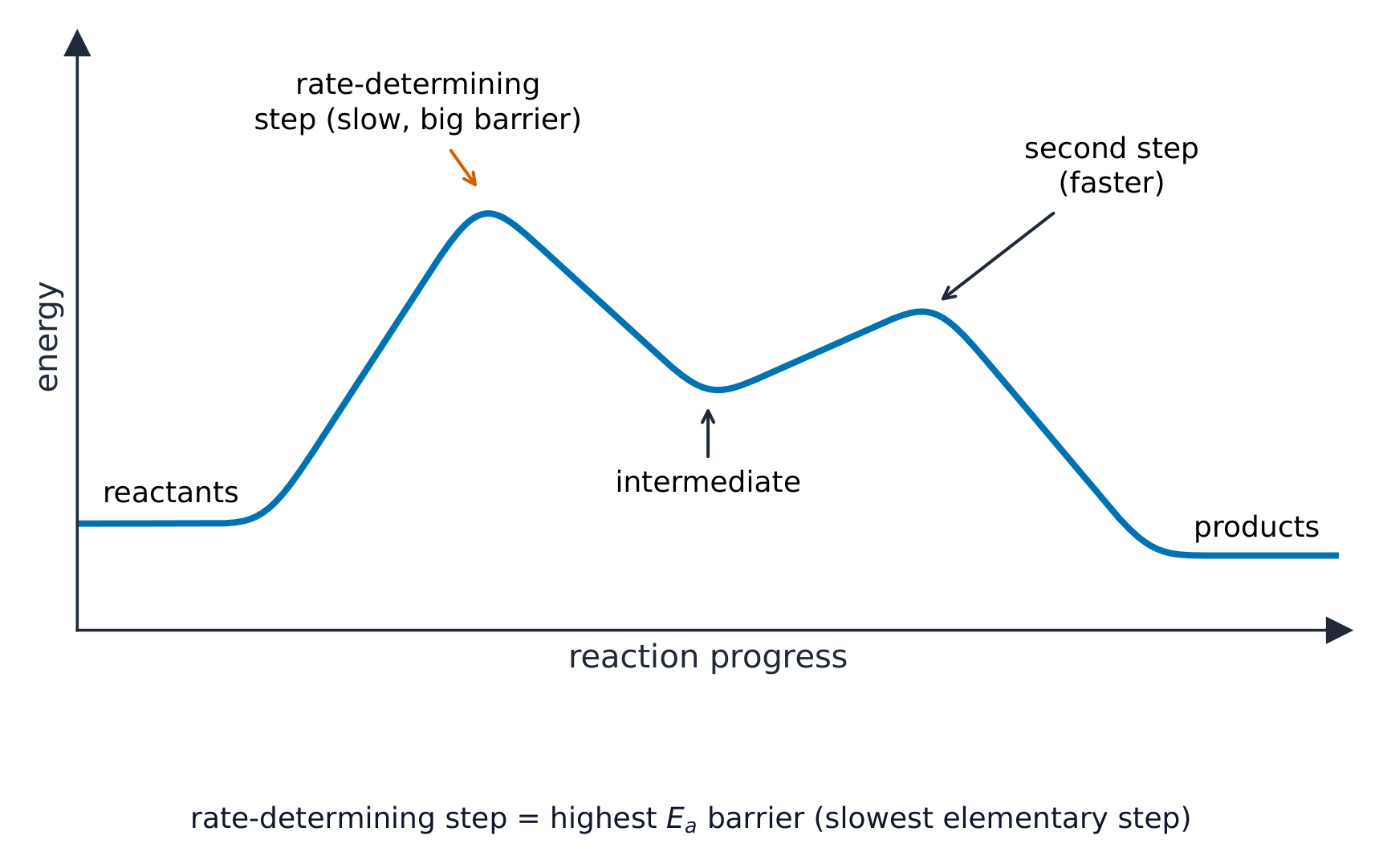
A two-step reaction: each step has its own barrier and the slow step sets the rate
The elementary steps of a mechanism add up to the overall reaction.
Difficulté 1/5 · 100 pièces + un petit bonus lors de la première réussite aujourd'hui
Summing the steps (cancelling intermediates) gives the overall equation.
A single molecular event within a mechanism is an ____ step.
Difficulté 1/5 · 100 pièces + un petit bonus lors de la première réussite aujourd'hui
Each single event is an elementary step.
Intermediates
- An intermediate 中间体 is made in one step and used up in a later one.
- It does not appear in the overall equation.
- Spot it: it shows up first as a product, then as a reactant.
An intermediate is a species that is...
Difficulté 1/5 · 100 pièces + un petit bonus lors de la première réussite aujourd'hui
An intermediate forms then is consumed, so it cancels overall.
How many collide
- Molecularity counts how many particles meet in a single step.
- One particle is unimolecular; two is bimolecular.
- Three-particle collisions are rare, so most steps involve one or two.
Molecularity of a step
Classify each elementary step by how many particles must collide.
A single step in which two particles collide is called...
Difficulté 1/5 · 100 pièces + un petit bonus lors de la première réussite aujourd'hui
Two colliding particles make a bimolecular step.
Steps requiring three particles to collide at once are common.
Difficulté 1/5 · 100 pièces + un petit bonus lors de la première réussite aujourd'hui
Three-body collisions are very unlikely, so they are rare.
Steps: $A + B \to C$ (fast), then $C + B \to D$.
- $C$ is made and then consumed, so it is an intermediate.
- Add both sides: $A+B+C+B\to C+D$. Cancel C and combine the two B reactants to get $A+2B\to D$. The overall equation alone does not establish the mechanism or its rate law.
How does an intermediate differ from a catalyst?
Difficulté 1/5 · 100 pièces + un petit bonus lors de la première réussite aujourd'hui
An intermediate appears as a product first; a catalyst appears as a reactant first.
An intermediate appears then disappears (a product of one step, a reactant of a later one) — do not confuse it with a catalyst, which appears first as a reactant then reappears. Elementary steps can use their coefficients as orders, unlike the overall reaction. Three-body steps are uncommon but possible; molecularity applies to one elementary event, not the overall equation.
A reaction mechanism is the sequence of elementary steps that add up to the overall reaction. An intermediate is made in one step and used up later, so it cancels from the overall equation. Molecularity counts the particles meeting in a step — almost always one or two.