Elemental Composition of Pure Substances
Introduit| English | Sens |
|---|---|
| percent composition/pəˈsent ˌkɒmpəˈzɪʃn/ | composition en pourcentage |
| empirical formula/emˈpɪrɪkl ˈfɔːmjʊlə/ | formule empirique |
| molecular formula/məˈlekjʊlə ˈfɔːmjʊlə/ | formule moléculaire |
What is it made of?
- Break any compound down and you find fixed proportions by mass.
- Water is always 11% hydrogen and 89% oxygen by weight.
- Those percentages never change, no matter the sample size.
- From the percentages you can rebuild the formula.
Percent by mass
- The percent composition 百分组成 is each element's share of the total mass:
- For a formula, work it out from one mole and the molar masses.
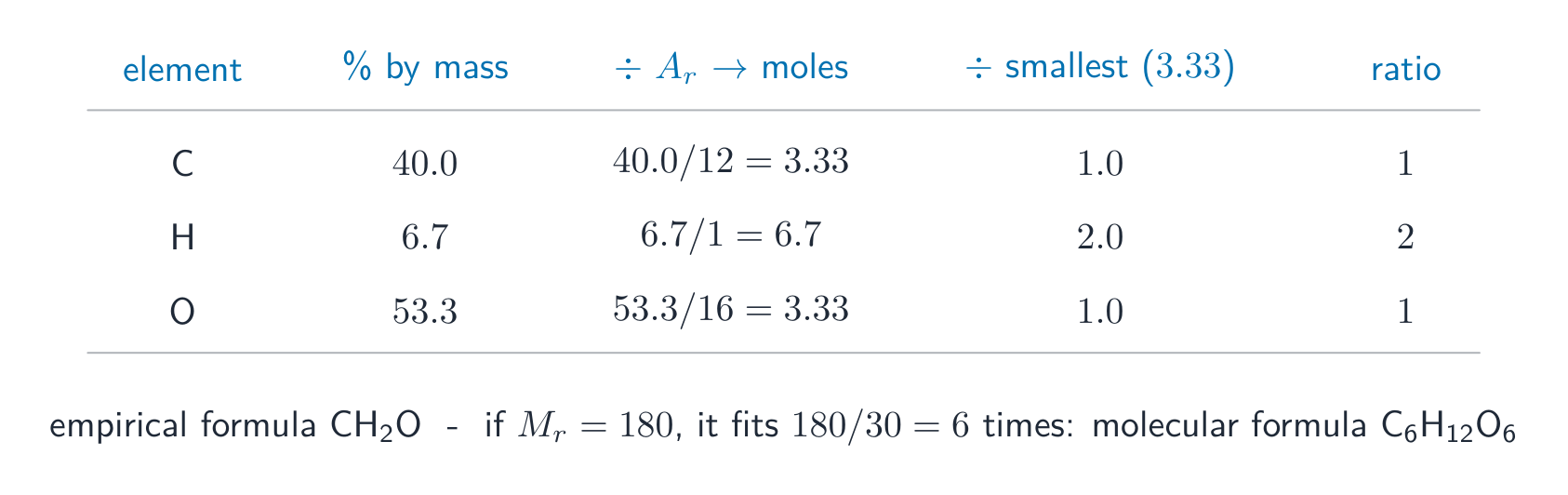
Finding the empirical formula 实验式: mass to moles, divide by the smallest, read the ratio
In water ($\text{H}_2\text{O}$, molar mass 18), what percent of the mass is oxygen (16)? (to nearest whole %)
Difficulté 2/5 · 140 pièces + un petit bonus lors de la première réussite aujourd'hui
Oxygen contributes $16$ of the $18\ \text{g}$ in one mole of water. Its mass percent is $(16/18)\times100=88.89\%\approx89\%$.
The empirical formula
- The empirical formula is the simplest whole-number ratio of atoms.
- Convert each element's mass to moles, then divide by the smallest.
- Glucose has the empirical formula $\text{CH}_2\text{O}$.
The empirical formula of a compound gives...
Difficulté 1/5 · 100 pièces + un petit bonus lors de la première réussite aujourd'hui
Empirical = simplest ratio; the molecular formula gives the actual counts.
From empirical to molecular
- The molecular formula 分子式 is a whole-number multiple of the empirical one.
- Divide the true molar mass by the empirical mass to get that multiple $n$.
- Glucose: empirical $\text{CH}_2\text{O}$ ($30$), molecular $\text{C}_6\text{H}_{12}\text{O}_6$ ($180$), so $n = 6$.
A compound has empirical mass 30 and molar mass 90. The multiple $n$ for its molecular formula?
Difficulté 2/5 · 140 pièces + un petit bonus lors de la première réussite aujourd'hui
The molecular formula contains $n$ empirical units: $n=M_{\mathrm{molecular}}/M_{\mathrm{empirical}}=90/30=3$. Multiply every empirical subscript by 3.
The molecular formula is always a whole-number multiple of the empirical formula.
Difficulté 1/5 · 100 pièces + un petit bonus lors de la première réussite aujourd'hui
By definition, molecular = empirical × n for some whole number n.
A compound is 40% C, 6.7% H, and 53.3% O by mass. Find its empirical formula.
- Moles per 100 g: using $n=m/M$, C $=40/12\approx3.33$, H $=6.7/1=6.7$, O $=53.3/16\approx3.33\ \text{mol}$.
- Divide by the smallest ($3.33$): C 1, H 2, O 1, giving $\text{CH}_2\text{O}$.
Percent composition to formula
Turn a compound's percent composition into its empirical formula, step by step.
Order the steps to find an empirical formula from mass percents.
Difficulté 3/5 · 200 pièces + un petit bonus lors de la première réussite aujourd'hui
Grams → moles → divide by smallest → whole-number ratio.
After dividing by the smallest, you get a ratio of 1:1.5. You should...
Difficulté 1/5 · 100 pièces + un petit bonus lors de la première réussite aujourd'hui
A .5 is real -- scale up to clear it, giving whole numbers 2:3.
Percent composition gives the empirical formula, not always the molecular one — you need the molar mass to find the multiple. When dividing moles by the smallest, round only near-whole results ($3.98 \to 4$); a stubborn $.5$ means multiply everything (by 2), never round it away. Start from a $100\ \text{g}$ sample so percentages become grams directly.
Percent composition is each element's fraction of the total mass. Turn those masses into moles and divide by the smallest to get the empirical formula (simplest ratio). The molecular formula is that empirical unit times $n$, where $n$ is the true molar mass divided by the empirical mass.