Finding the Area Between Curves That Intersect at More Than Two Points
Introduit| English | Sens |
|---|---|
| subintervals/ˌsʌbɪnˈtɜːvlz/ | sous-intervalles |
When the curves keep crossing
- Two curves can cross more than twice, so the "top" curve swaps along the way. One integral of top minus bottom would then be wrong on part of the region.
- The fix: find every crossing, split the region there, and add the pieces.
Find every intersection first
- Solve $f(x)=g(x)$ completely on the interval. The crossings cut it into subintervals 子区间 where one curve stays on top.
- On each subinterval, test one point to see which curve is on top, then integrate upper − lower there.
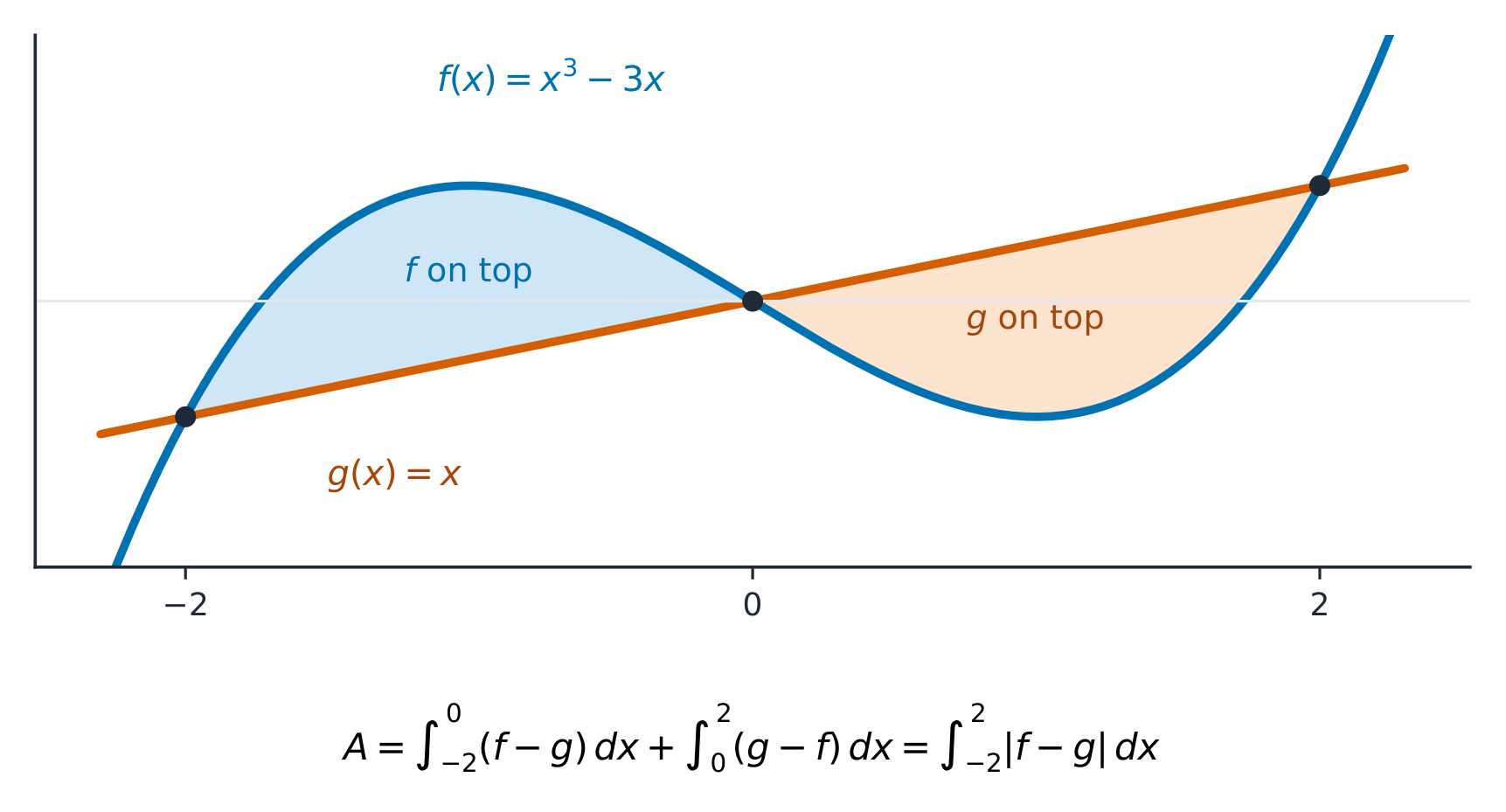
A cubic crossing a line 3 times
y = ax³ + bx
$y=x^3$ et $y=x$ cross at $-1,0,1$; the top curve switches at $0$, so the area needs two pieces.
Where do $y=x^3$ et $y=x$ cross?
Difficulté 2/5 · 140 pièces + un petit bonus lors de la première réussite aujourd'hui
$x^3=x\Rightarrow x(x-1)(x+1)=0$.
The intersection points divide the region into ____ where the ordering is fixed.
Difficulté 1/5 · 100 pièces + un petit bonus lors de la première réussite aujourd'hui
On each subinterval one curve is consistently on top.
Area between $y=x^3$ and $y=x$ on $[-1,1]$.
- $x^3=x\Rightarrow x(x-1)(x+1)=0$: $x=-1,0,1$. Test $-0.5$: $x^3>x$. Test $0.5$: $x>x^3$.
- $A=\displaystyle\int_{-1}^{0}(x^3-x)\,dx+\int_{0}^{1}(x-x^3)\,dx=\tfrac14+\tfrac14=\tfrac12$.
Pour $y=x^3$ et $y=x$ on $[-1,1]$, each piece has area $\tfrac14$. Find the total area.
Difficulté 2/5 · 140 pièces + un petit bonus lors de la première réussite aujourd'hui
$\tfrac14+\tfrac14=\tfrac12$.
Why one integral fails
- $\displaystyle\int_{-1}^{1}(x^3-x)\,dx=0$, but the area is $\tfrac12$. The two pieces have opposite signs and cancel.
- The safe single formula is $A=\displaystyle\int_a^b|f(x)-g(x)|\,dx$: the absolute gap. On the calculator section, enter exactly that.
You split the region at each intersection because...
Difficulté 1/5 · 100 pièces + un petit bonus lors de la première réussite aujourd'hui
Where curves swap, part of the region would count negative.
Integrating $|f(x)-g(x)|$ over the whole interval gives the same total area as splitting.
Difficulté 1/5 · 100 pièces + un petit bonus lors de la première réussite aujourd'hui
The absolute value handles the switching automatically.
Using one integral of $f-g$ across all crossings (curves swapping) gives...
Difficulté 1/5 · 100 pièces + un petit bonus lors de la première réussite aujourd'hui
Sign-cancellation understates the true area.
Trig curves. Find the area between $y=\sin x$ and $y=\cos x$ on $[0,\pi]$.
- $\sin x=\cos x$ at $x=\tfrac{\pi}{4}$ only. On $(0,\tfrac{\pi}{4})$, $\cos x$ is on top; on $(\tfrac{\pi}{4},\pi)$, $\sin x$ is.
- $A=\Big[\sin x+\cos x\Big]_0^{\pi/4}+\Big[-\cos x-\sin x\Big]_{\pi/4}^{\pi}$
- $=(\sqrt2-1)+(1+\sqrt2)=2\sqrt2\approx2.83$
Find the total area between $y=x^3-4x$ and the $x$-axis on $[-2,2]$.
Difficulté 2/5 · 140 pièces + un petit bonus lors de la première réussite aujourd'hui
$x^3-4x=x(x-2)(x+2)$ crosses at $-2,0,2$. $\int_{-2}^{0}(x^3-4x)\,dx=4$ et $\int_0^2(4x-x^3)\,dx=4$, so the area is $8$. (One integral over $[-2,2]$ gives 0.)
- Find all crossings, including ones inside the interval that the question does not mention.
- A point where the curves only touch (like $x^2$ and $0$ at $x=0$) does not swap the top curve. Test a point on each side.
- Each piece's integral should be positive. A negative piece means top and bottom are the wrong way round.
If two curves meet at $x=c$, the top curve always switches at $c$.
Difficulté 1/5 · 100 pièces + un petit bonus lors de la première réussite aujourd'hui
They may only touch: $y=x^2$ et $y=0$ meet at 0, but $x^2$ stays on top on both sides. Test a point on each side.
When curves intersect more than twice, find all intersections, split into subintervals, and integrate upper − lower on each. Or integrate $|f(x)-g(x)|$ in one go. A single integral of $f-g$ cancels area.