Connecting Position, Velocity, and Acceleration of Functions Using Integrals
Introduit| English | Sens |
|---|---|
| position/pəˈzɪʃn/ | position |
| Displacement/dɪˈspleɪsmənt/ | déplacement |
Motion, now run through integrals
- Unit 4 went position → velocity → acceleration by differentiating. Integration goes backward.
- Integrate acceleration to recover velocity; integrate velocity to recover position 位置.
- Each step adds up a rate to get the quantity it changes.
- So integrals rebuild the motion story from the rates.
To recover position from velocity you...
Difficulté 1/5 · 100 pièces + un petit bonus lors de la première réussite aujourd'hui
Position $=$ initiale $+\int v\,dt$.
Going up the chain
- Velocity from acceleration: $v(t)=v(t_0)+\displaystyle\int_{t_0}^{t} a(s)\,ds$.
- Position from velocity: $s(t)=s(t_0)+\displaystyle\int_{t_0}^{t} v(s)\,ds$.
- Each needs an initial value (the constant of integration in disguise).
- Integrate the rate, then add where you started.
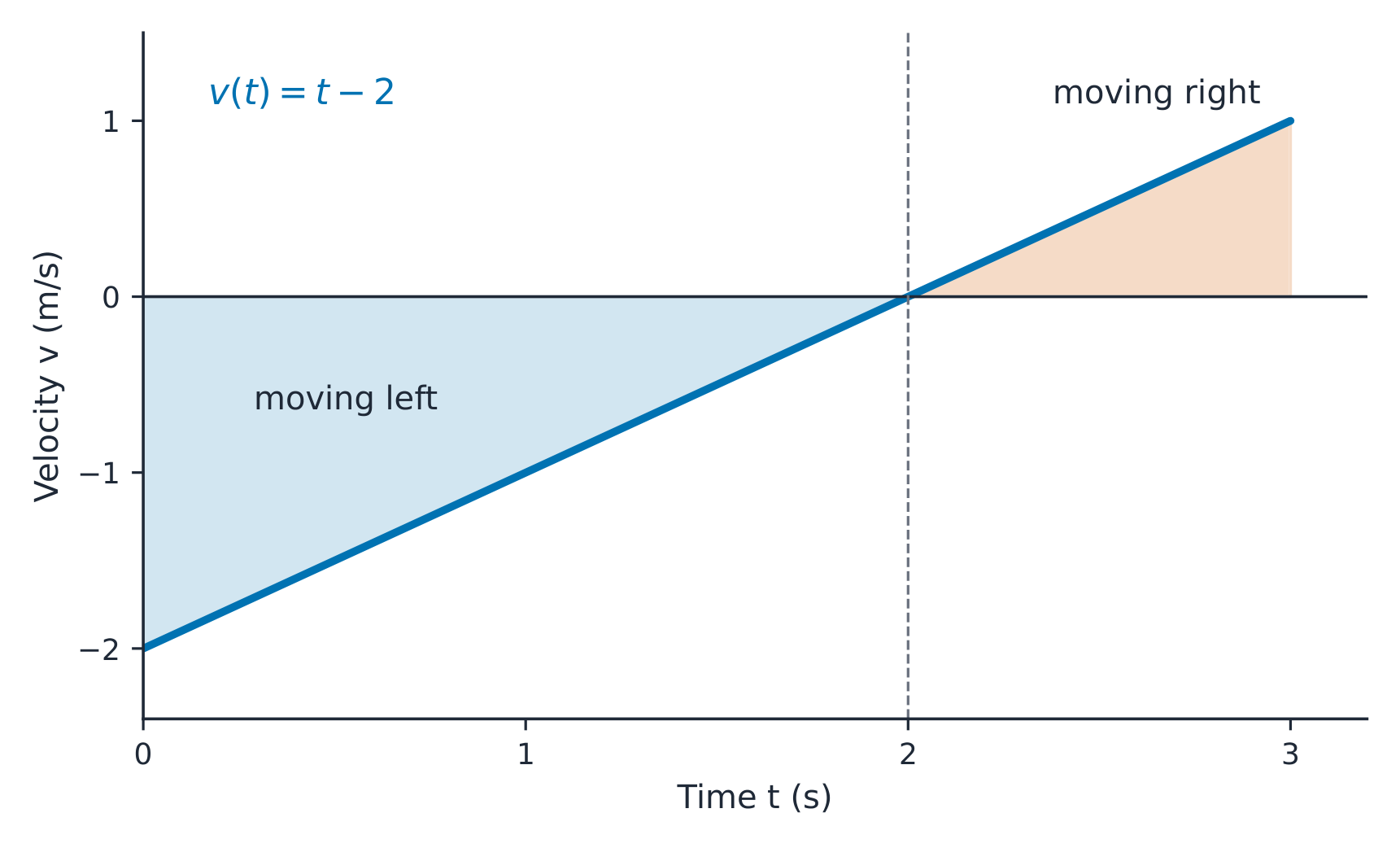
Teacher-created velocity model: signed areas distinguish displacement 位移 and distance.
Recovering position from velocity requires an ____ value to fix the constant.
Difficulté 1/5 · 100 pièces + un petit bonus lors de la première réussite aujourd'hui
Position $=$ initial position $+\int v\,dt$.
a(t) = 6t and v(0) = −3. Find v(2).
Difficulté 2/5 · 140 pièces + un petit bonus lors de la première réussite aujourd'hui
v(2) = −3 + ∫ from 0 to 2 of 6t dt = −3 + 12 = 9.
Displacement vs. distance
- Displacement over $[a,b]$ is the signed integral of velocity: $\displaystyle\int_a^b v(t)\,dt$ — net change in position.
- Total distance is the integral of speed $|v|$: $\displaystyle\int_a^b |v(t)|\,dt$ — it never subtracts.
- If the object turns around, displacement and distance differ.
- Displacement can be zero after real motion; distance cannot (unless it never moved).
Aire signée sous la vitesse
y = t − 2 (velocity)
The signed area under $v(t)$ is displacement; taking absolute value on each piece (split at $v=0$) gives distance.
Pour $v(t)=t-2$ on $[0,3]$, find the displacement $\int_0^3 (t-2)\,dt$.
Difficulté 2/5 · 140 pièces + un petit bonus lors de la première réussite aujourd'hui
$\tfrac92-6=-\tfrac32$.
Displacement can be zero even when the object has actually moved.
Difficulté 1/5 · 100 pièces + un petit bonus lors de la première réussite aujourd'hui
Out-and-back gives zero net displacement but positive distance.
Distance means splitting at the turns
- To get total distance, find where $v=0$ (the turning points) and integrate $|v|$ piece by piece.
- On each piece $v$ keeps one sign, so $|v|$ is just $\pm v$ there.
- Add the absolute areas of the pieces — no cancellation.
- This "split at $v=0$" step is exactly what makes distance $\neq$ displacement.
Pour $v(t)=t-2$ on $[0,3]$, total distance is $\int_0^3 |t-2|\,dt$. Compute it.
Difficulté 2/5 · 140 pièces + un petit bonus lors de la première réussite aujourd'hui
Split at $t=2$: $2+\tfrac12=\tfrac52$.
Total distance traveled over $[a,b]$ is...
Difficulté 1/5 · 100 pièces + un petit bonus lors de la première réussite aujourd'hui
Integrate speed $|v|$; splitting at turning points is required.
Displacement ($\int v\,dt$) is signed and can be zero even after moving; total distance ($\int|v|\,dt$) is never negative. To get distance, split the interval where $v=0$ and add the absolute values — do not just integrate $v$ and take its absolute value at the end. And recovering position/velocity needs the initial value.
A particle has $v(t)=t-2$ (m/s) on $[0,3]$. Find displacement and total distance.
- Displacement: $\displaystyle\int_0^3 (t-2)\,dt=\Big[\tfrac{t^2}{2}-2t\Big]_0^3=\tfrac92-6=-\tfrac32$ m.
- $v=0$ at $t=2$: negative on $[0,2)$, positive on $(2,3]$.
- Distance: $\displaystyle\int_0^2 |t-2|\,dt+\int_2^3|t-2|\,dt = 2 + \tfrac12 = \tfrac52$ m.
A full AP-style question. A particle moves along the $x$-axis with $v(t)=3t^2-12$ (m/s) and $x(0)=5$.
- Position at $t=3$: $x(3)=5+\displaystyle\int_0^3(3t^2-12)\,dt=5+\big[t^3-12t\big]_0^3=5+(27-36)=-4$ m.
- $v=0$ at $t=2$. Distance $=\left|\displaystyle\int_0^2 v\,dt\right|+\left|\displaystyle\int_2^3 v\,dt\right|=|8-24|+|(27-36)-(8-24)|=16+7=23$ m.
- Displacement is $-9$ m, but the particle travelled 23 m: it went left 16 m, then right 7 m.
v(t) = 2t − 6 and x(0) = 10. Find x(4).
Difficulté 2/5 · 140 pièces + un petit bonus lors de la première réussite aujourd'hui
x(4) = 10 + [t² − 6t] from 0 to 4 = 10 + (16 − 24) = 2.
For the same v(t) = 2t − 6, find the total distance travelled from t = 0 to t = 4.
Difficulté 2/5 · 140 pièces + un petit bonus lors de la première réussite aujourd'hui
v = 0 at t = 3. |∫0³ v dt| = 9 and |∫3⁴ v dt| = 1, so the distance is 10.
Average velocity and speeding up
- Average velocity on $[a,b]$ is $\dfrac{1}{b-a}\displaystyle\int_a^b v(t)\,dt$, the displacement divided by the time. In the example: $\dfrac{-9}{3}=-3$ m/s.
- The particle is speeding up when $v$ and $a$ have the same sign. At $t=1$: $v=-9$, $a=v'=6t=6$, different signs, so it is slowing down.
For v(t) = 2t − 6, find the average velocity on [0, 4].
Difficulté 2/5 · 140 pièces + un petit bonus lors de la première réussite aujourd'hui
Displacement −8 divided by 4 seconds = −2.
Integrals rebuild motion: velocity $=$ initial $+\int a\,dt$, position $=$ initial $+\int v\,dt$. Displacement over $[a,b]$ is the signed $\int_a^b v\,dt$; total distance is $\int_a^b|v|\,dt$ — split at the turning points ($v=0$) and add absolute values.