Integrating Using Integration by Parts
Introduit| English | Sens |
|---|---|
| Integration by parts/ˌɪntɪˈɡreɪʃn baɪ pɑːts/ | intégration par parties |
The product rule, run backward
- $u$-substitution reverses the chain rule. Integration by parts 分部积分法 reverses the product rule.
- Use it for a product of two different kinds of function, like $\int xe^x\,dx$, where substitution does not help.
Integration by parts is the reverse of which rule?
Difficulté 1/5 · 100 pièces + un petit bonus lors de la première réussite aujourd'hui
It undoes the product rule.
The formula
- Choose $u$ (you differentiate it) and $dv$ (you integrate it). Then find $du$ and $v$, and put them into $uv-\int v\,du$.
The integration by parts formula is $\int u\,dv=$
Difficulté 1/5 · 100 pièces + un petit bonus lors de la première réussite aujourd'hui
$\int u\,dv=uv-\int v\,du$ (mind the minus).
Choosing $u$
- Choose so that the new integral $\int v\,du$ is simpler. Usually $u$ gets simpler when you differentiate it.
- LIATE gives the order for $u$: Logarithm, Inverse trig, Algebraic, Trig, Exponential. Take $u$ from the earliest type present.
Pour $\int x e^x\,dx$, a good choice is $u=$
Difficulté 1/5 · 100 pièces + un petit bonus lors de la première réussite aujourd'hui
By LIATE, the algebraic $x$ est $u$; $dv=e^x\,dx$.
$\displaystyle\int x e^x\,dx=$
Difficulté 1/5 · 100 pièces + un petit bonus lors de la première réussite aujourd'hui
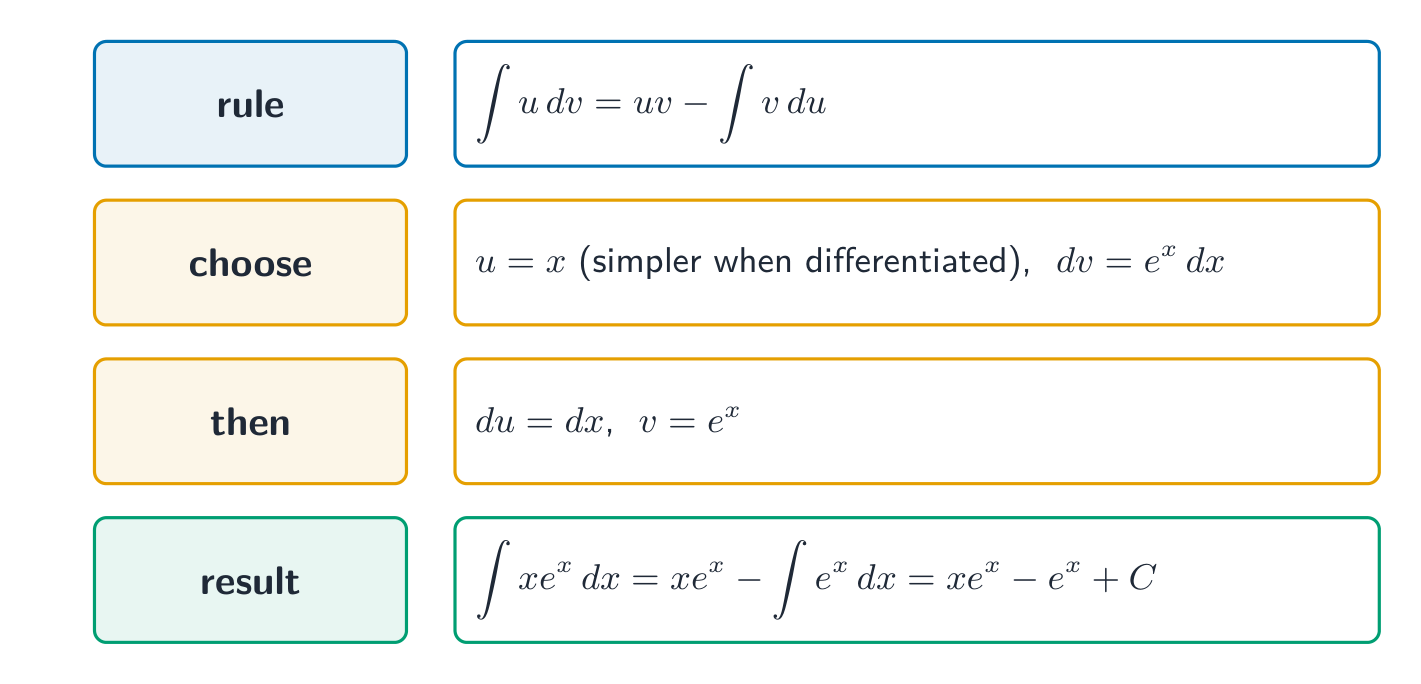
Choose $u=x$, $dv=e^x\,dx$, so $du=dx$, $v=e^x$. Then $\int xe^x\,dx=xe^x-\int e^x\,dx=xe^x-e^x+C=e^x(x-1)+C$.
A common mnemonic for choosing $u$ is ____ (L-I-A-T-E).
Difficulté 1/5 · 100 pièces + un petit bonus lors de la première réussite aujourd'hui
Logarithm, Inverse trig, Algebraic, Trig, Exponential.
$\displaystyle\int xe^x\,dx$
- $u=x$, $dv=e^x\,dx$, so $du=dx$, $v=e^x$.
- $xe^x-\displaystyle\int e^x\,dx=xe^x-e^x+C$.
Rechercher $\displaystyle\int x\cos x\,dx$.
Difficulté 1/5 · 100 pièces + un petit bonus lors de la première réussite aujourd'hui
$u=x$, $dv=\cos x\,dx$: $v=\sin x$. $x\sin x-\int\sin x\,dx=x\sin x+\cos x+C$.
Only one factor? $\displaystyle\int\ln x\,dx$
- Write it as $\ln x\cdot1$: $u=\ln x$, $dv=dx$. So $du=\dfrac1x\,dx$, $v=x$.
- $x\ln x-\displaystyle\int x\cdot\frac1x\,dx=x\ln x-x+C$.
Evaluate $\displaystyle\int_1^{e}\ln x\,dx$.
Difficulté 2/5 · 140 pièces + un petit bonus lors de la première réussite aujourd'hui
$\Big[x\ln x-x\Big]_1^{e}=(e-e)-(0-1)=1$.
Twice. $\displaystyle\int x^2e^x\,dx$
- $u=x^2$, $dv=e^x\,dx$ gives $x^2e^x-\displaystyle\int 2xe^x\,dx$. The new integral still has a product, so use parts again.
- $\displaystyle\int 2xe^x\,dx=2(xe^x-e^x)$, so the answer is $e^x(x^2-2x+2)+C$.
Definite. $\displaystyle\int_0^{\pi}x\sin x\,dx$
- $u=x$, $dv=\sin x\,dx$. Then $du=dx$ and $v=-\cos x$.
- $\Big[-x\cos x\Big]_0^{\pi}+\displaystyle\int_0^{\pi}\cos x\,dx=(\pi-0)+\Big[\sin x\Big]_0^{\pi}=\pi$.
- The formula has a minus: $uv-\int v\,du$. Most errors are a lost sign, especially when $v=-\cos x$.
- A bad choice of $u$ makes the integral harder. With $u=e^x$ in $\int xe^x\,dx$, you get $\int\frac{x^2}{2}e^x\,dx$.
- In a definite integral, evaluate $uv$ at the limits too.
You should choose $u$ et $dv$ so the new integral $\int v\,du$ is simpler than the original.
Difficulté 1/5 · 100 pièces + un petit bonus lors de la première réussite aujourd'hui
That is the whole point of the choice.
Integration by parts: $\int u\,dv=uv-\int v\,du$. Choose $u$ by LIATE so that $\int v\,du$ is simpler; repeat if a product remains. Use $u=\ln x$, $dv=dx$ for $\int\ln x\,dx$.