Approximating Values Using Local Linearity and Linearization
Introduit| English | Sens |
|---|---|
| tangent line/ˈtændʒənt laɪn/ | tangente |
| local linearity/ˈləʊkl lɪˈnɪərɪti/ | linéarité locale |
| linearization/ˌlɪnɪəraɪˈzeɪʃn/ | linéarisation |
Zoom in far enough and a curve looks straight
- Pick any smooth curve, zoom in on one point, and it flattens into (almost) a straight line.
- That line is the tangent line 切线, and near the point it hugs the curve tightly.
- So the tangent is a great approximation to the function nearby — this is local linearity 局部线性性.
- It lets you estimate hard function values with just a slope and a point.
La tangente épouse la courbe
y = x²
Zoomed in on $y=x^2$ près $x=3$, the tangent $L(x)=9+6(x-3)$ and the curve almost coincide: $L(3.1)=9.6$ against the true $9.61$. The same idea gives $\sqrt{4.1}\approx2.025$.
The idea that a smooth curve looks straight up close is called local ____.
Difficulté 1/5 · 100 pièces + un petit bonus lors de la première réussite aujourd'hui
Local linearity underlies the tangent-line approximation.
Build the tangent line
- The tangent at $x=a$ passes through $\big(a,f(a)\big)$ with slope $f'(a)$.
- Point-slope form gives the linearization 线性化:
-
$$L(x)=f(a)+f'(a)(x-a)$$
- This $L(x)$ is just the tangent line, renamed as an approximation formula.
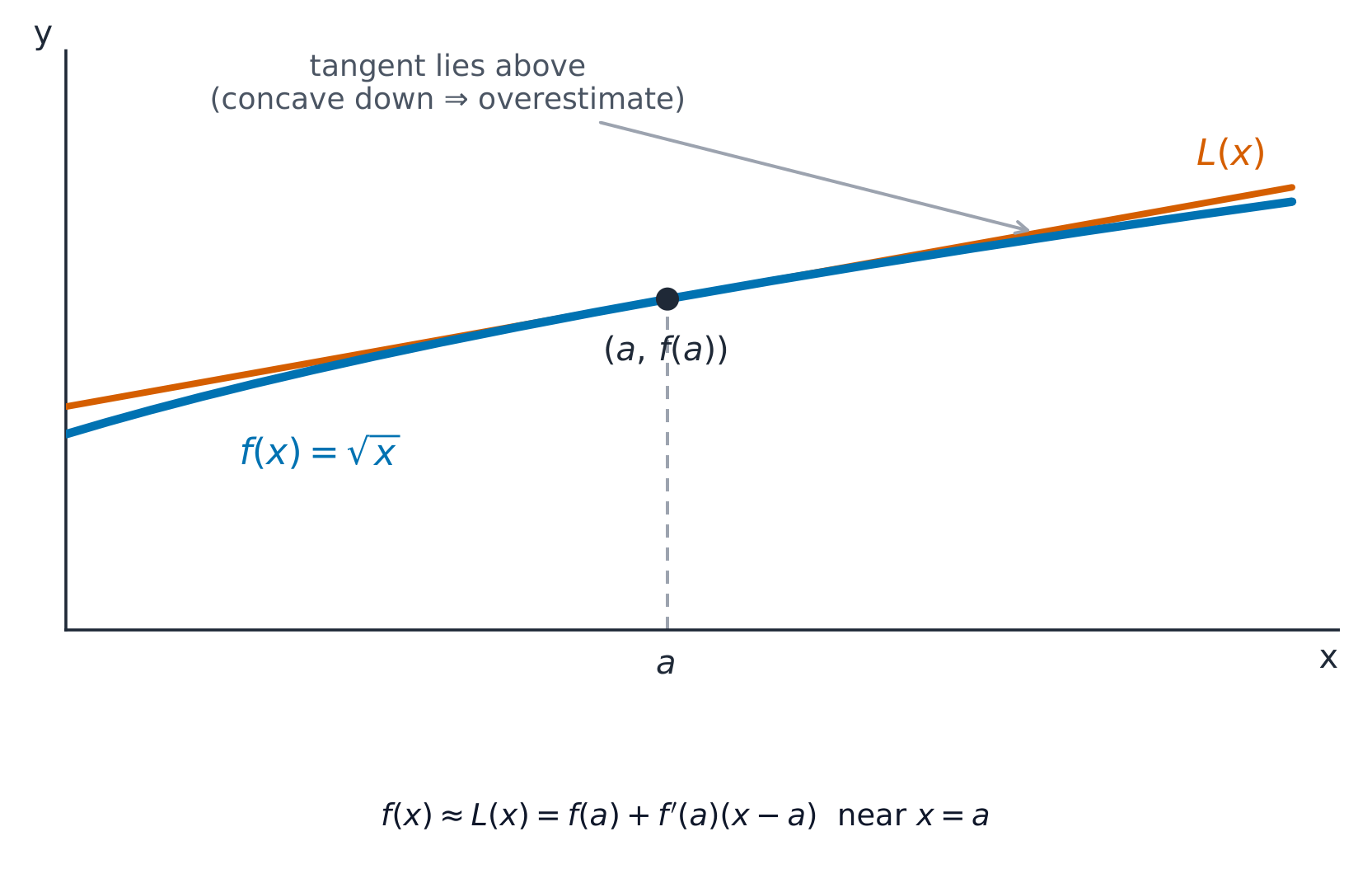
Near x = a the tangent line L(x) approximates f(x)
The linearization of $f$ at $a$ est $L(x)=$
Difficulté 1/5 · 100 pièces + un petit bonus lors de la première réussite aujourd'hui
Point-slope of the tangent: $f(a)+f'(a)(x-a)$.
Approximate a nearby value
- To estimate $f(x)$ for $x$ near $a$, compute $L(x)$ instead — it's usually easy arithmetic.
- Choose $a$ to be a nearby point where $f(a)$ and $f'(a)$ are simple (a "nice" number).
- The closer $x$ is to $a$, the better the approximation.
- Example: to estimate $\sqrt{4.1}$, use $f(x)=\sqrt x$ at $a=4$, where $f(4)=2$ is clean.
Using $L(x)=2+\tfrac14(x-4)$, estimate $\sqrt{4.1}=L(4.1)$.
Difficulté 2/5 · 140 pièces + un petit bonus lors de la première réussite aujourd'hui
$2+\tfrac14(0.1)=2.025$.
Over- or underestimate? Ask concavity
- The tangent line lies on one side of a curved graph, so $L(x)$ leans one way.
- Concave up (curve bends upward, $f''>0$): the tangent is below the curve → $L$ is an underestimate.
- Concave down ($f''<0$): the tangent is above the curve → $L$ is an overestimate.
- Checking the sign of $f''$ tells you which way your approximation errs.
If $f$ is concave down near $a$, the tangent-line estimate $L(x)$ is an...
Difficulté 1/5 · 100 pièces + un petit bonus lors de la première réussite aujourd'hui
Concave down → tangent above the curve → overestimate.
A linearization is most accurate for inputs far from the point of tangency.
Difficulté 1/5 · 100 pièces + un petit bonus lors de la première réussite aujourd'hui
It is most accurate près the point; accuracy drops as you move away.
Select tout correct over/under conclusions.
Difficulté 2/5 · 140 pièces + un petit bonus lors de la première réussite aujourd'hui
Up → tangent below → under; down → tangent above → over; both set by $f''$.
Linearization is only accurate near the point of tangency — far from $a$ the straight line drifts away from the curve. And the over/under call depends on concavity: concave up → tangent below → underestimate; concave down → overestimate. Don't guess the direction; check the sign of $f''$.
Estimate $\sqrt{4.1}$ using linearization at $a=4$.
- $f(x)=\sqrt x=x^{1/2}$, so $f'(x)=\tfrac{1}{2\sqrt x}$; $\;f(4)=2$, $\;f'(4)=\tfrac14$.
- $L(x)=2+\tfrac14(x-4)$, so $L(4.1)=2+\tfrac14(0.1)=2.025$.
- Since $\sqrt x$ is concave down ($f''<0$), this is a slight overestimate (true value $\approx2.0248$).
A root without a calculator. Estimate $\sqrt[3]{8.3}$.
- Use $f(x)=x^{1/3}$ at $a=8$. Then $f(8)=2$ and $f'(x)=\tfrac13x^{-2/3}$, so $f'(8)=\tfrac13\cdot\tfrac14=\tfrac{1}{12}$.
- $L(8.3)=2+\tfrac{1}{12}(0.3)=2.025$. The true value is about $2.0247$.
The AP form: no formula for $f$
- AP often gives only $f(a)$ and $f'(a)$, or a table. You still write $L(x)=f(a)+f'(a)(x-a)$ and substitute.
- With a differential equation, find the slope from it first: for $\frac{dy}{dx}=x+y$ at $(1,2)$, the slope is $1+2=3$.
A function has $f(3)=7$ et $f'(3)=-2$. Use the tangent line at $x=3$ to estimate $f(3.2)$.
Difficulté 2/5 · 140 pièces + un petit bonus lors de la première réussite aujourd'hui
L(3.2) = 7 + (−2)(0.2) = 6.6.
Tangent line from a differential equation. $y=f(x)$ solves $\frac{dy}{dx}=x+y$ with $f(1)=2$. Estimate $f(1.2)$.
- The slope at $(1,2)$ is $1+2=3$. Tangent line: $y=2+3(x-1)$.
- $f(1.2)\approx2+3(0.2)=2.6$.
- Is it an under- or overestimate? $\frac{d^2y}{dx^2}=1+\frac{dy}{dx}=1+(x+y)$, which is $4>0$ at $(1,2)$. The graph is concave up, so 2.6 is an underestimate.
$y=f(x)$ solves $\frac{dy}{dx}=xy$ with $f(2)=1$. Use the tangent line at $x=2$ to estimate $f(2.1)$.
Difficulté 2/5 · 140 pièces + un petit bonus lors de la première réussite aujourd'hui
Slope at (2, 1) is 2 × 1 = 2. f(2.1) ≈ 1 + 2(0.1) = 1.2.
Pour $\frac{dy}{dx}=xy$, the second derivative is $\frac{d^2y}{dx^2}=y+x\frac{dy}{dx}$, which equals 5 at the point $(2,1)$. Is the tangent-line estimate of $f(2.1)$ an under- or overestimate?
Difficulté 1/5 · 100 pièces + un petit bonus lors de la première réussite aujourd'hui
The second derivative is positive, so the curve bends up above its tangent line.
Local linearity lets the tangent line approximate a function near a point. The linearization is $L(x)=f(a)+f'(a)(x-a)$; use it to estimate $f(x)$ for $x$ near $a$. Concavity sets the direction of error: concave up → underestimate, concave down → overestimate.