Implicit Differentiation
Introduit| English | Sens |
|---|---|
| implicit differentiation/ɪmˈplɪsɪt ˌdɪfəˌrenʃɪˈeɪʃn/ | dérivation implicite |
| implicit/ɪmˈplɪsɪt/ | implicite |
When you can't solve for $y$
- The circle $x^2+y^2=25$ defines $y$ implicitly — you can't write it as a single $y=f(x)$.
- Yet the curve still has a slope at each point. How do we get $\tfrac{dy}{dx}$ without solving for $y$?
- The trick: differentiate both sides with respect to $x$, treating $y$ as a hidden function of $x$.
- This is implicit differentiation 隐函数求导.
An equation like $x^2+y^2=25$ defines $y$ ____, since it is not solved for $y$.
Difficulté 1/5 · 100 pièces + un petit bonus lors de la première réussite aujourd'hui
That is why we use implicit differentiation.
Every $y$ term triggers the chain rule
- Because $y$ secretly depends on $x$, differentiating a $y$-term needs the chain rule.
- $\dfrac{d}{dx}[y^2]=2y\cdot\dfrac{dy}{dx}$ — the extra $\tfrac{dy}{dx}$ is the inner derivative.
- $\dfrac{d}{dx}[x^2]=2x$ as usual (no $y$, no extra factor).
- So each time you differentiate a term containing $y$, tack on a $\tfrac{dy}{dx}$.
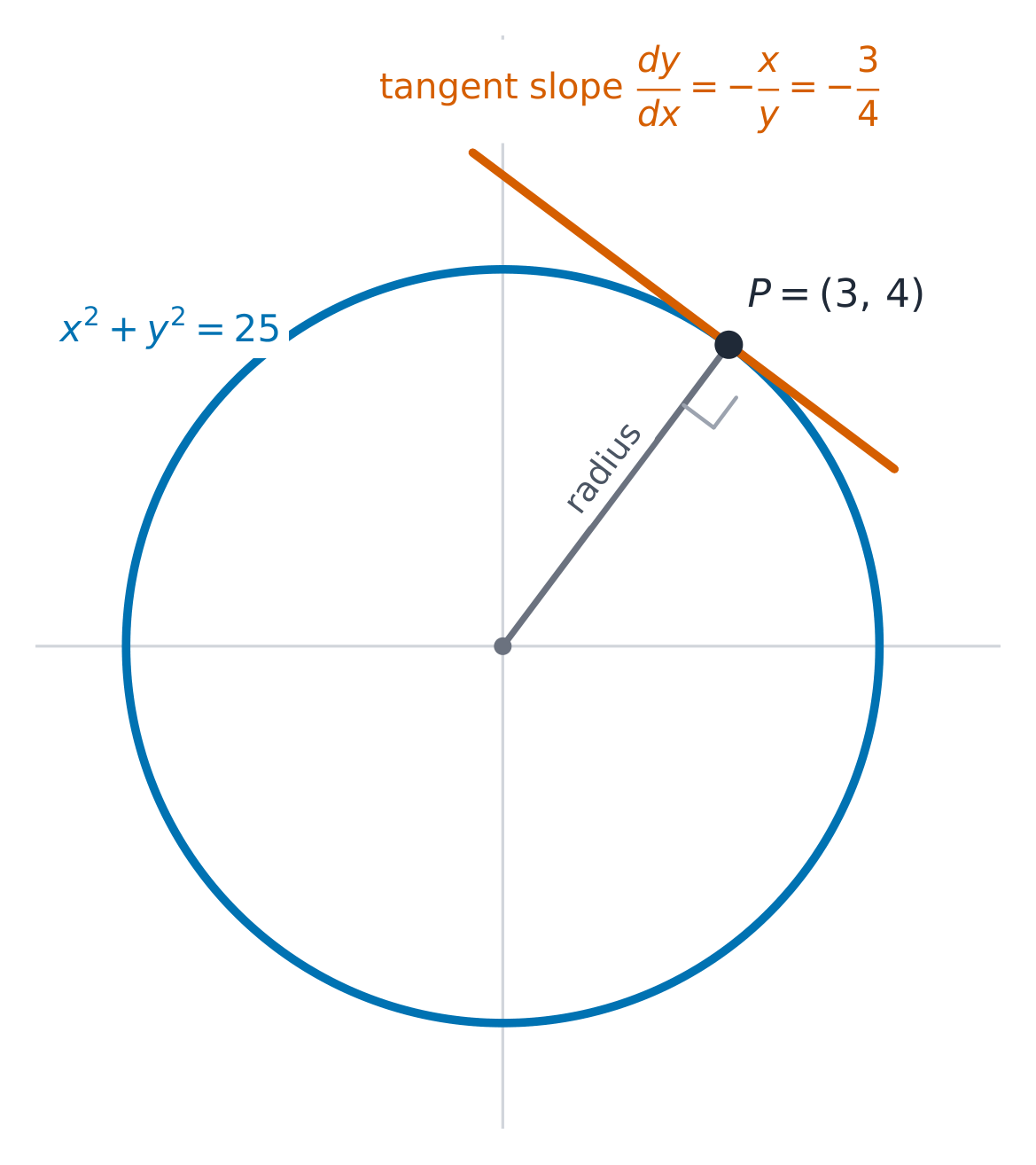
Implicit 隐式 differentiation on the circle x² + y² = 25: the tangent slope at (3, 4) is −3/4
Differentiating with respect to $x$, $\dfrac{d}{dx}[y^2]=$
Difficulté 1/5 · 100 pièces + un petit bonus lors de la première réussite aujourd'hui
Chain rule: $2y$ times the inner derivative $\tfrac{dy}{dx}$.
Solve for $\tfrac{dy}{dx}$
- After differentiating, you get an equation with $\tfrac{dy}{dx}$ scattered around.
- Collect all $\tfrac{dy}{dx}$ terms on one side, everything else on the other.
- Factor out $\tfrac{dy}{dx}$ and divide to isolate it.
- The result usually depends on both $x$ and $y$ — that's expected for a curve.
Une pente tangente sur une courbe
y = −0.75x + 6.25 (tangent line to the circle at (3, 4))
The circle has slope $-3/4$ at $(3,4)$. This grapher shows its tangent line $y-4=-(3/4)(x-3)$, rather than the circle itself. The widget rounds readouts to one decimal; the exact slope is $-0.75$.
Put the implicit-differentiation steps in order.
Difficulté 3/5 · 200 pièces + un petit bonus lors de la première réussite aujourd'hui
Differentiate, collect, solve, then evaluate.
Evaluate at a point
- To get an actual slope, plug a point $(x,y)$ on the curve into your $\tfrac{dy}{dx}$ formula.
- For $x^2+y^2=25$: differentiating gives $2x+2y\tfrac{dy}{dx}=0$, so $\tfrac{dy}{dx}=-\dfrac{x}{y}$.
- At $(3,4)$: slope $=-\tfrac34$. At $(3,-4)$: slope $=+\tfrac34$.
- The same $x$ can give different slopes — because the curve has two $y$-branches.
Pour $x^2+y^2=25$, $\dfrac{dy}{dx}=-\dfrac{x}{y}$. Find the slope at $(3,4)$ (a decimal).
Difficulté 2/5 · 140 pièces + un petit bonus lors de la première réussite aujourd'hui
$-\tfrac{3}{4}=-0.75$.
The factor $\tfrac{dy}{dx}$ is added to every term, including pure $x$ terms like $x^2$.
Difficulté 1/5 · 100 pièces + un petit bonus lors de la première réussite aujourd'hui
Only terms containing $y$ get the $\tfrac{dy}{dx}$ factor.
Differentiating $xy$ with respect to $x$ gives...
Difficulté 1/5 · 100 pièces + un petit bonus lors de la première réussite aujourd'hui
Product rule: $\frac{d}{dx}[xy]=1\cdot y+x\cdot\tfrac{dy}{dx}$.
The chain-rule factor $\tfrac{dy}{dx}$ appears only on terms containing $y$. $\frac{d}{dx}[x^3]=3x^2$ (no factor), but $\frac{d}{dx}[y^3]=3y^2\tfrac{dy}{dx}$. Forgetting the $\tfrac{dy}{dx}$ on $y$-terms is the defining mistake of implicit differentiation. And a product like $xy$ needs the product rule: $\frac{d}{dx}[xy]=y+x\tfrac{dy}{dx}$.
With the product rule. The curve $xy+y^2=6$ passes through $(5,1)$. Find the tangent line there.
- Differentiate: $\Big(y+x\dfrac{dy}{dx}\Big)+2y\dfrac{dy}{dx}=0$. The term $xy$ needs the product rule.
- Collect: $\dfrac{dy}{dx}(x+2y)=-y$, so $\dfrac{dy}{dx}=\dfrac{-y}{x+2y}$.
- At $(5,1)$: slope $=-\dfrac17$. Tangent: $y-1=-\dfrac17(x-5)$.
Find dy/dx for x²y = 8.
Difficulté 1/5 · 100 pièces + un petit bonus lors de la première réussite aujourd'hui
2xy + x² dy/dx = 0, so dy/dx = −2xy/x² = −2y/x.
x² + xy + y² = 7 passes through (1, 2). Find dy/dx there.
Difficulté 2/5 · 140 pièces + un petit bonus lors de la première réussite aujourd'hui
2x + y + x dy/dx + 2y dy/dx = 0, so dy/dx = −(2x + y)/(x + 2y) = −4/5 = −0.8.
Horizontal and vertical tangents
- Write $\dfrac{dy}{dx}$ as a fraction. A horizontal tangent needs numerator $=0$; a vertical tangent needs denominator $=0$ (with numerator $\neq0$).
- Then use the curve's equation to find the actual points. For $x^2+y^2=25$, $\dfrac{dy}{dx}=-\dfrac xy$: horizontal at $x=0$, so $(0,\pm5)$; vertical at $y=0$, so $(\pm5,0)$.
For a curve with dy/dx = (3 − x)/(y + 1), where can a horizontal tangent occur?
Difficulté 1/5 · 100 pièces + un petit bonus lors de la première réussite aujourd'hui
A horizontal tangent needs the numerator to be 0 while the denominator is not.
The second derivative. For $x^2+y^2=25$, find $\dfrac{d^2y}{dx^2}$ at $(3,4)$.
- Differentiate $\dfrac{dy}{dx}=-\dfrac xy$ with the quotient rule: $\dfrac{d^2y}{dx^2}=-\dfrac{y-x\frac{dy}{dx}}{y^2}$.
- Substitute $\dfrac{dy}{dx}=-\dfrac xy$ and simplify, using $x^2+y^2=25$.
- $\dfrac{d^2y}{dx^2}=-\dfrac{y+x^2/y}{y^2}=-\dfrac{x^2+y^2}{y^3}=-\dfrac{25}{y^3}$.
- At $(3,4)$: $-\dfrac{25}{64}$. Negative, so the circle is concave down there, as expected on the top half.
Implicit differentiation: differentiate both sides with respect to $x$, treating $y$ as a function of $x$ so every $y$-term picks up a $\tfrac{dy}{dx}$ (chain rule); then collect, factor, and solve for $\tfrac{dy}{dx}$. Plug in a point on the curve to get a slope. The answer usually depends on both $x$ and $y$.