Defining the Derivative of a Function and Using Derivative Notation
Introduit| English | Sens |
|---|---|
| derivative/dɪˈrɪvətɪv/ | dérivée |
The derivative: instantaneous rate, packaged
- The instantaneous rate of change is so useful it gets its own name: the derivative 导数.
- It turns "slope of the tangent at each $x$" into a brand-new function, $f'(x)$.
- Feed it an $x$, and it returns the slope of $f$ right there.
- This lesson makes the definition precise and shows the notations you'll use everywhere.
La dérivée est la pente de la tangente
y = x²
Drag the point along the curve — the number the tangent slope shows is exactly $f'(x)$ at that input.
The limit definition
- The derivative of $f$ is
-
$$f'(x)=\lim_{h\to 0}\frac{f(x+h)-f(x)}{h}$$
- Inside is a difference quotient — the secant slope over an interval of width $h$.
- Taking $h\to0$ shrinks the interval to nothing, turning the secant slope into the tangent slope.
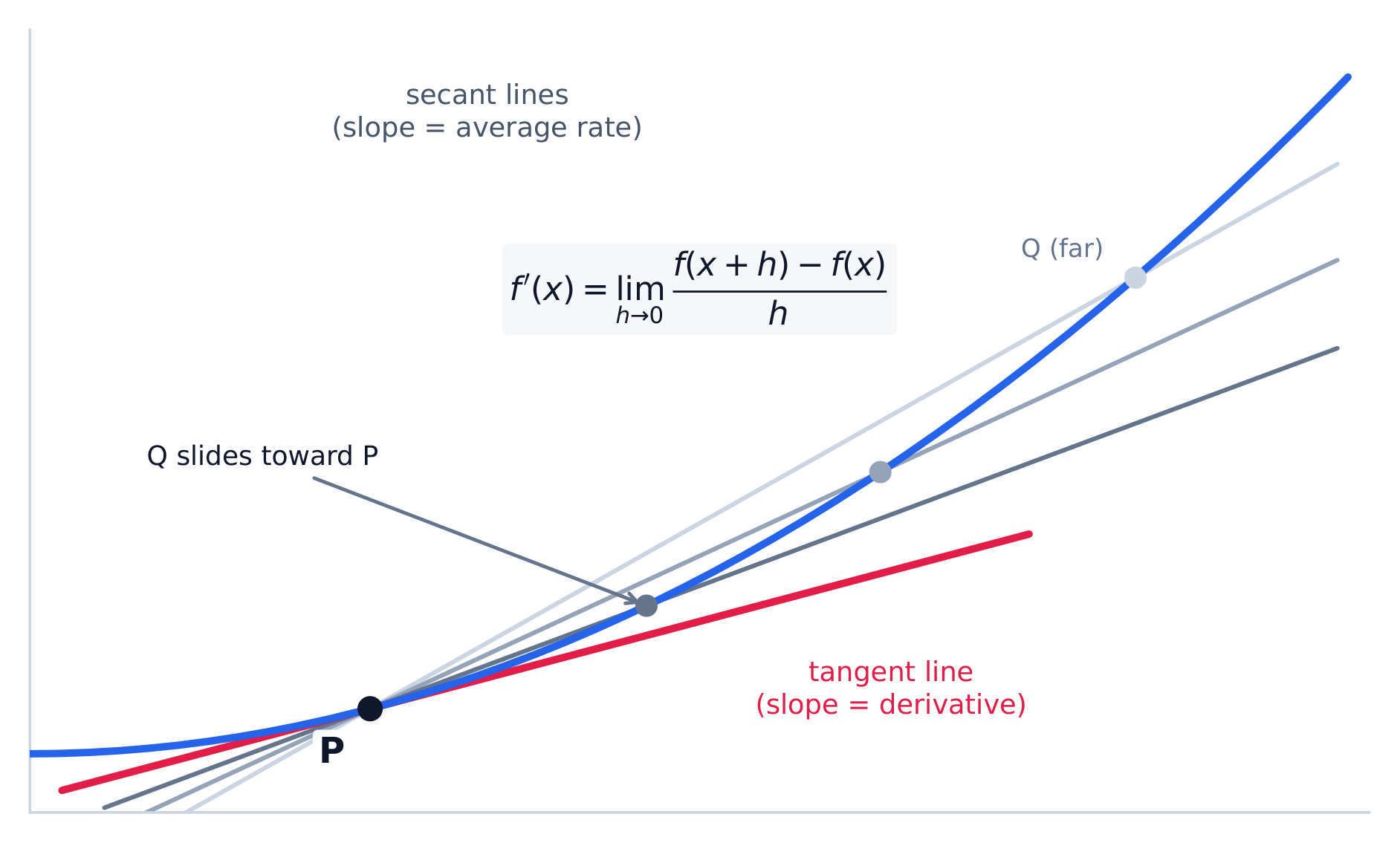
Secant slopes approach the tangent slope: the derivative is the limit of average rates
Secant slopes approach the tangent slope as h shrinks to 0
Which expression is the limit definition of $f'(x)$?
Difficulté 1/5 · 100 pièces + un petit bonus lors de la première réussite aujourd'hui
The derivative is the limit of the difference quotient as $h\to0$.
The "at a point" version
- To find the slope at one specific input $a$, use the alternate form:
-
$$f'(a)=\lim_{x\to a}\frac{f(x)-f(a)}{x-a}$$
- Here $x$ slides toward $a$ instead of a step $h$ shrinking to $0$ — same idea, different bookkeeping.
- Both definitions are just "secant slope, in the limit," so they always agree.
You can compute $f'(x)$ by setting $h=0$ directly in $\dfrac{f(x+h)-f(x)}{h}$.
Difficulté 1/5 · 100 pièces + un petit bonus lors de la première réussite aujourd'hui
That gives $\tfrac00$; you must take the limit after simplifying.
The alternate form $f'(a)=\lim_{x\to a}\dfrac{f(x)-f(a)}{x-a}$ is best described as...
Difficulté 1/5 · 100 pièces + un petit bonus lors de la première réussite aujourd'hui
It is the same tangent slope at $a$, expressed with $x\to a$ instead of $h\to0$.
Reading the notations
- The same derivative wears several outfits — learn to recognize all of them:
- Lagrange: $f'(x)$ (read "$f$ prime of $x$").
- Leibniz: $\dfrac{dy}{dx}$ or $\dfrac{d}{dx}[f(x)]$ — emphasizes "rate of $y$ with respect to $x$."
- All mean the instantaneous rate of change, i.e. the slope of the tangent line at $x$.
The Leibniz notation $\dfrac{dy}{dx}$ means the same thing as $f'(x)$: the ____ of the tangent line.
Difficulté 1/5 · 100 pièces + un petit bonus lors de la première réussite aujourd'hui
Both denote the instantaneous rate of change = tangent slope.
Select tout notations that denote the derivative of $y=f(x)$.
Difficulté 2/5 · 140 pièces + un petit bonus lors de la première réussite aujourd'hui
The first three are all the derivative; $f(x)^{-1}$ is a reciprocal/inverse, not a derivative.
You cannot just plug $h=0$ into $\frac{f(x+h)-f(x)}{h}$ — that gives $\tfrac00$. The derivative is the limit as $h\to0$, which you evaluate by simplifying the difference quotient first (cancel the $h$), then letting $h\to0$. Skipping the limit is the classic mistake.
From the definition, $f(x)=x^2$ gives $f'(x)=2x$. Evaluate $f'(3)$.
Difficulté 2/5 · 140 pièces + un petit bonus lors de la première réussite aujourd'hui
$f'(3)=2\cdot3=6$.
Use the definition to find $f'(x)$ for $f(x)=x^2$.
- $\dfrac{f(x+h)-f(x)}{h}=\dfrac{(x+h)^2-x^2}{h}=\dfrac{x^2+2xh+h^2-x^2}{h}$.
- $=\dfrac{2xh+h^2}{h}=2x+h$ (for $h\neq0$).
- $\displaystyle\lim_{h\to0}(2x+h)=2x$, so $f'(x)=2x$.
Recognising a limit as a derivative
- AP multiple-choice questions often show a limit and ask for its value. Match it to $\displaystyle\lim_{h\to0}\frac{f(a+h)-f(a)}{h}$: find $f$ and $a$, then the answer is $f'(a)$.
- This is usually much faster than working out the limit by algebra.
Spot $f$ and $a$. Find $\displaystyle\lim_{h\to0}\frac{\cos\!\big(\frac{\pi}{3}+h\big)-\frac12}{h}$.
- $\cos\frac{\pi}{3}=\frac12$, so this is the definition with $f(x)=\cos x$ and $a=\frac{\pi}{3}$.
- The limit is $f'\big(\tfrac{\pi}{3}\big)=-\sin\tfrac{\pi}{3}=-\dfrac{\sqrt3}{2}$.
Find the limit as h → 0 of (e^(2 + h) − e²)/h, to 2 decimal places.
Difficulté 2/5 · 140 pièces + un petit bonus lors de la première réussite aujourd'hui
This is f′(2) for f(x) = eˣ, which is e² ≈ 7.39.
The limit as h → 0 of (ln(1 + h) − 0)/h equals which derivative?
Difficulté 1/5 · 100 pièces + un petit bonus lors de la première réussite aujourd'hui
ln 1 = 0, so it is (ln(1 + h) − ln 1)/h → (ln x)′ at x = 1 = 1/1 = 1.
The alternate form. Find $\displaystyle\lim_{x\to2}\frac{x^3-8}{x-2}$.
- $8=2^3$, so this is $\dfrac{f(x)-f(2)}{x-2}$ with $f(x)=x^3$ and $a=2$.
- The limit is $f'(2)=3(2)^2=12$.
Find the limit as x → 9 of (√x − 3)/(x − 9), as a decimal.
Difficulté 2/5 · 140 pièces + un petit bonus lors de la première réussite aujourd'hui
f(x) = √x, a = 9: f′(9) = 1/(2√9) = 1/6 ≈ 0.1667.
The derivative $f'(x)=\lim_{h\to0}\frac{f(x+h)-f(x)}{h}$ (or the point form $f'(a)=\lim_{x\to a}\frac{f(x)-f(a)}{x-a}$) is the limit of a difference quotient — the slope of the tangent line, i.e. the instantaneous rate of change. Write it as $f'(x)$, $\frac{dy}{dx}$, or $\frac{d}{dx}[f(x)]$.