Probabilité
Introduit| English | Sens |
|---|---|
| independent/ˌɪndɪˈpendənt/ | indépendant |
| mutually exclusive/ˈmjuːtʃuːəli eksˈkluːsɪv/ | mutuellement exclusif |
| conditional probability/kənˈdɪʃənl ˌprɒbəˈbɪlɪti/ | probabilité conditionnelle |
| tree diagram/triː ˈdaɪəɡræm/ | diagramme en arbre |
| without replacement/wɪˈðaʊt rɪˈpleɪsmənt/ | sans remise |
| Venn diagram/ven ˈdaɪəɡræm/ | diagramme de Venn |
| two-way table/tuː weɪ ˈteɪbl/ | tableau à double entrée |
The birthday paradox
- In a room of just 23 people, there's a greater than 50% chance that two share a birthday.
- Probability is counterintuitive. The rules are simple, but the results can surprise you.
Combining probabilities
- Addition ("or"): $P(A \cup B) = P(A) + P(B) - P(A \cap B)$.
- Multiplication ("and", if independent 独立): $P(A \cap B) = P(A)\,P(B)$.
- Mutually exclusive 互斥 events can't both happen; independent events don't affect each other.
Worked example. P(rain) = 0.3, P(bus late) = 0.2, independent. P(rain or bus late) = 0.3 + 0.2 − 0.3 × 0.2 = 0.44.
Mutually exclusive ≠ independent. Mutually exclusive means they can't both happen (so $P(A \cap B) = 0$). Independent means one doesn't affect the other (so $P(A \cap B) = P(A) \times P(B)$). These are completely different concepts.
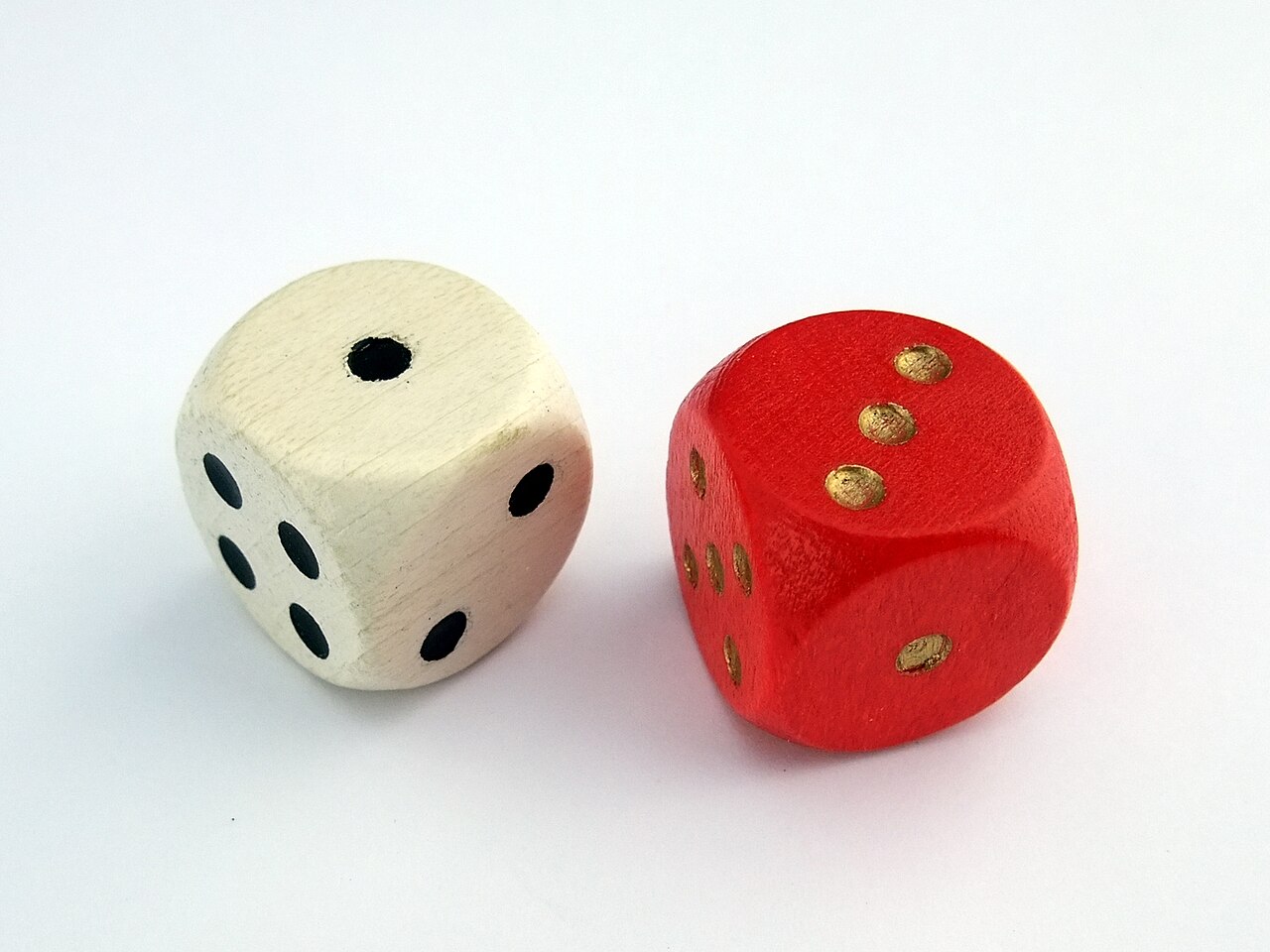
Dice: a starting point for probability
Probabilité conditionnelle
P(A ∩ B) = P(A)·P(B|A)
Le modèle en aire montre comment les probabilités conditionnelles s'associent — et comment Bayes trouve P(A | B).
P(A) = 0.5, P(B) = 0.4 et P(A∩B) = 0.2. A et B sont-ils indépendants ?
Difficulté 1/5 · 100 pièces + un petit bonus lors de la première réussite aujourd'hui
P(A)×P(B) = 0.5 × 0.4 = 0.2, ce qui est égal à P(A∩B), donc ils sont indépendants.
P(A) = 0.5, P(B) = 0.4, P(A∩B) = 0.2. Quelle est P(A∪B) ?
Difficulté 2/5 · 140 pièces + un petit bonus lors de la première réussite aujourd'hui
P(A∪B) = 0.5 + 0.4 − 0.2 = 0.7.
Si A et B sont mutuellement exclusifs, alors P(A∩B) = 0.
Difficulté 1/5 · 100 pièces + un petit bonus lors de la première réussite aujourd'hui
Les événements mutuellement exclusifs ne peuvent pas tous deux se produire, donc leur intersection a une probabilité de 0.
Les événements mutuellement exclusifs sont toujours indépendants.
Difficulté 1/5 · 100 pièces + un petit bonus lors de la première réussite aujourd'hui
Si A et B sont mutuellement exclusifs (et que tous deux ont P > 0), alors P(A∩B) = 0 ≠ P(A)×P(B), donc ils NE sont PAS indépendants.
Conditional probability 条件概率
- Conditional: the chance of $A$ given $B$ has happened:
- Independence test: check whether $P(A \cap B) = P(A)\times P(B)$.
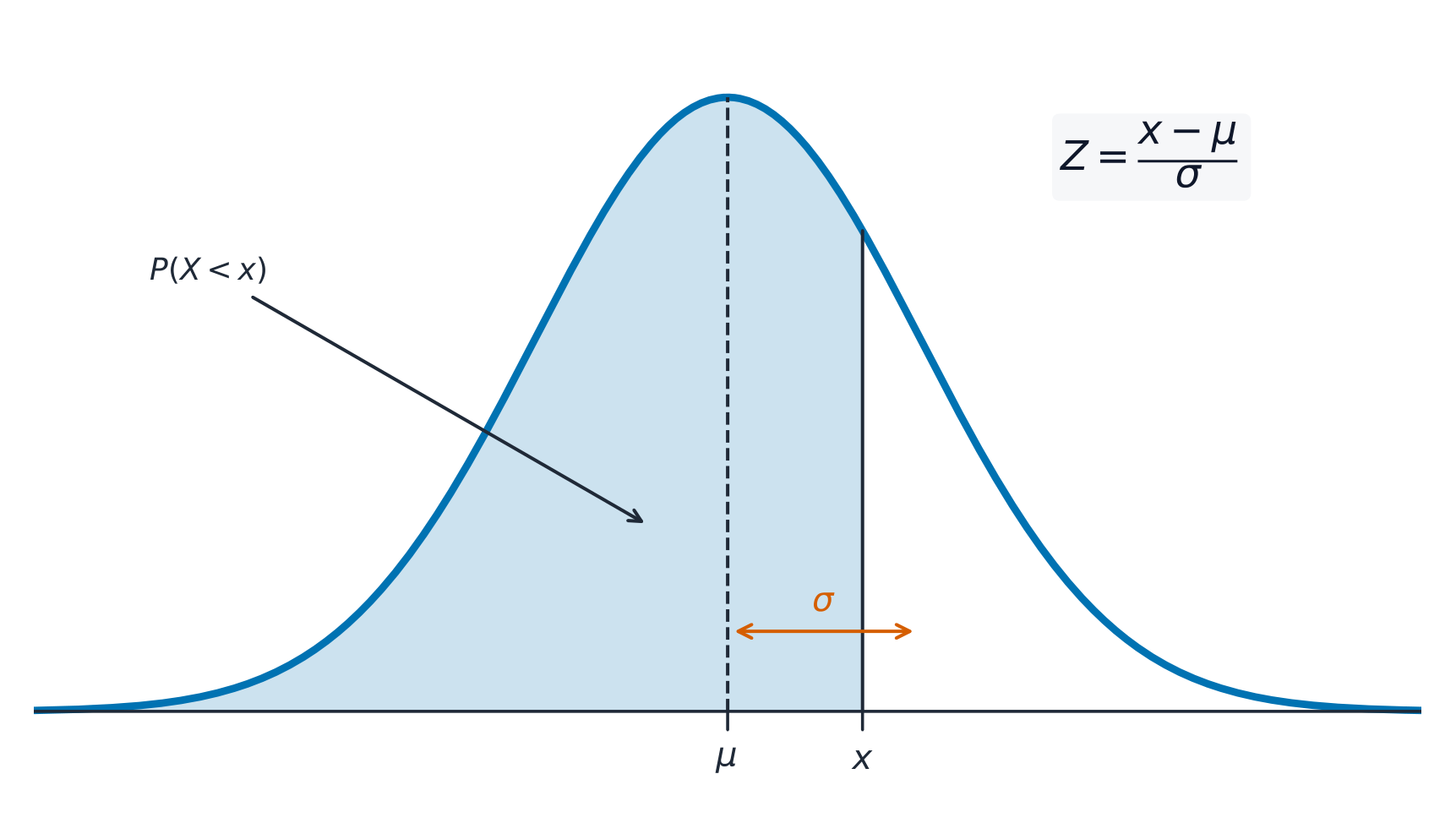
The normal curve: a probability is the area under it, centred on the mean
P(A∩B) = 0.2 et P(B) = 0.4. Quelle est P(A | B) ?
Difficulté 2/5 · 140 pièces + un petit bonus lors de la première réussite aujourd'hui
P(A|B) = P(A∩B)/P(B) = 0.2/0.4 = 0.5.
Worked example — tree diagrams 树状图
- A bag has 3 red and 2 blue balls. Two are drawn without replacement 不放回.
- P(both red) = $\dfrac{3}{5} \times \dfrac{2}{4} = \dfrac{6}{20} = 0.3$.
- P(one of each) = $\dfrac{3}{5} \times \dfrac{2}{4} + \dfrac{2}{5} \times \dfrac{3}{4} = \dfrac{6}{20} + \dfrac{6}{20} = 0.6$.
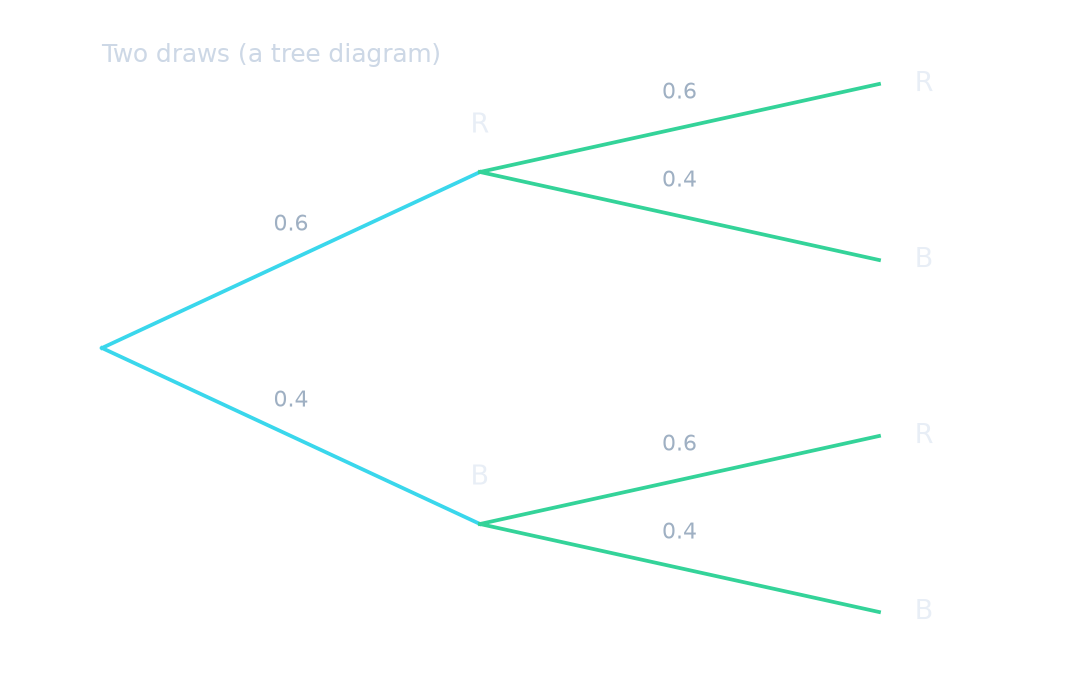
On a tree diagram, multiply probabilities along the branches, then add the paths you want.
Un sac contient 3 rouges et 2 bleus. Deux tirages sans remise. P(les deux rouges) = (3/5)(2/4). Calculez-le.
Difficulté 2/5 · 140 pièces + un petit bonus lors de la première réussite aujourd'hui
(3/5) × (2/4) = 6/20 = 0.3.
Un sac contient 3 rouges et 2 bleus, tirés sans remise. Rangez les étapes pour P(les deux rouges) par ordre.
Difficulté 3/5 · 200 pièces + un petit bonus lors de la première réussite aujourd'hui
Sur un arbre, multipliez les probabilités le long de la branche choisie, puis simplifiez.
Venn diagrams 韦恩图 and two-way tables 双向表
- Venn diagrams show overlapping events visually — the intersection is $A \cap B$.
- Two-way tables organise data by two categories — read conditional probabilities from the relevant row or column.
- Count arrangements with permutations (order matters) and combinations (order does not).
You've got it
- addition (or): $P(A\cup B) = P(A) + P(B) - P(A\cap B)$
- multiplication (and, independent): $P(A\cap B) = P(A)P(B)$
- conditional: $P(A\mid B) = \dfrac{P(A\cap B)}{P(B)}$; test independence with $P(A\cap B) = P(A)P(B)$
Write from the data: find the probability
- P(A) = 0.4 and P(B) = 0.25, and the events are independent.
- Find P(A or B).
P(A) est 0.4, P(B) est 0.25, et les événements sont indépendants. Quelle est P(A ou B) ?
0.65 moins 0.1 est 0.55.
Quelle est P(A ou B) ?
Difficulté 1/5 · 100 pièces + un petit bonus lors de la première réussite aujourd'hui
0.4 plus 0.25 moins 0.1 est 0.55.