Vecteurs
Introduit| English | Sens |
|---|---|
| vector/ˈvektə/ | vecteur |
| magnitude/ˈmæɡnɪtjuːd/ | module |
| unit vector/ˈjuːnɪt ˈvektə/ | vecteur unitaire |
| parallel/ˈpærəlel/ | parallèle |
| intersect/ˌɪntəˈsekt/ | intersection |
| skew/skjuː/ | gauche |
| perpendicular/ˌpɜːpənˈdɪkjʊlə/ | perpendiculaire |
| scalar product/ˈskeɪlə ˈprɒdʌkt/ | produit scalaire |
Navigating in 3D
- GPS satellites track your position in three dimensions. Aircraft navigate using heading, pitch, and roll.
- Vectors 向量 are the mathematics of direction and magnitude 模长 in space — essential for physics, engineering, and computer graphics.
Vectors in 3D
- A vector has size and direction: $\mathbf{v} = x\mathbf{i} + y\mathbf{j} + z\mathbf{k}$.
- Magnitude $|\mathbf{v}| = \sqrt{x^2 + y^2 + z^2}$; a unit vector 单位向量 has magnitude 1.
Worked example. $\mathbf{v} = 3\mathbf{i} + 4\mathbf{j}$. Magnitude $= \sqrt{9 + 16} = 5$. Unit vector $= \dfrac{1}{5}(3\mathbf{i} + 4\mathbf{j})$.
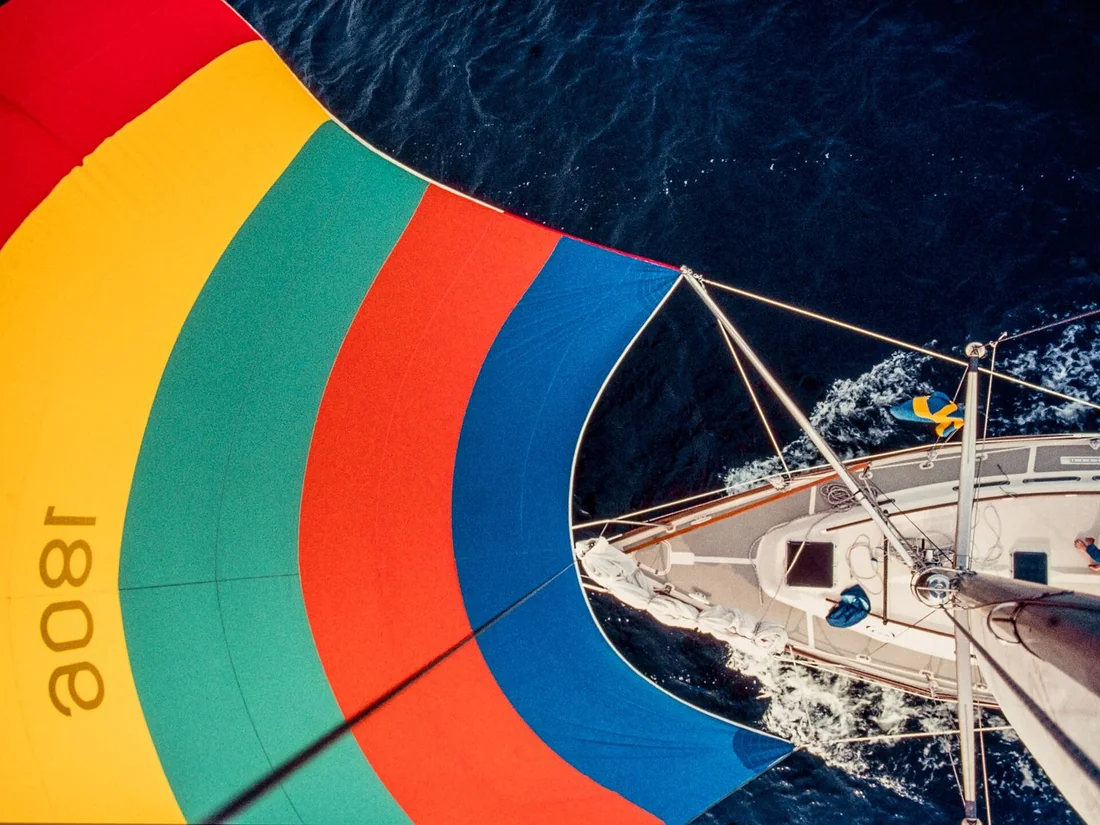
Forces like wind and water are vectors, with size and direction
Quelle est la norme du vecteur i + 2j + 2k ?
Difficulté 2/5 · 140 pièces + un petit bonus lors de la première réussite aujourd'hui
|v| = √(1² + 2² + 2²) = √(1+4+4) = √9 = 3.
Vector equations of lines
- A line through point $\mathbf{a}$ in direction $\mathbf{b}$: $\mathbf{r} = \mathbf{a} + t\mathbf{b}$.
- Lines may be parallel 平行 (same direction), intersect 相交 (share a point), or be skew 异面 (neither).
Skew lines don't intersect and aren't parallel. In 3D, two lines can miss each other entirely — they're not in the same plane. This is impossible in 2D.
Le produit scalaire
a · b = |a||b|cos θ
Le produit scalaire mesure dans quelle mesure deux vecteurs pointent dans la même direction — il est nul lorsqu'ils sont perpendiculaires.
L'équation vectorielle d'une droite passant par le point a dans la direction b est :
Difficulté 1/5 · 100 pièces + un petit bonus lors de la première réussite aujourd'hui
r = a + tb, où t est un paramètre scalaire.
En 3D, deux droites qui ne se coupent pas doivent être parallèles.
Difficulté 1/5 · 100 pièces + un petit bonus lors de la première réussite aujourd'hui
En 3D, les droites peuvent être gauches — ni parallèles ni sécantes. Cela est impossible en 2D.
The scalar (dot) product
- So $\mathbf{a}\cdot\mathbf{b} = 0$ means the vectors are perpendicular 垂直.
- Use it to find the angle between two vectors: $\cos\theta = \dfrac{\mathbf{a}\cdot\mathbf{b}}{|\mathbf{a}||\mathbf{b}|}$.

The scalar product 数量积 gives the angle: a·b = |a||b|cos θ, so cos θ = (a·b)/(|a||b|).
Trouvez le produit scalaire (i + 2j + 2k)·(2i + 2j + k).
Difficulté 2/5 · 140 pièces + un petit bonus lors de la première réussite aujourd'hui
(1)(2) + (2)(2) + (2)(1) = 2 + 4 + 2 = 8.
Si a·b = 0, les deux vecteurs sont perpendiculaires.
Difficulté 1/5 · 100 pièces + un petit bonus lors de la première réussite aujourd'hui
cos θ = 0 donne θ = 90°, donc un produit scalaire nul signifie que les vecteurs sont perpendiculaires.
Si a·b = 6, |a| = 3, |b| = 4, quelle est la valeur de cos θ ?
Difficulté 2/5 · 140 pièces + un petit bonus lors de la première réussite aujourd'hui
cos θ = (a·b)/(|a||b|) = 6/(3×4) = 6/12 = 0,5.
Worked example — angle between vectors
-
$\mathbf{a} = \mathbf{i} + 2\mathbf{j} + 2\mathbf{k}$, $\mathbf{b} = 2\mathbf{i} + \mathbf{j} - 2\mathbf{k}$.
-
$\mathbf{a}\cdot\mathbf{b} = 2 + 2 - 4 = 0$. So $\mathbf{a}$ and $\mathbf{b}$ are perpendicular ($\theta = 90^{\circ}$).
-
Use position vectors and displacement vectors, and unit vectors; the ratio theorem divides a line in a given ratio.
You've got it
- magnitude $|\mathbf{v}| = \sqrt{x^2+y^2+z^2}$; line: $\mathbf{r} = \mathbf{a} + t\mathbf{b}$
- scalar product $\mathbf{a}\cdot\mathbf{b} = a_1b_1 + a_2b_2 + a_3b_3 = |\mathbf a||\mathbf b|\cos\theta$
- $\mathbf{a}\cdot\mathbf{b} = 0$ → perpendicular
Write from the data: find the magnitude
- The vector is 5 i plus 12 j.
- Find its magnitude.
Trouvez la norme du vecteur 5 i + 12 j.
5² + 12² = 169, ce qui correspond à 13².
Quelle est la grandeur ?
Difficulté 1/5 · 100 pièces + un petit bonus lors de la première réussite aujourd'hui
La racine carrée de 169 est 13.