Revenue and profit · Revenu et profit
| English | Français |
|---|---|
| profit/ˈprɒfɪt/ | bénéfice |
| marginal revenue/ˈmɑːdʒɪnl ˈrevənjuː/ | revenu marginal |
| total revenue/ˈtəʊtl ˈrevənjuː/ | revenu total |
| average revenue/ˈævrɪdʒ ˈrevənjuː/ | revenu moyen |
| normal profit/ˈnɔːml ˈprɒfɪt/ | profit normal |
| supernormal profit/ˈsuːpənɔːml ˈprɒfɪt/ | profits anormaux |
| profit-maximising/ˈprɒfɪt ˈmæksɪmaɪzɪŋ/ | maximisation du profit |
Revenue isn't profit 利润
- A firm selling a million units can still go bust. What matters isn't how much money comes in, but how much is left after costs.
- Understanding revenue, then subtracting cost, gives profit — and the rule for maximising it.
Le chiffre d'affaires n'est pas le profit 利润
- Une entreprise vendant un million d'unités peut toujours faire faillite. Ce qui importe n'est pas combien d'argent rentre, mais combien reste après les coûts.
- Comprendre le chiffre d'affaires, puis soustraire les coûts, donne le profit — et la règle pour le maximiser.
A firm sells 30 units at a price of 5. What is total revenue (TR = P x Q)? · Une entreprise vend 30 unités à un prix de 5. Quel est le revenu total (RT = P x Q) ?
TR = 5 x 30 = 150. · RT = 5 x 30 = 150.
Average revenue (TR divided by quantity) is the same as the ______. · Le revenu moyen (RT divisé par la quantité) est le même que le ______.
AR = TR/Q = P. · RM = RT/Q = P.
Total, average and marginal revenue 边际收益
- Total revenue 总收益 (TR) = price × quantity.
- Average revenue 平均收益 (AR) = TR ÷ Q = the price.
- Marginal revenue (MR) = the revenue from one more unit.
For a price-maker, AR is the demand curve and MR lies below it; for a price-taker both are horizontal.
Worked example. Sell 30 units at a price of 5. TR = 5 × 30 = 150. If total cost is 100, profit = 150 − 100 = 50.
Revenu total, moyen et marginal 边际收益
- Revenu total 总收益 (TR) = prix × quantité.
- Revenu moyen 平均收益 (AR) = TR ÷ Q = le prix.
- Revenu marginal (MR) = le revenu généré par une unité supplémentaire.
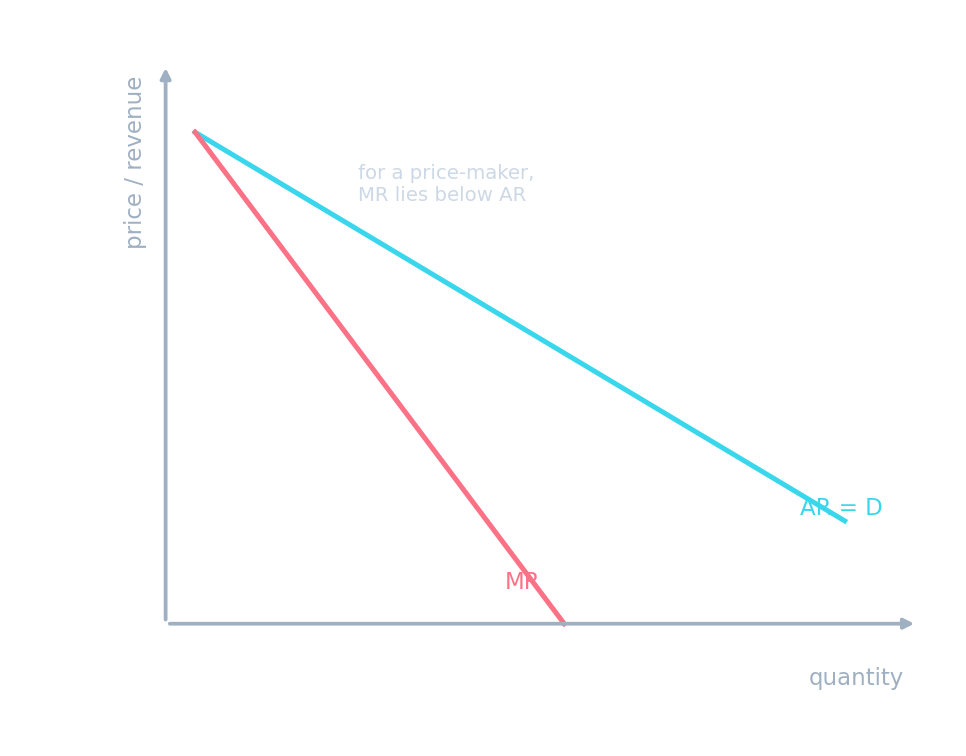
Pour un fixateur de prix, AR est la courbe de demande et MR est en dessous ; pour un accepteur de prix, les deux sont horizontales.
Exemple résolu. Vendre 30 unités à un prix de 5. TR = 5 × 30 = 150. Si le coût total est de 100, le profit = 150 − 100 = 50.
Revenue & profit · Revenu & profit
y = ax² + bx + c
Total revenue · Revenu total rises then falls as price changes. · Le revenu total augmente puis diminue lorsque le prix change.
Total revenue is 150 and total cost is 100. What is the profit? · Le revenu total est de 150 et le coût total est de 100. Quel est le profit ?
Profit = TR - TC = 150 - 100 = 50. · Profit = RT - CT = 150 - 100 = 50.
Normal profit is the minimum needed to keep a firm in the industry. · Le profit normal est le minimum nécessaire pour maintenir une entreprise dans l'industrie.
It covers opportunity cost; anything above is supernormal profit. · Il couvre le coût d'opportunité ; tout ce qui dépasse est un profit anormal.
Profit and its types
- Profit = total revenue − total cost.
- Normal profit 正常利润: just enough to keep the firm in the industry (covers opportunity cost).
- Supernormal (abnormal) profit: anything above normal.
A monopoly maximises profit at MC = MR and earns supernormal profit 超常利润
Le profit et ses types
- Profit = revenu total − coût total.
- Profit normal 正常利润 : juste assez pour maintenir l'entreprise dans la branche (couvre le coût d'opportunité).
- Profit anormal (supernormal) : tout ce qui dépasse le profit normal.
Un monopole maximise son profit à MC = MR et réalise un profit anormal 超常利润
A firm maximises profit where: · Une entreprise maximise son profit où :
MR = MC: before it each unit adds net profit, beyond it each unit loses money. · RM = CM : avant cela, chaque unité ajoute un profit net, au-delà, chaque unité perd de l'argent.
The profit-maximising 利润最大化 rule
- A firm maximises profit where marginal revenue = marginal cost (MR = MC).
- Before that point, an extra unit adds more revenue than cost (make it); beyond it, the reverse.
La règle de maximisation du profit 利润最大化
- Une entreprise maximise son profit lorsque le revenu marginal = coût marginal (MR = MC).
- Avant ce point, une unité supplémentaire rapporte plus qu'elle ne coûte (la produire) ; après, c'est l'inverse.
You've got it
- TR = P × Q; AR = price; MR = revenue from one more unit
- profit = TR − TC; normal profit keeps the firm in; supernormal is extra
- maximise profit where MR = MC
Vous avez compris
- TR = P × Q ; AR = prix ; MR = revenu d'une unité supplémentaire
- profit = TR − TC ; normal maintient l'entreprise en place ; supernormal est le surplus
- Maximiser le profit là où MR = MC