Price controls, regulation and government failure
Introduit| English | Sens |
|---|---|
| shortage/ˈʃɔːtɪdʒ/ | pénurie |
| surplus/ˈsɜːpləs/ | excédent |
| price ceiling/praɪs ˈsiːlɪŋ/ | plafonnement des prix |
| price floor/praɪs flɔː/ | plancher des prix |
| government failure/ˈɡʌvənmənt ˈfeɪlɪə/ | échec de l'État |
| unintended consequences/ˌʌnɪnˈtendɪd ˈkɒnsɪkwənsɪz/ | conséquences involontaires |
Stockholm's 20-year queue
- Stockholm has controlled rents for decades. Rents for controlled flats are well below what the market would charge, so demand far exceeds supply: in central districts, people on the city's housing queue have often waited 20 years or more for a contract. Many rent second-hand at much higher prices instead.
- Governments sometimes set prices directly, or make rules that limit what firms may do. These tools can help some groups, but they can also cause shortages 短缺, surpluses 过剩 and new problems.
Maximum price (price ceiling)
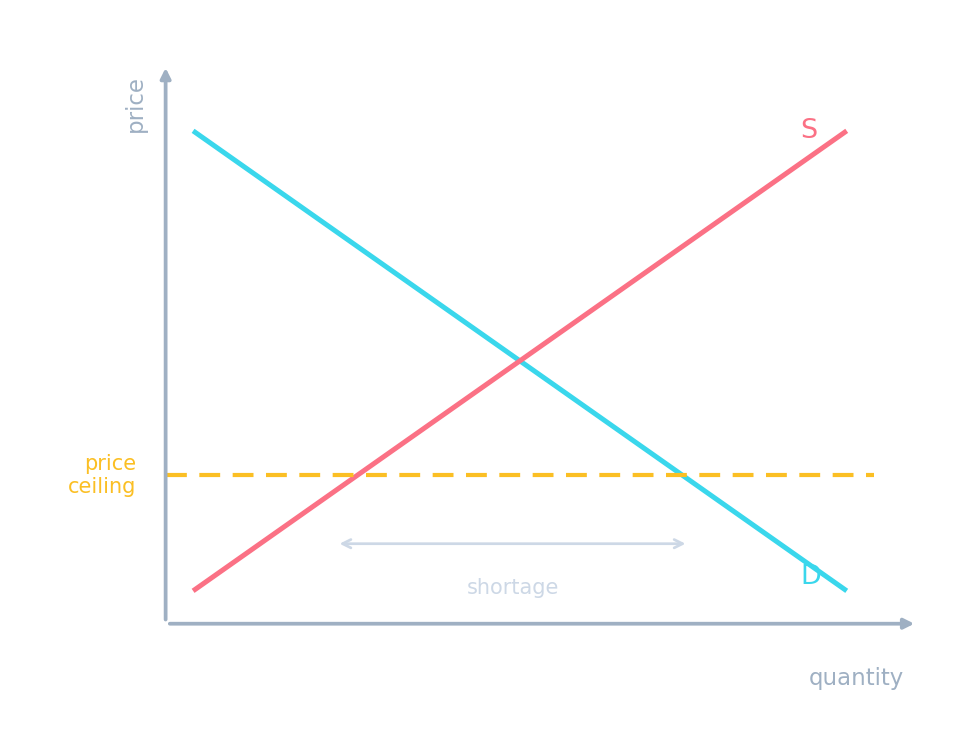
- A price ceiling 价格上限 is a legal maximum price. It only has an effect if set below equilibrium. Then quantity demanded is greater than quantity supplied: a shortage.
- Examples: rent control; caps on energy or food prices. Side effects: queues, black markets, rationing by who you know, falling quality as sellers cut costs.
Price controls
A price set away from equilibrium causes a shortage or a excédent.
A maximum price below equilibrium
The equilibrium price is 20. A maximum price of 14 raises quantity demanded and cuts quantity supplied, so a shortage opens and only the smaller quantity is traded. The straight-line curves here are illustrative. A maximum set above 20 changes nothing.
The equilibrium price is 20 and the government sets a maximum price of 14. What happens?
Difficulté 1/5 · 100 pièces + un petit bonus lors de la première réussite aujourd'hui
A ceiling below equilibrium binds and causes a shortage.
At the maximum price, quantity demanded is 900 and quantity supplied is 600. How large is the shortage?
Difficulté 2/5 · 140 pièces + un petit bonus lors de la première réussite aujourd'hui
900 − 600 = 300.
Minimum price (price floor)
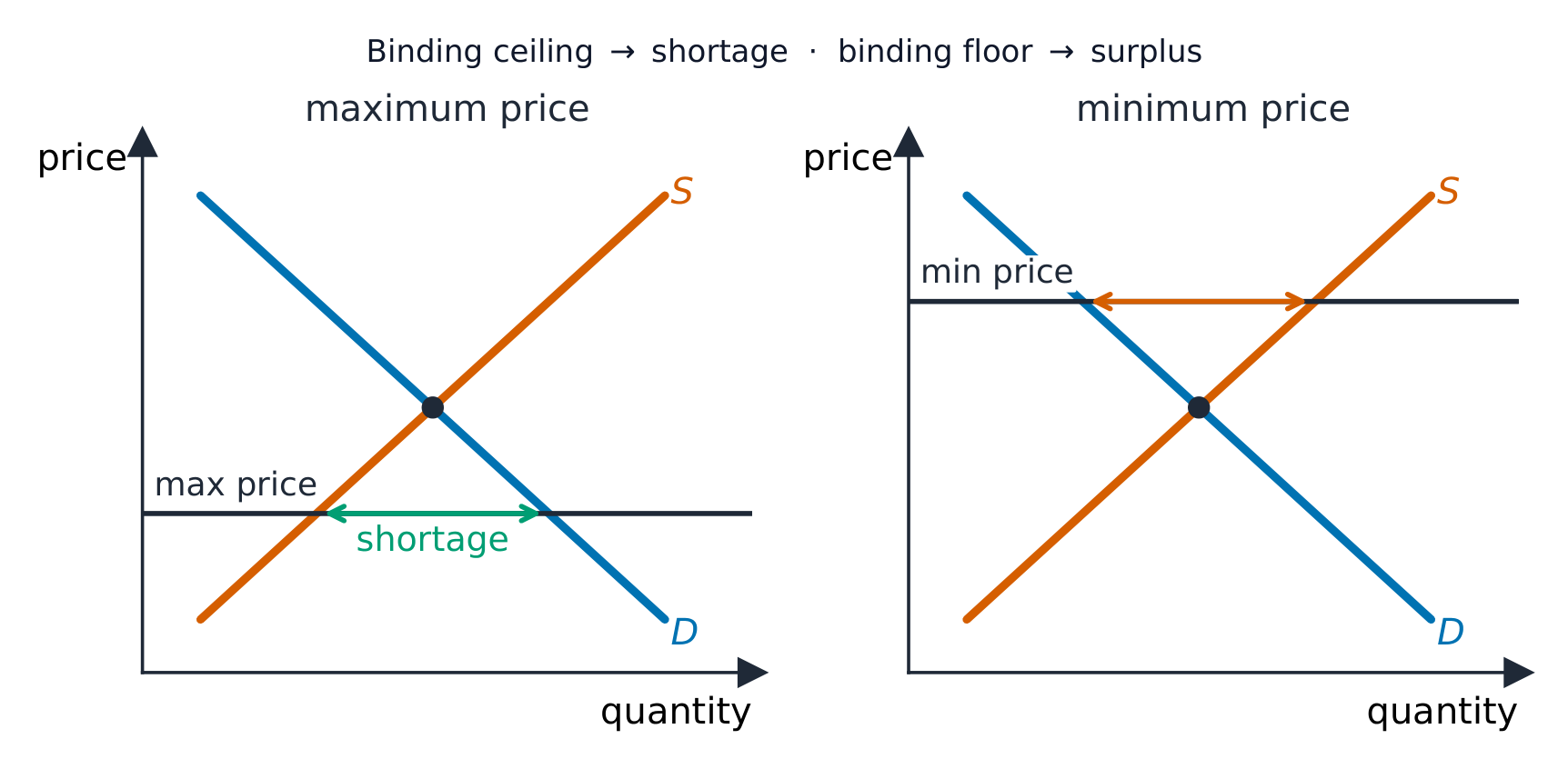
- A price floor 价格下限 is a legal minimum price. It only has an effect if set above equilibrium. Then quantity supplied is greater than quantity demanded: a surplus.
- Examples: a minimum wage (a possible surplus of labour, i.e. unemployment); minimum prices for farm goods, where the government may have to buy and store the surplus; a minimum price per unit of alcohol (Scotland, 2018) to cut heavy drinking.
Match each policy to its likely result.
Difficulté 2/5 · 140 pièces + un petit bonus lors de la première réussite aujourd'hui
Floors cause surpluses; ceilings cause shortages.
Regulation
- Regulation means rules that limit or require certain behaviour, backed by penalties: bans (smoking indoors), limits (emissions standards), required standards (food safety), and rules on information (health warnings, nutrition labels).
- Strengths: simple to understand, and can act quickly against serious harm. Weaknesses: firms may find ways around the rules; checking and enforcement cost money; a rule may be set too strict or too loose because the government lacks full information.
Which are forms of regulation?
Difficulté 2/5 · 140 pièces + un petit bonus lors de la première réussite aujourd'hui
A subsidy is a payment, not a rule.
Government failure
| Cause of government failure 政府失灵 | Example |
|---|---|
| Information gaps | a minimum wage set too high, so firms hire fewer young workers |
| Unintended consequences 意外后果 | rent control leads landlords to stop maintaining or building flats |
| Administrative and enforcement costs | inspectors, paperwork, court cases |
| Political pressure | farm price support kept for decades because farmers vote |
- Government failure occurs when intervention makes the allocation of resources worse than before.
Government failure means intervention leaves the allocation of resources worse than before.
Difficulté 1/5 · 100 pièces + un petit bonus lors de la première réussite aujourd'hui
Causes include information gaps, unintended consequences and costs.
Worked exam answer
In a city, the market rent is £1,200 a month and 50,000 flats are let. The council caps rent at £900. At £900, 70,000 households want flats but landlords offer only 40,000. Analyse the effects. [8]
The cap is below equilibrium, so it binds. Quantity demanded is 70,000 but quantity supplied is only 40,000: a shortage of 30,000 flats. Fewer flats are let than before (40,000 instead of 50,000), as some landlords sell or leave the market. Tenants who find a flat pay £300 a month less, but others cannot find one; some pay illegal extra fees (a black market). Landlords earn less, so they spend less on repairs, and fewer new flats are built, which makes the shortage worse over time. This is an unintended consequence and a form of government failure.
- Why it scores: uses the data (shortage, fall in quantity), explains winners and losers, and traces the long-run consequence (AO2 with some AO3).
Ceiling = maximum, below equilibrium → shortage. Floor = minimum, above equilibrium → surplus. A ceiling set above equilibrium, or a floor set below it, has no effect.
A maximum price set above the equilibrium price causes a shortage.
Difficulté 1/5 · 100 pièces + un petit bonus lors de la première réussite aujourd'hui
It does not bind, so the market stays at equilibrium.
A price ceiling below equilibrium causes a shortage, with queues, black markets and lower quality. A price floor above equilibrium causes a surplus, such as unemployment or unsold farm goods. Regulation sets rules backed by penalties. Government failure happens when intervention worsens the allocation, through information gaps, unintended consequences, costs or political pressure.
Essay practice. Assess whether a national minimum wage is a good way to reduce poverty. [12]
The level of the floor decides the outcome.