Demande
Introduit| English | Sens |
|---|---|
| law of demand/lɔː ɒv dɪˈmænd/ | loi de la demande |
| demand/dɪˈmænd/ | demande |
| quantity demanded/ˈkwɒntɪti dɪˈmændɪd/ | quantité demandée |
| normal goods/ˈnɔːml ɡʊdz/ | biens normaux |
| substitutes/ˈsʌbstɪtjuːts/ | substituts |
| complements/ˈkɒmplɪmənts/ | compléments |
Why queues form on Black Friday
- Cut a price and crowds appear; raise it and they melt away. That predictable response is the law of demand 需求定律.
- Demand 需求 is the foundation of every market. Understanding it lets you predict how buyers react to price, income, fashion and the prices of other goods.
The law of demand
- Demand is the quantity buyers are willing and able to buy at each price in a given time period. "Able" matters: wanting a car you cannot afford is not demand. Economists call this effective demand.
- The law of demand: as price rises, quantity demanded 需求量 falls, other things equal, so the demand curve slopes downward.
Demande & offre
Demande slopes down — a lower price, more is wanted.
A student who wants a 2,000-pound laptop but has no money is part of the demand for laptops.
Difficulté 1/5 · 100 pièces + un petit bonus lors de la première réussite aujourd'hui
Demand must be effective, backed by the ability to pay.
Why the curve slopes down
- Substitution effect: when a good's price rises, it becomes dearer compared with other goods, so buyers switch to substitutes. Income effect: a higher price reduces what your income can buy, so you buy less of most goods.
- Diminishing marginal utility: each extra unit gives less satisfaction than the one before, so buyers will only buy more if the price falls. Market demand is the sum of all individual demands at each price.
Match each reason the demand curve slopes down to its meaning.
Difficulté 2/5 · 140 pièces + un petit bonus lors de la première réussite aujourd'hui
All three explain a movement along the curve.
Movement along vs shift of the curve
- A change in the good's own price → a movement along the curve: an extension (price falls, more bought) or a contraction (price rises, less bought).
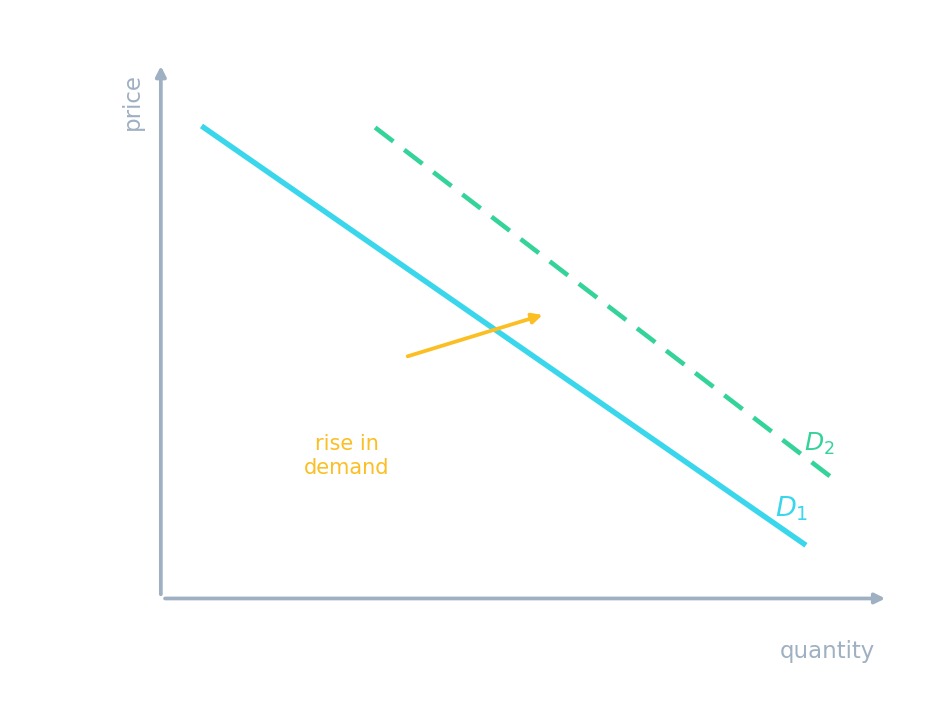
- A change in anything else → a shift of the whole curve: an increase (right) or a decrease (left) in demand.
The price of tea rises from 2 to 3 and quantity demanded falls from 40 to 30 cups. How is this shown?
Difficulté 1/5 · 100 pièces + un petit bonus lors de la première réussite aujourd'hui
An own-price change is a movement along the curve; a price rise gives a contraction.
What shifts demand
| Factor | Example | Shift |
|---|---|---|
| Income | incomes rise | right for normal goods 正常品; left for inferior goods (bus travel, own-brand food) |
| Price of a substitute 替代品 | Pepsi's price rises | Coke demand right |
| Price of a complement 互补品 | printer prices fall | ink demand right |
| Tastes and fashion | a health campaign against sugar | fizzy drinks demand left |
| Population and age structure | more elderly people | care-home demand right |
| Expectations | buyers expect prices to rise next month | demand right now |
Match each event to its effect on demand for cinema tickets.
Difficulté 2/5 · 140 pièces + un petit bonus lors de la première réussite aujourd'hui
Only the ticket's own price moves along the curve.
Incomes rise and demand for bus travel falls. What type of good is bus travel here?
Difficulté 1/5 · 100 pièces + un petit bonus lors de la première réussite aujourd'hui
Demand for an inferior good falls as income rises, because people switch to cars and taxis.
Worked example: a demand schedule shifts
At prices of £4, £3 and £2, students buy 100, 140 and 180 coffees a day. A rival café raises its prices. Explain what happens, and contrast it with this café cutting its own price from £4 to £3.
- The rival's coffee is a substitute that has become dearer, so at every price more students buy here, for example 130, 170 and 210: the demand curve shifts right (an increase in demand).
- Cutting its own price from £4 to £3 raises quantity demanded from 100 to 140: a movement along the original curve (an extension of demand), not a shift.
This distinction wins marks. Only the good's own price moves you along the curve. Income, tastes and other goods' prices shift it. Writing "the price fell so demand increased" is the classic error: it is quantity demanded that increased.
Demand is what buyers are willing and able to buy. Law of demand: price up → quantity demanded down, because of the substitution and income effects and diminishing marginal utility. Own-price change = movement along (extension or contraction); anything else = shift (increase or decrease): income, substitutes, complements, tastes, population, expectations.
Using a demand diagram, explain the effect on the demand for electric cars of (a) a fall in the price of electric cars and (b) a fall in the price of electricity.
Own price moves along; other factors shift.