Break-even analysis
Introduit| English | Sens |
|---|---|
| break-even point/breɪk ˈiːvən pɔɪnt/ | point d'équilibre |
| contribution/ˌkɒntrɪˈbjuːʃn/ | marge contributive |
| variable cost/ˈveərɪəbl kɒst/ | A cost that rises with each unit made or sold, such as materials. |
| fixed costs/fɪkst kɒsts/ | coûts fixes |
| break-even output/breɪk ˈiːvən ˈaʊtpʊt/ | quantité d'équilibre |
| total revenue/ˈtəʊtl ˈrevənjuː/ | chiffre d'affaires total |
| margin of safety/ˈmɑːdʒɪn ɒv ˈseɪfti/ | marge de sécurité |
| target profit | The profit a firm aims for; output needed = (fixed costs + target profit) ÷ contribution per unit. |
When does a new café stop losing money?
- Lina opens a café. Rent, salaries and insurance cost $4,000 a month, even if she sells nothing. Each cup sells for $20 and its coffee, milk and cup cost $12.
- In her first months she makes a loss. How many cups must she sell each month before the café stops losing money? That level of sales is the break-even point 盈亏平衡点.
Contribution 贡献: what each sale adds
- Contribution per unit = selling price − variable cost 可变成本 per unit. For Lina: 20 − 12 = $8 a cup.
- Each cup "contributes" $8 towards paying the fixed costs 固定成本. Once fixed costs are paid, every further $8 is profit.
Total contribution = contribution per unit × units sold. Profit = total contribution − fixed costs. At 400 cups: 400 × 8 = $3,200 contribution, so profit = 3,200 − 4,000 = −$800 (a loss).
Selling price is 15 and variable cost per unit is 9. What is the contribution per unit?
Difficulté 2/5 · 140 pièces + un petit bonus lors de la première réussite aujourd'hui
Contribution = 15 − 9 = 6.
Selling price minus variable cost per unit gives the ______ per unit.
Difficulté 1/5 · 100 pièces + un petit bonus lors de la première réussite aujourd'hui
Contribution covers fixed costs, then becomes profit.
The break-even output
- Break-even output 盈亏平衡产量 = fixed costs ÷ contribution per unit.
- At this output total revenue 总收入 = total cost: no profit and no loss.
Worked example: Lina's café
- Contribution per cup = 20 − 12 = $8.
- Break-even output = 4,000 ÷ 8 = 500 cups a month.
- Check: revenue = 500 × 20 = 10,000 and total cost = 4,000 + 500 × 12 = 10,000. They are equal.
- Break-even revenue = 500 × $20 = $10,000 a month.
- Always give the unit ("500 cups a month"). If the answer is not a whole number, round up: 312.5 units means 313 must be sold.
Fixed costs are 3,000 and contribution per unit is 6. What is the break-even output (units)?
Difficulté 2/5 · 140 pièces + un petit bonus lors de la première réussite aujourd'hui
Break-even = 3000 ÷ 6 = 500 units.
Reading a break-even chart
- Fixed costs (FC) are a flat line. Total costs (TC) start at FC and rise by the variable cost per unit. Total revenue (TR) starts at zero and rises by the price.
- Where TR crosses TC is the break-even point. Left of it, TC is above TR: a loss. Right of it, TR is above TC: a profit.
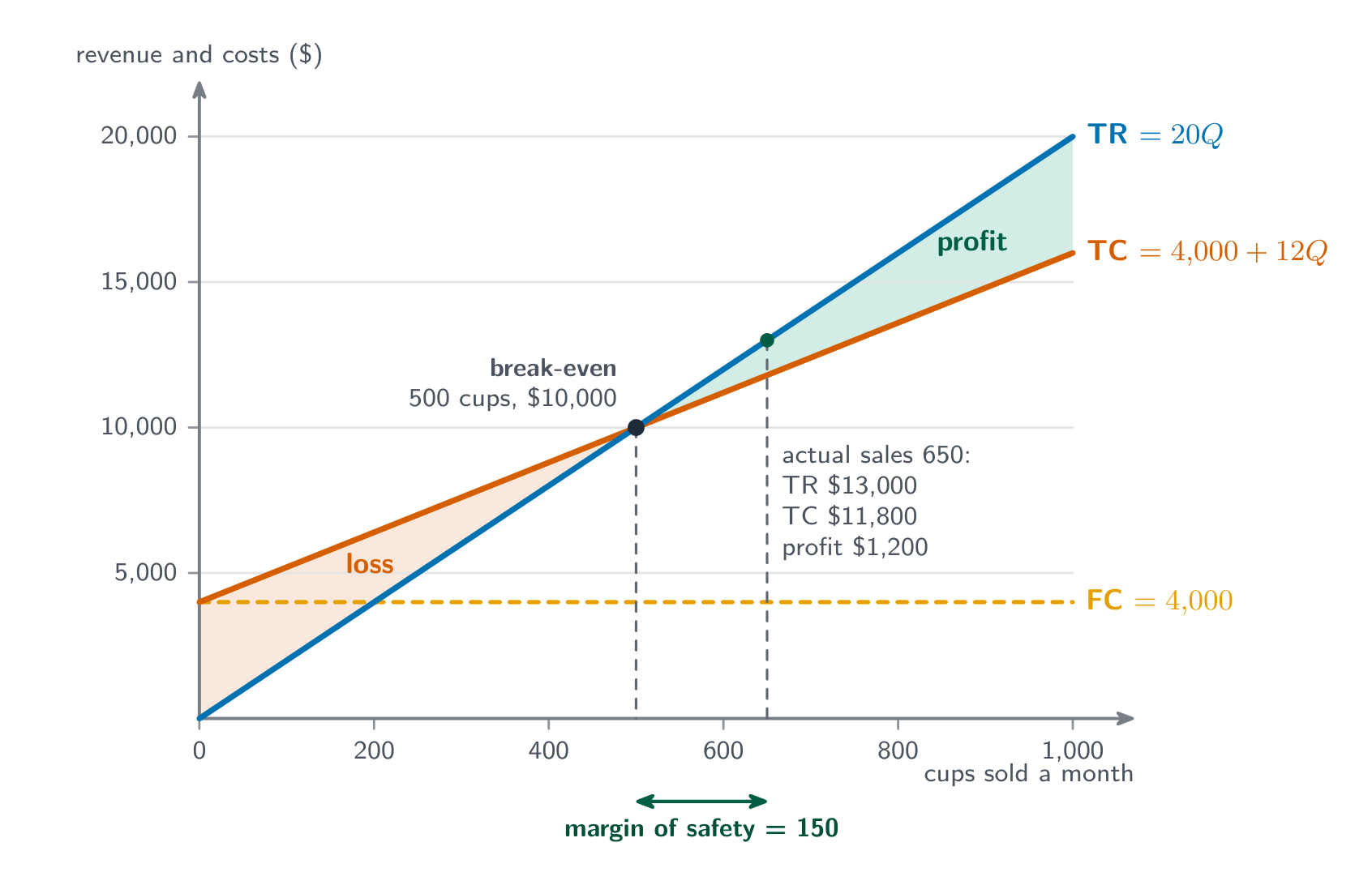
- The vertical gap between TR and TC is the profit or loss at that output: at 650 cups, 13,000 − 11,800 = $1,200 profit.
Test the assumptions behind break-even
$Q_{BE}=\frac{F}{p-v};\quad \pi=(p-v)Q-F$
Changing sales volume changes profit while fixed costs remain. The starting values match the lesson example.
At the break-even point, the business makes:
Difficulté 1/5 · 100 pièces + un petit bonus lors de la première réussite aujourd'hui
Revenue exactly equals total cost — no profit, no loss.
Margin of safety 安全边际
- Margin of safety = actual output − break-even output. It shows how far sales can fall before the firm makes a loss.
- As a percentage: margin of safety ÷ actual output × 100. This lets you compare firms of different sizes.
Lina sells 650 cups a month.
- Margin of safety = 650 − 500 = 150 cups.
- As a percentage = 150 ÷ 650 × 100 = 23%. Sales could fall by almost a quarter before she makes a loss.
- In revenue: 150 × $20 = $3,000.
Break-even output is 400 and the firm sells 520. What is the margin of safety (units)?
Difficulté 2/5 · 140 pièces + un petit bonus lors de la première réussite aujourd'hui
Margin of safety = 520 − 400 = 120 units.
Break-even output is 800 units and actual output is 1,000 units. What is the margin of safety as a percentage of actual output?
Difficulté 2/5 · 140 pièces + un petit bonus lors de la première réussite aujourd'hui
Margin of safety = 1,000 − 800 = 200 units. 200 ÷ 1,000 × 100 = 20%.
What happens when something changes?
- Break-even analysis is most useful for "what if?" questions. Change one figure, then recalculate. Each row starts from Lina's original numbers.
| Change | New contribution | New break-even |
|---|---|---|
| Price rises to $22 | 22 − 12 = $10 | 4,000 ÷ 10 = 400 cups |
| Coffee costs rise: VC $14 | 20 − 14 = $6 | 4,000 ÷ 6 = 666.7 → 667 cups |
| Rent rises: FC $4,800 | $8 | 4,800 ÷ 8 = 600 cups |
- A higher price lowers break-even, but only if customers keep buying. With price-elastic demand, sales may fall by more than the break-even point does.
Fixed costs are 5,000, price is 25 and variable cost is 15 per unit. The firm raises its price to 30. What is the new break-even output (units)?
Difficulté 2/5 · 140 pièces + un petit bonus lors de la première réussite aujourd'hui
New contribution = 30 − 15 = 15. Break-even = 5,000 ÷ 15 = 333.3, rounded up to 334 units (it was 5,000 ÷ 10 = 500).
The cost of raw materials rises, and price and fixed costs stay the same. What happens?
Difficulté 1/5 · 100 pièces + un petit bonus lors de la première réussite aujourd'hui
Raw materials are a variable cost. A higher variable cost means a smaller contribution per unit, so more units are needed to cover the same fixed costs.
Output for a target profit
- To reach a target profit 目标利润, contribution must cover fixed costs and the profit:
- Lina wants $2,000 profit a month: (4,000 + 2,000) ÷ 8 = 750 cups. That is 100 more than she sells now.
Fixed costs are 3,000 and contribution is 6 per unit. How many units must be sold to make a profit of 1,200?
Difficulté 2/5 · 140 pièces + un petit bonus lors de la première réussite aujourd'hui
(3,000 + 1,200) ÷ 6 = 4,200 ÷ 6 = 700 units.
How useful is break-even analysis?
| Strengths | Limitations |
|---|---|
| Quick and simple; shows the minimum sales needed | Assumes every unit made is sold, with no stock left over |
| Shows the effect of a change in price or costs | Assumes one price; in reality firms give discounts for bulk |
| Useful in a business plan to persuade a bank | Assumes costs are straight lines; bulk buying can lower variable cost per unit |
| Margin of safety shows the level of risk | Only as good as the forecast data; hard for a firm with many products |
- It is most reliable for a single-product firm in a stable market over a short period.
A farm sells strawberries. Unsold fruit goes bad after two days. Which limitation of break-even analysis matters most here?
Difficulté 1/5 · 100 pièces + un petit bonus lors de la première réussite aujourd'hui
Break-even analysis assumes every unit made is sold. Strawberries that go bad are made but not sold, so real profit is lower than the chart shows.
Worked exam answer
Lina plans to open a second café. Her forecasts: fixed costs 6,000 a month, price 20, variable cost 12, expected sales 900 cups a month (all money in dollars).
(a) Calculate the margin of safety for the second café. [3]
Contribution = 20 − 12 = $8 per cup. Break-even = 6,000 ÷ 8 = 750 cups. Margin of safety = 900 − 750 = 150 cups a month (17% of sales).
(b) Evaluate the usefulness of break-even analysis to Lina in deciding whether to open the second café. [8]
Useful: it shows she needs 750 cups a month just to cover costs. Her first café shows that she can sell 650 cups, so 750 tells her how much more demand the new site needs. A bank may ask for this figure before lending.
Limited: the 900 cups is only a forecast for a new site with no sales history. The margin of safety is only 17%, so if sales fall by more than 150 cups a month she makes a loss. Costs may also not stay the same: a new site may need to pay staff more.
Judgement: the analysis is useful as a first test of risk, but Lina should not rely on it alone. She should test the 900-cup forecast with market research and plan for a lower sales figure before she decides.
- Why it scores: (a) shows each step with units. (b) applies the case numbers (750, 900, 17%), gives both sides and reaches a judgement that says what the decision depends on.
Common mistakes. Dividing fixed costs by the price instead of the contribution. Rounding break-even down. Forgetting that a change in price changes the contribution.
You've got it
- contribution per unit = price − variable cost per unit
- break-even output = fixed costs ÷ contribution per unit (revenue = total cost)
- margin of safety = actual output − break-even output; also as a % of actual output
- output for a target profit = (fixed costs + target profit) ÷ contribution per unit
- Break-even assumes all output is sold at one price with straight-line costs, so it is only as good as its forecasts.
Write from the data: find the margin of safety
- Price is 20 and variable cost is 12. Fixed costs are 1,600.
- The firm sells 260 units.
- Find contribution, break-even output and the margin of safety.
Price is 20, variable cost per unit is 12 and fixed costs are 1600. The firm sells 260 units. What are the contribution per unit, the break-even output and the margin of safety?
Price minus variable cost is 8. Fixed cost divided by 8 is 200. Sales minus 200 is 60.
What is the margin of safety?
Difficulté 1/5 · 100 pièces + un petit bonus lors de la première réussite aujourd'hui
Sales of 260 are 60 above the break-even output. Other options — 120 units (the lesson margin); 200 units (the break-even output).