Principles and tools of genetic technology
Introduit| English | Sens |
|---|---|
| genetic engineering/dʒɪˈnetɪk ˌendʒɪˈnɪərɪŋ/ | génie génétique |
| recombinant DNA/ˌriːˈkɒmbɪnənt ˌdiː en ˈeɪ/ | ADN recombinant |
| reverse transcriptase/rɪˈvɜːs trænˈskrɪpteɪs/ | transcriptase inverse |
| plasmid/ˈplæzmɪd/ | plasmide |
| vector/ˈvektə/ | vecteur |
| restriction endonuclease/rɪˈstrɪkʃn ˈendəʊnjuːklɪeɪs/ | endonucléase de restriction |
| sticky ends/ˈstɪki endz/ | extrémités cohésives |
| promoter/prəˈməʊtə/ | promoteur |
| marker gene/ˈmɑːkə dʒiːn/ | gène marqueur |
| gene editing/dʒiːn ˈedɪtɪŋ/ | édition génique |
Genetic engineering 基因工程
- Recombinant DNA 重组DNA is DNA joined from two different sources.
- Genetic engineering deliberately changes an organism's genes — often by transferring a gene so it is expressed.
- It uses a clever toolkit of enzymes and carriers.
Recombinant DNA is:
Difficulté 1/5 · 100 pièces + un petit bonus lors de la première réussite aujourd'hui
Recombinant DNA combines DNA from two sources — e.g. a human gene joined into a bacterial plasmid.
Recombinant DNA is made by joining DNA from two different sources (e.g. a human gene into a bacterial plasmid).
Difficulté 1/5 · 100 pièces + un petit bonus lors de la première réussite aujourd'hui
Because the genetic code is universal, a human gene works inside a bacterium that takes it up.
Getting the gene
The gene to transfer can be obtained by:
- cutting it out of a donor's DNA,
- making it from mRNA using reverse transcriptase 逆转录酶,
- building it chemically from nucleotides.
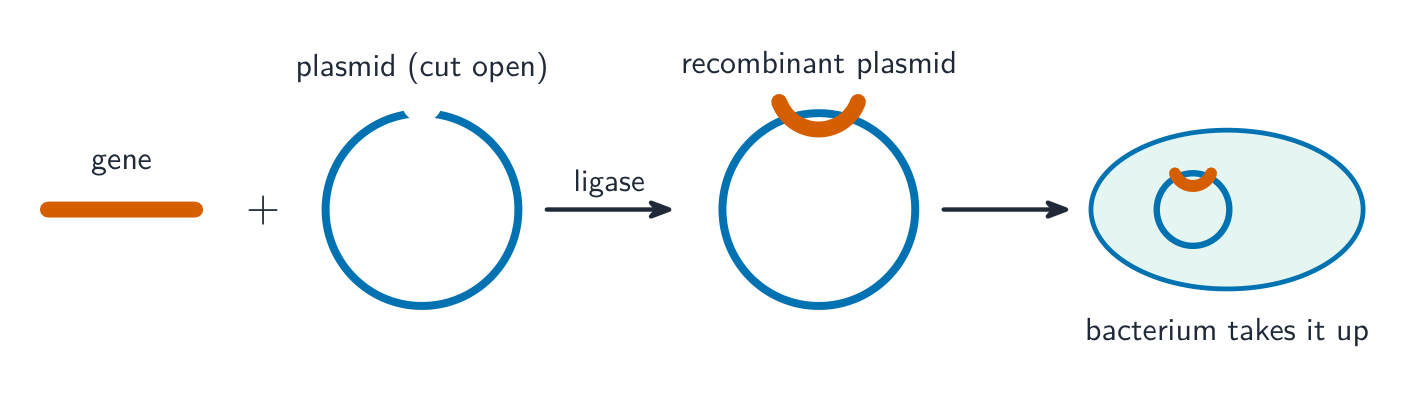
A gene inserted into a plasmid 质粒 vector 媒介 and taken up by a bacterium
The tools of genetic technology
Genetic engineering moves a useful gene into another organism so it makes a desired protein.
Reverse transcriptase is used to:
Difficulté 1/5 · 100 pièces + un petit bonus lors de la première réussite aujourd'hui
Reverse transcriptase builds a DNA copy from mRNA — one way of obtaining the gene to transfer.
The tools
| Tool | Role |
|---|---|
| restriction endonuclease 限制性内切酶 | cuts DNA at a specific sequence, leaving sticky ends 黏性末端 |
| DNA ligase | joins DNA pieces together |
| plasmid | a DNA ring used as a vector to carry the gene into a cell |
| reverse transcriptase | makes DNA from an mRNA template |
- A promoter 启动子 (the "switch") must go in too, or the gene stays silent.
- A marker gene 标记基因 (e.g. one that glows) shows the transfer worked.
Which tool cuts DNA, leaving "sticky ends"?
Difficulté 1/5 · 100 pièces + un petit bonus lors de la première réussite aujourd'hui
Restriction enzymes cut at specific sequences leaving sticky ends; ligase then joins matching ends.
A plasmid is used in genetic engineering as a:
Difficulté 1/5 · 100 pièces + un petit bonus lors de la première réussite aujourd'hui
The plasmid is a cloning vector: the gene is joined into it and the recombinant plasmid is taken up by a cell.
A gene that shows (e.g. by glowing) which cells took up the new gene is a ______ gene.
Difficulté 1/5 · 100 pièces + un petit bonus lors de la première réussite aujourd'hui
A marker gene (e.g. coding for a fluorescent product) reveals which cells were successfully transformed.
Match each tool to its job.
Difficulté 2/5 · 140 pièces + un petit bonus lors de la première réussite aujourd'hui
Cut with restriction enzymes, join with ligase, carry with a plasmid vector; reverse transcriptase makes the gene from mRNA.
Gene editing 基因编辑
- Gene editing is a precise form of genetic engineering.
- It inserts, deletes or replaces DNA at an exact site in the genome.
Worked example: making human insulin in bacteria
Outline how the gene for human insulin is put into E. coli so the bacteria make insulin.
- Get the gene: take insulin mRNA from pancreas β cells and use reverse transcriptase to make cDNA (with no introns, which bacteria could not remove). Add a bacterial promoter. Cut a plasmid with the same restriction enzyme, so their sticky ends are complementary, and join them with DNA ligase.
- Put the recombinant plasmids into bacteria. Only a few take them up, so a marker gene (for example, one for a fluorescent protein) identifies the transformed bacteria, which are grown in fermenters and make insulin.
Why is the insulin gene made from mRNA rather than cut from human DNA?
Difficulté 1/5 · 100 pièces + un petit bonus lors de la première réussite aujourd'hui
mRNA has already had its introns removed.
Cutting the plasmid and the gene with the same restriction enzyme gives complementary sticky ends.
Difficulté 1/5 · 100 pièces + un petit bonus lors de la première réussite aujourd'hui
The single-stranded overhangs can then base-pair.
You've got it
- recombinant DNA = DNA joined from two sources; genetic engineering transfers a gene to be expressed
- get the gene by cutting it out, reverse transcriptase (from mRNA), or synthesis
- tools: restriction enzyme (sticky ends), ligase (join), plasmid vector, plus a promoter + marker gene
- gene editing = precise insert/delete/replace at an exact site
Write from this case
- A wanted gene is cut out of a donor genome.
- The same enzyme cuts a plasmid.
What enzyme makes the cuts?
Restriction enzymes recognise a sequence and cut there.
What cuts the DNA at a specific sequence?
Difficulté 1/5 · 100 pièces + un petit bonus lors de la première réussite aujourd'hui
The restriction enzyme is the cutting tool.