- define the term recombinant DNA
- explain that genetic engineering is the deliberate manipulation of genetic material to modify specific characteristics of an organism and that this may involve transferring a gene into an organism so that the gene is expressed
- explain that genes to be transferred into an organism may be: • extracted from the DNA of a donor organism • synthesised from the mRNA of a donor organism • synthesised chemically from nucleotides
- explain the roles of restriction endonucleases, DNA ligase, plasmids, DNA polymerase and reverse transcriptase in the transfer of a gene into an organism
- explain why a promoter may have to be transferred into an organism as well as the desired gene
- explain how gene expression may be confirmed by the use of marker genes coding for fluorescent products
- explain that gene editing is a form of genetic engineering involving the insertion, deletion or replacement of DNA at specific sites in the genome
- describe and explain the steps involved in the polymerase chain reaction (PCR) to clone and amplify DNA, including the role of Taq polymerase
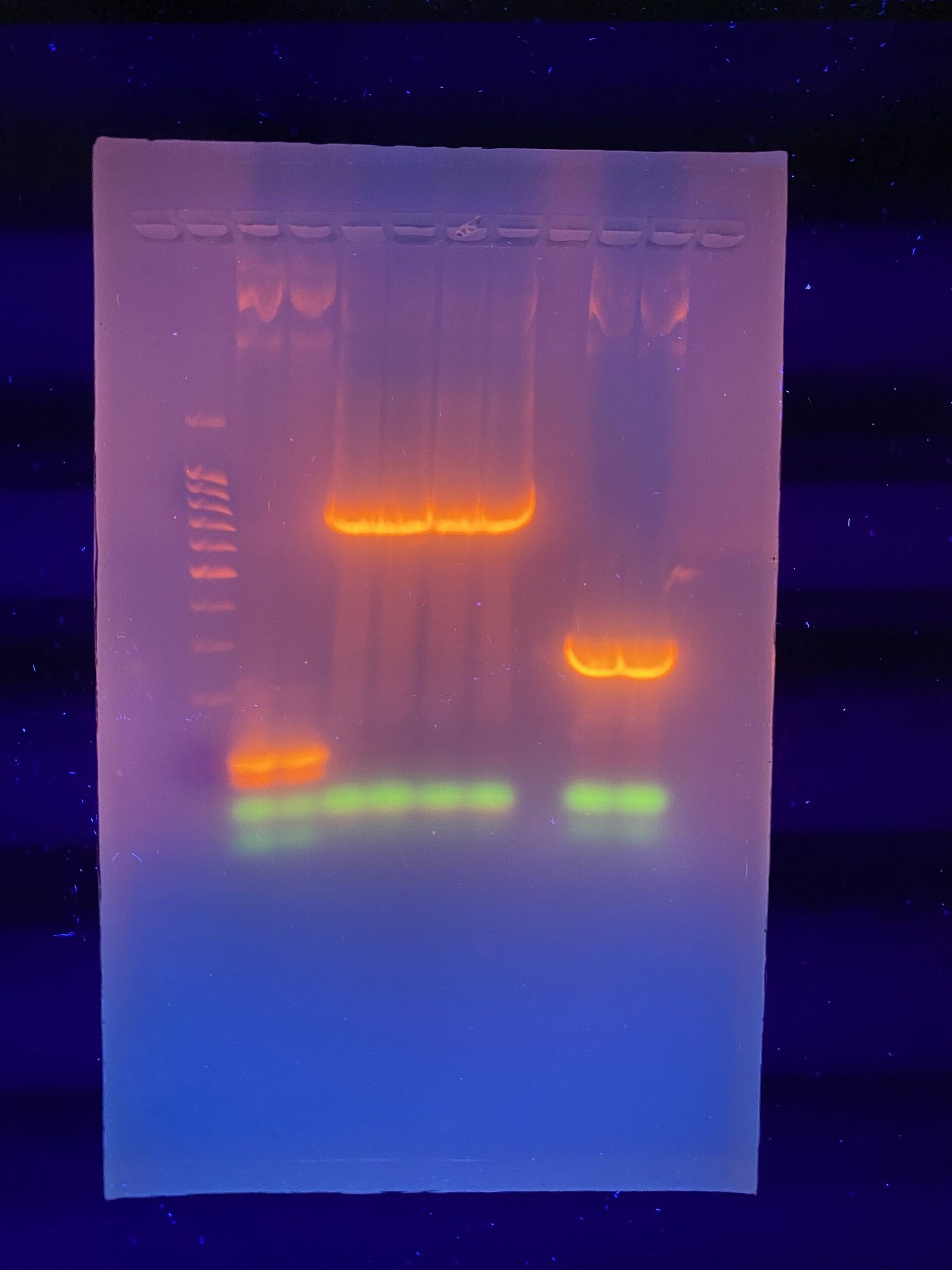
- describe and explain how gel electrophoresis is used to separate DNA fragments of different lengths
- outline how microarrays are used in the analysis of genomes and in detecting mRNA in studies of gene expression
- outline the benefits of using databases that provide information about nucleotide sequences of genes and genomes, and amino acid sequences of proteins and protein structures
Genetic technology
A-Level Biology · Topic 19
 8:31
8:31
Genetic technology
Two cotton plants. Same field, same insects, same week. The one on the left is barely touched. The one on the right has been eaten to bare stalks. The…
English narration · English + 中文 subtitles burned in
19.1
Principles of genetic technology

Syllabus
Source: Cambridge International syllabus
Recombinant 重组 DNA is DNA that has been made by joining together DNA from two different sources. Genetic engineering 基因工程 is the deliberate changing of an organism's genetic material — often by transferring a gene 基因 into an organism so that the gene is expressed (switched on to make its protein 蛋白质).
The gene to be transferred can be obtained in three ways:
- cut out of the DNA of a donor 供体 organism,
- made from the donor's mRNA, using the enzyme reverse transcriptase 逆转录酶,
- built chemically from nucleotides 核苷酸.
The tools
| Tool | Role |
|---|---|
| restriction endonuclease 限制性内切酶 | cuts DNA at a specific base sequence, leaving "sticky ends" |
| DNA ligase 连接酶 | joins pieces of DNA together |
| plasmid 质粒 | a small ring of bacterial DNA used as a cloning vector 载体 to carry the gene into a cell |
| DNA polymerase 聚合酶 | copies DNA |
| reverse transcriptase | makes DNA from an mRNA template |

A promoter 启动子 often has to be transferred along with the gene. The promoter is the "switch" that lets the gene be transcribed in its new organism, so without it the gene would stay silent.
To check the gene has gone in and is working, scientists add a marker gene 标记基因 next to it — for example one that codes for a fluorescent 荧光 (glowing) product. If the cells glow, the transfer worked.

Gene editing
Gene editing 基因编辑 is a precise form of genetic engineering. It inserts, deletes or replaces DNA at an exact site in the genome 基因组.
Copying and sorting DNA
- the polymerase chain reaction 聚合酶链式反应 (PCR) is used to clone 克隆 and amplify 扩增 DNA — to make millions of copies. It repeats cycles of heating and cooling, using a heat-stable enzyme called Taq polymerase.

- gel electrophoresis 凝胶电泳 separates DNA fragments 片段 by length. The fragments move through a gel in an electric field, and shorter fragments move further, so the lengths spread out into bands.

- microarrays 微阵列 are used to study whole genomes and to detect which genes are switched on, by picking up their mRNA.
- databases 数据库 store the nucleotide sequences of genes and the amino acid 氨基酸 sequences of proteins, so scientists anywhere can compare them.
Explore
The tools of genetic technology
Genetic engineering moves a useful gene into another organism so it makes a desired protein.
Vocabulary
Train
| English |
|---|
| recombinant/ˌriːˈkɒmbɪnənt/ |
| genetic engineering/dʒɪˈnetɪk ˌendʒɪˈnɪərɪŋ/ |
| gene/dʒiːn/ |
| protein/ˈprəʊtiːn/ |
| donor/ˈdəʊnə/ |
| reverse transcriptase/rɪˈvɜːs trænˈskrɪpteɪs/ |
| nucleotide/ˈnjuːklɪɒtaɪd/ |
| restriction endonuclease/rɪˈstrɪkʃn ˈendəʊnjuːklɪeɪs/ |
| ligase/ˈlɪɡeɪs/ |
| plasmid/ˈplæzmɪd/ |
| cloning vector/ˈkləʊnɪŋ ˈvektə/ |
| polymerase/ˌpɒlɪməˈreɪz/ |
| promoter/prəˈməʊtə/ |
| marker gene/ˈmɑːkə dʒiːn/ |
| fluorescent/flʊəˈresənt/ |
| gene editing/dʒiːn ˈedɪtɪŋ/ |
| genome/ˈdʒiːnəʊm/ |
| polymerase chain reaction/ˌpɒlɪməˈreɪz tʃeɪn rɪˈækʃn/ |
| clone/kləʊn/ |
| amplify/ˈæmplɪfaɪ/ |
| gel electrophoresis/dʒel ɪˌlektrəʊfɔːˈriːsɪs/ |
| fragment/ˈfræɡmənt/ |
| microarray/ˈmaɪkrəʊəreɪ/ |
| database/ˈdeɪtəbeɪs/ |
| amino acid/əˈmiːnəʊ ˈæsɪd/ |
19.2
Genetic technology in medicine

Syllabus
- explain the advantages of using recombinant human proteins to treat disease, using the examples insulin, factor VIII and adenosine deaminase
- outline the advantages of genetic screening, using the examples of breast cancer (BRCA1 and BRCA2), Huntington’s disease and cystic fibrosis
- outline how genetic diseases can be treated with gene therapy, using the examples severe combined immunodeficiency (SCID) and inherited eye diseases
- discuss the social and ethical considerations of using genetic screening and gene therapy in medicine
Source: Cambridge International syllabus
Recombinant human proteins
A human gene can be put into bacteria or other cells so that they make a recombinant human protein — an exact copy of the human one. This is safer and never in short supply, and it avoids using proteins taken from animals or donors. Examples are insulin 胰岛素 (for diabetes 糖尿病), factor VIII (for haemophilia) and adenosine deaminase (for a faulty immune system).
Genetic screening
Genetic screening 基因筛查 tests a person's DNA for disease alleles before symptoms appear. Examples are the BRCA1 and BRCA2 alleles (which raise the risk of breast cancer 乳腺癌), Huntington's disease 亨廷顿病, and cystic fibrosis 囊性纤维化. Knowing the result helps people make informed choices about treatment and family.
Gene therapy
Gene therapy 基因治疗 treats a genetic disease by putting a working copy of a gene into the patient's cells. It has been used for SCID (a disease in which the immune system fails) and for some inherited eye diseases.
Social and ethical questions
Genetic screening and gene therapy raise concerns: who should see your genetic results, whether insurers or employers could misuse them, whether changes are safe and permanent, and who decides. These ethical 伦理 and social questions must be weighed against the benefits.
Explore
Making human insulin with GM bacteria
Step through it. The human insulin gene goes into bacteria, which then churn out exact human insulin in fermenters.
Vocabulary
Train
| English |
|---|
| insulin/ˈɪnsjuːlɪn/ |
| diabetes/ˌdaɪəˈbiːtiːz/ |
| genetic screening/dʒɪˈnetɪk ˈskriːnɪŋ/ |
| breast cancer/brest ˈkænsə/ |
| Huntington's disease/ˈhʌntɪŋtnz dɪˈziːz/ |
| cystic fibrosis/ˈsɪstɪk fɪˈbrəʊsɪs/ |
| gene therapy/dʒiːn ˈθerəpi/ |
| ethical/ˈeθɪkl/ |
19.3
Genetically modified organisms in agriculture

Syllabus
- explain that genetic engineering may help to solve the global demand for food by improving the quality and productivity of farmed animals and crop plants, using the examples of GM salmon, herbicide resistance in soybean and insect resistance in cotton
- discuss the ethical and social implications of using genetically modified organisms (GMOs) in food production
Source: Cambridge International syllabus
Genetic engineering can help feed a growing world by improving farmed animals and crops. Examples of genetically modified organisms 转基因生物 (GMOs) are:
- GM salmon 鲑鱼 that grow to size faster.
- soybean 大豆 made resistant to a herbicide 除草剂, so weeds can be sprayed without harming the crop.
- cotton 棉花 made resistant to insect pests 害虫, because it makes a protein that kills the insects.
GMOs also raise ethical and social questions: whether they are safe to eat, what effect they have on the environment and wild species, whether the engineered genes might spread, and whether a few large companies should control the food supply.
Worked example. A tiny DNA sample from a crime scene must be amplified and then compared with a suspect's. Outline the two techniques and what each achieves. PCR copies the DNA in repeated cycles: denaturation at about $95\ °\text{C}$ separates the strands, annealing at about $55\ °\text{C}$ lets primers bind at each end of the target, and extension at about $72\ °\text{C}$ has Taq polymerase build the new strands. Each cycle doubles the amount, so $n$ cycles give $2^n$ copies - 30 cycles turn one molecule into roughly a billion. Gel electrophoresis then separates the fragments: DNA is negatively charged because of its phosphate groups, so it moves towards the anode, and shorter fragments travel further through the gel. Matching band patterns point to the same source. Taq polymerase is used because it is thermostable - an ordinary polymerase would denature at $95\ °\text{C}$ in the very first cycle.
Explore
How a GMO is made
Step through it — the same recombinant-DNA toolkit, now used to give a crop or microbe a brand-new useful gene.
Vocabulary
Train
| English |
|---|
| genetically modified organism/dʒɪˈnetɪkli ˈmɒdɪfaɪd ˈɔːɡənɪzəm/ |
| salmon/ˈsæmən/ |
| soybean/ˈsɔɪbiːn/ |
| herbicide/ˈhɜːbɪsaɪd/ |
| cotton/ˈkɒtn/ |
| pest/pest/ |
19.3
Exam tips
- Outline the toolkit: restriction enzymes (cut at specific sequences, sticky ends), ligase (join), plasmid vectors, and PCR (amplify).
- Explain gel electrophoresis: DNA separates by size, smaller fragments travel further — used in genetic fingerprinting.
- Give a balanced benefit vs concern for GMOs and gene therapy.
Interactive lessons on this topic
Work through it step by step, with instant-check exercises.