From genes to phenotype
Introduit| English | Sens |
|---|---|
| albinism/ˈælbɪnɪzəm/ | albinisme |
| sickle cell anaemia/ˈsɪkl sel əˈniːmɪə/ | anémie falciforme |
| haemophilia/ˌhiːməˈfɪlɪə/ | hémophilie |
| gibberellin/ˌdʒɪbəˈrelɪn/ | gibbérelline |
From code to characteristic
- A gene codes for a protein, and that protein affects the phenotype.
- If the gene is faulty, the protein is faulty — and the phenotype changes.
- A few classic examples show this clearly.
How does a faulty allele change the phenotype?
Difficulté 1/5 · 100 pièces + un petit bonus lors de la première réussite aujourd'hui
A gene codes for a protein; a faulty allele makes a faulty protein, altering the phenotype.
A faulty allele changes the phenotype because it codes for a faulty protein.
Difficulté 1/5 · 100 pièces + un petit bonus lors de la première réussite aujourd'hui
The DNA sequence sets the protein's shape; change the sequence and you change (or break) the protein.
The phenotype is decided by the genotype together with the ______.
Difficulté 1/5 · 100 pièces + un petit bonus lors de la première réussite aujourd'hui
Both nature (genotype) and nurture (environment) shape the phenotype.
Faulty alleles, faulty proteins
| Gene | Protein | Faulty allele causes |
|---|---|---|
| TYR | tyrosinase (enzyme) | albinism 白化病 (no pigment) |
| HBB | haemoglobin | sickle cell anaemia 镰状细胞贫血 |
| F8 | factor VIII (clotting) | haemophilia 血友病 |
| HTT | huntingtin | Huntington's disease |
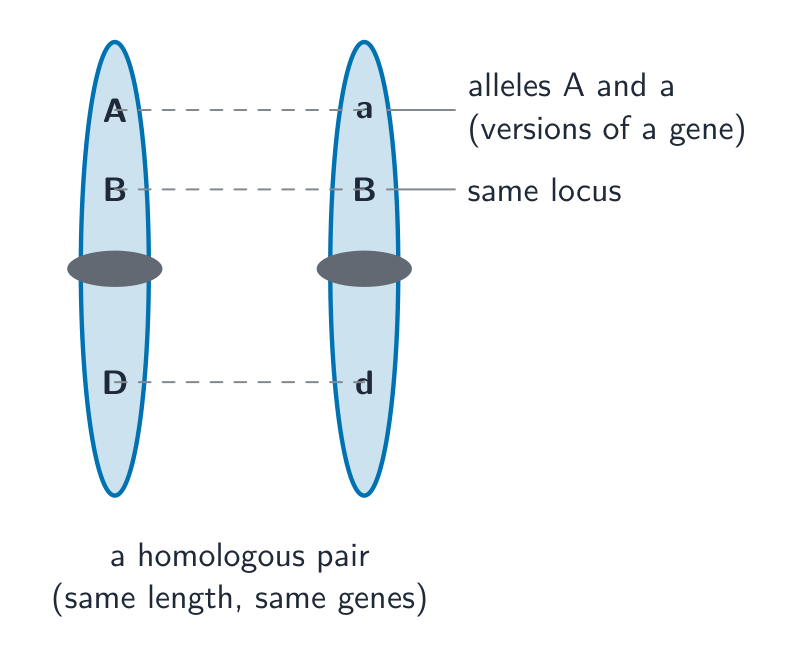
A homologous pair of chromosomes with alleles at the same loci
From gene to phenotype
Step through it. A gene makes a protein that does a job — so a faulty allele makes a faulty protein and a changed feature.
Albinism is caused by a faulty allele of the TYR gene because:
Difficulté 1/5 · 100 pièces + un petit bonus lors de la première réussite aujourd'hui
TYR codes for tyrosinase; a faulty version cannot make pigment, causing albinism.
Match each gene to the condition a faulty allele causes.
Difficulté 2/5 · 140 pièces + un petit bonus lors de la première réussite aujourd'hui
Each gene codes for a protein; a faulty version of that protein causes the condition.
Gibberellin 赤霉素 and stem height
- In pea plants, the dominant allele Le codes for a working enzyme that makes gibberellin, so the plant grows tall.
- The recessive allele le codes for a broken enzyme, so little gibberellin is made and the plant is short.
A pea plant with two le alleles is short because:
Difficulté 1/5 · 100 pièces + un petit bonus lors de la première réussite aujourd'hui
le codes for a broken enzyme; with little gibberellin, the stem does not elongate, so the plant is short.
The environment matters too
- The phenotype is set by the genotype and the environment.
- For example, a plant's height depends on its alleles and on light, water and nutrients.
Worked example: one base change, sickle cells
In the HBB gene, one base substitution changes the codon GAG to GTG. Explain how this leads to sickle cell anaemia.
- GAG codes for glutamic acid, GTG for valine, so the β-globin chain has one different amino acid. Valine is non-polar, so the haemoglobin molecules stick together when oxygen is low.
- The long fibres pull red blood cells into a sickle shape. These cells carry less oxygen and block capillaries. Gene → protein → phenotype: a single base change alters the whole organism.
A mutation replaces one base with another. This is called a:
Difficulté 1/5 · 100 pièces + un petit bonus lors de la première réussite aujourd'hui
One base is swapped; the reading frame stays the same.
A pea plant with genotype lele is short because it makes little gibberellin.
Difficulté 1/5 · 100 pièces + un petit bonus lors de la première réussite aujourd'hui
Both alleles code for a non-working enzyme.
You've got it
- gene → protein → phenotype; a faulty allele → faulty protein → changed phenotype
- examples: TYR (albinism), HBB (sickle cell), F8 (haemophilia), HTT (Huntington's)
- pea height: Le (working enzyme → gibberellin → tall) vs le (broken → short)
Write from this case
- A mutation changes one allele.
- The enzyme that should make a pigment is not produced.
Why does the phenotype change?
One faulty protein can block a whole pathway.
Why is the pigment missing?
Difficulté 1/5 · 100 pièces + un petit bonus lors de la première réussite aujourd'hui
Without the enzyme the pathway stops.