The immune response and memory cells
Introduit| English | Sens |
|---|---|
| primary response/ˈpraɪməri rɪˈspɒns/ | primary response : réponse primaire |
| T-helper cell/tiː ˈhelpə sel/ | T-helper cell : lymphocyte T auxiliaire |
| B-lymphocyte/biː ˈlɪmfəsaɪt/ | B-lymphocyte : lymphocyte B |
| plasma cell/ˈplæzmə sel/ | plasma cell : plasmocyte |
| memory cell/ˈmeməri sel/ | memory cell : cellule mémoire |
| secondary response/ˈsekəndəri rɪˈspɒns/ | secondary response : réponse secondaire |
| clonal selection/ˈkləʊnl sɪˈlekʃn/ | clonal selection : sélection clonale |
The body fights back and remembers
- The first time you catch a new virus, you are ill for a week or more. If the same virus returns, you usually do not notice it at all.
- The difference comes from lymphocytes 淋巴细胞. These white blood cells give a specific response: each one targets one antigen only.
- They also leave behind memory cells 记忆细胞, which make you immune.
The secondary immune response is slower and weaker than the first.
Difficulté 1/5 · 100 pièces + un petit bonus lors de la première réussite aujourd'hui
False. Memory cells from the first exposure react quickly, so the secondary response is faster and stronger. This is the basis of long-term immunity.
Two kinds of lymphocyte
| Lymphocyte | Matures in | Main job |
|---|---|---|
| B-lymphocyte B淋巴细胞 | bone marrow | becomes plasma cells that secrete antibodies |
| T-lymphocyte T淋巴细胞 | thymus 胸腺 | T-helper cells coordinate; T-killer cells kill infected cells |
- While they mature, each lymphocyte gets receptors of one shape only, complementary to one antigen. There are millions of different lymphocytes, so almost any antigen has a match.
- Lymphocytes whose receptors fit self antigens are destroyed as they mature. Only those that ignore the body's own cells survive.
Match each lymphocyte to where it matures.
Difficulté 2/5 · 140 pièces + un petit bonus lors de la première réussite aujourd'hui
Both are made in the bone marrow, but T cells move to the thymus to mature.
Clonal selection 克隆选择 and expansion
- Selection: when a pathogen arrives, only the few lymphocytes whose receptors are complementary to its antigens bind to it. Those lymphocytes are selected.
- Expansion: the selected cells divide again and again by mitosis, making a clone of identical cells, all with the same receptor. This takes several days.
Only the lymphocyte with the matching receptor is cloned. The others are not activated.
Put the events of clonal selection in order.
Difficulté 3/5 · 200 pièces + un petit bonus lors de la première réussite aujourd'hui
Only the matching lymphocyte is selected; the clone all share its receptor.
The primary response 初次反应 step by step
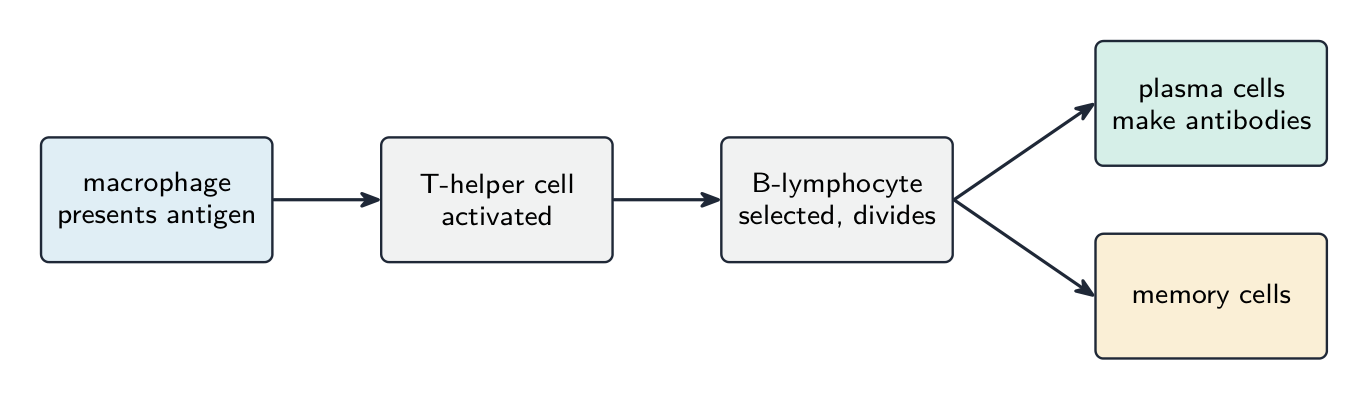
- A macrophage engulfs the pathogen and presents its antigens on its surface.
- A T-helper cell 辅助性T细胞 with a matching receptor binds to the presented antigen. It is selected, divides, and releases cytokines 细胞因子 (chemical signals).
- The cytokines stimulate the selected B-lymphocytes to divide. Most become plasma cells 浆细胞, which make and secrete antibodies. Plasma cells have lots of rough ER and Golgi for this protein synthesis. Some become memory B cells.
- Selected T-killer cells 杀伤性T细胞 bind to body cells infected by a virus, which show the viral antigen on their surface. They release toxic chemicals that kill the infected cell. Some also become memory T cells.
La réponse immunitaire primaire
Step through the specific response — the antigen is presented, T-helper cells switch on B-cells, and plasma cells pour out antibodies.
T-helper cells in the immune response:
Difficulté 1/5 · 100 pièces + un petit bonus lors de la première réussite aujourd'hui
T-helper cells recognise the presented antigen and activate B-lymphocytes and other cells.
Which cells actually secrete antibodies?
Difficulté 1/5 · 100 pièces + un petit bonus lors de la première réussite aujourd'hui
Selected B-lymphocytes divide into plasma cells (which secrete antibodies) and memory cells.
Put the primary immune response in order.
Difficulté 3/5 · 200 pièces + un petit bonus lors de la première réussite aujourd'hui
Antigen presented → T-helper activated → B-lymphocytes selected → plasma cells make antibodies.
Match each cell to its job in the immune response.
Difficulté 2/5 · 140 pièces + un petit bonus lors de la première réussite aujourd'hui
The macrophage presents, the T-helper switches things on, plasma cells make antibodies, and memory cells wait for next time.
Plasma cells are the cells that secrete antibodies.
Difficulté 1/5 · 100 pièces + un petit bonus lors de la première réussite aujourd'hui
Activated B-lymphocytes divide to form plasma cells, which secrete antibodies.
What do T-killer cells destroy?
Difficulté 1/5 · 100 pièces + un petit bonus lors de la première réussite aujourd'hui
Infected cells show the viral antigen on their surface; T-killer cells bind to it and release toxic chemicals.
Memory and the secondary response 二次反应
- After the infection, plasma cells die, but memory cells stay in the blood and lymph nodes for years.
- If the same antigen returns, there are many more matching cells than the first time, and no selection delay. They divide into plasma cells at once.
- The secondary response is faster, much larger and lasts longer. The pathogen is destroyed before symptoms appear: this is immunity.
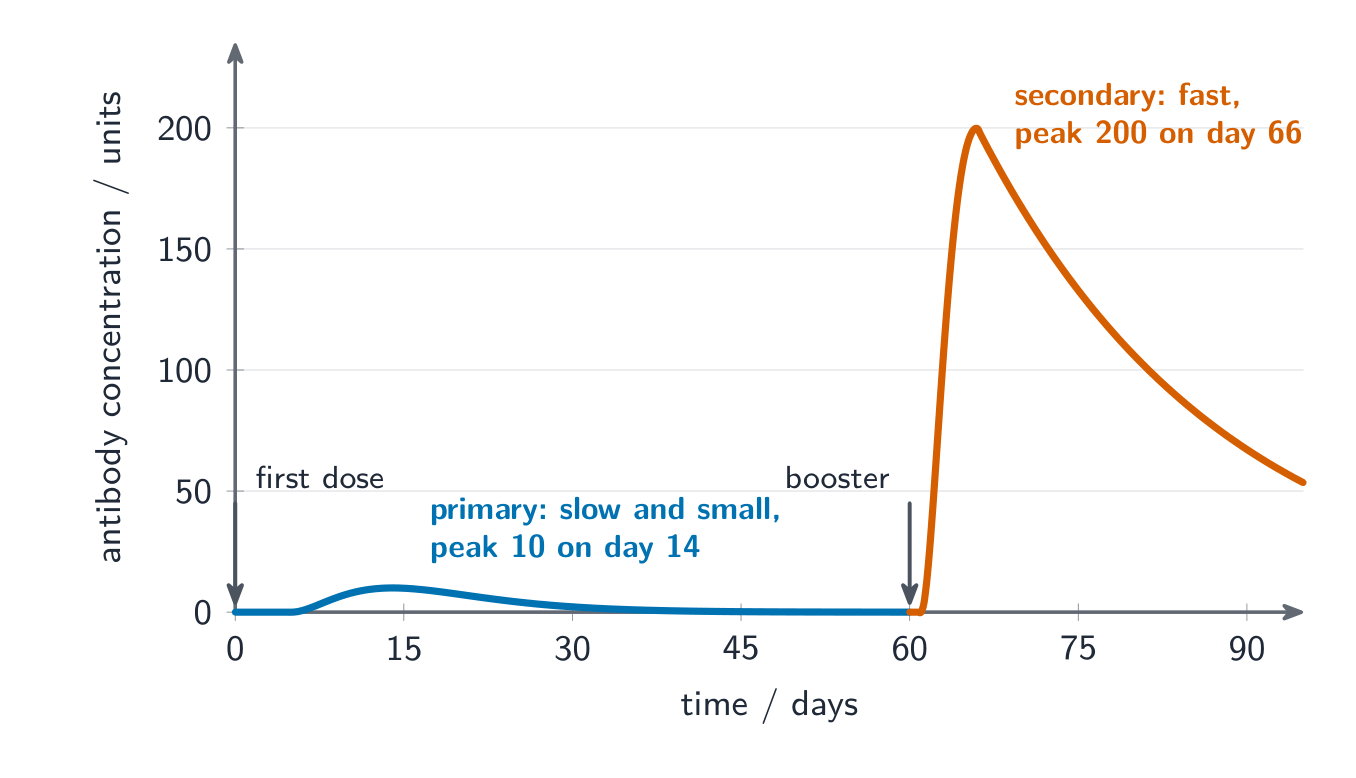
These are the data used in the worked question below.
The secondary immune response is faster and larger because:
Difficulté 1/5 · 100 pièces + un petit bonus lors de la première réussite aujourd'hui
Memory cells made in the primary response respond quickly and strongly when the same pathogen returns.
Long-lived cells that stay behind to give a fast secondary response are ______ cells.
Difficulté 1/5 · 100 pièces + un petit bonus lors de la première réussite aujourd'hui
Memory cells let the body respond before you even feel ill the second time — the basis of immunity.
Worked exam question: reading a vaccine graph
Question (4 marks). A child is vaccinated on day 0 and again on day 60. Antibody levels peak at about 10 units on day 14, fall, then peak at about 200 units on day 66. Explain the differences between the two responses.
- First dose (primary response): few lymphocytes match the antigen. They must be selected and divide by mitosis first, so antibodies appear slowly and reach only 10 units (1 mark). Memory cells are made (1 mark).
- Second dose (secondary response): the many memory cells recognise the antigen at once (1 mark). They divide quickly into plasma cells, so antibodies rise within days to about 20 times the first peak, 200 ÷ 10 (1 mark).
Mark-scheme trap: "the body remembers the virus" earns nothing. Name the memory cells and say there are more of them than there were matching cells the first time.
How does the second response compare with the first?
Memory cells are ready before the second meeting.
Why is the antibody response to a booster faster than to the first dose?
Difficulté 1/5 · 100 pièces + un petit bonus lors de la première réussite aujourd'hui
Memory cells divide quickly into plasma cells on second exposure.
Worked exam question: the roles of T-lymphocytes
Question (4 marks). Describe the roles of T-helper cells and T-killer cells in the response to a virus.
- T-helper cells bind to the viral antigen presented by a macrophage (1 mark). They release cytokines that stimulate the matching B-lymphocytes to divide into plasma cells, and they also activate T-killer cells (1 mark).
- T-killer cells bind to the antigen on the surface of infected body cells (1 mark). They release toxic chemicals that kill those cells, so the virus cannot replicate inside them (1 mark).
Why answers lose marks: saying T-killer cells "kill the virus" or "make antibodies". They kill infected body cells; only plasma cells secrete antibodies.
Without looking back: describe the roles of T-helper and T-killer cells in the response to a virus (4 marks).
Keep the jobs apart: only plasma cells make antibodies.
You've got it
- B-lymphocytes mature in bone marrow; T-lymphocytes mature in the thymus; each has receptors of one shape; self-reacting ones are destroyed
- clonal selection: the matching lymphocyte binds the antigen; clonal expansion: it divides by mitosis into a clone
- T-helper → cytokines → B cells divide into plasma cells (antibodies; lots of rough ER) and memory cells
- T-killer cells kill infected body cells
- memory cells last for years: the secondary response is faster, larger and longer, which gives immunity
Why is the second response faster?
Difficulté 1/5 · 100 pièces + un petit bonus lors de la première réussite aujourd'hui
Memory removes the slow start.