Antibiotics and antibiotic resistance
Introduit| English | Sens |
|---|---|
| antibiotic/ˌæntɪbaɪˈɒtɪk/ | antibiotic : antibiotique |
| resistant/rɪˈzɪstənt/ | resistant : résistant |
| penicillin/ˌpenɪˈsɪlɪn/ | penicillin : pénicilline |
| cell wall/sel wɔːl/ | cell wall : paroi cellulaire |
| mutation/mjuːˈteɪʃn/ | mutation |
| natural selection/ˈnætʃərəl sɪˈlekʃn/ | sélection naturelle |
The drugs that fight bacteria
- Before 1940, a scratch that became infected could kill. Penicillin, discovered by Alexander Fleming in 1928, changed that.
- An antibiotic 抗生素 is a chemical that kills bacteria or stops them growing, without harming the host's cells.
- Today some bacteria, such as MRSA, survive almost every antibiotic. This lesson explains how antibiotics work and how resistance 抗药性 evolves.
How penicillin 青霉素 works
- A bacterial cell wall is made of peptidoglycan 肽聚糖: long chains held together by cross-links. The wall stops the cell bursting when water enters by osmosis.
- When a bacterium grows, it makes small gaps in its wall and fills them with new peptidoglycan. Penicillin inhibits the enzymes that form the cross-links, so the new wall is weak.
- Water enters by osmosis, the weak wall cannot resist the pressure, and the cell bursts (osmotic lysis). Penicillin only affects bacteria that are growing.
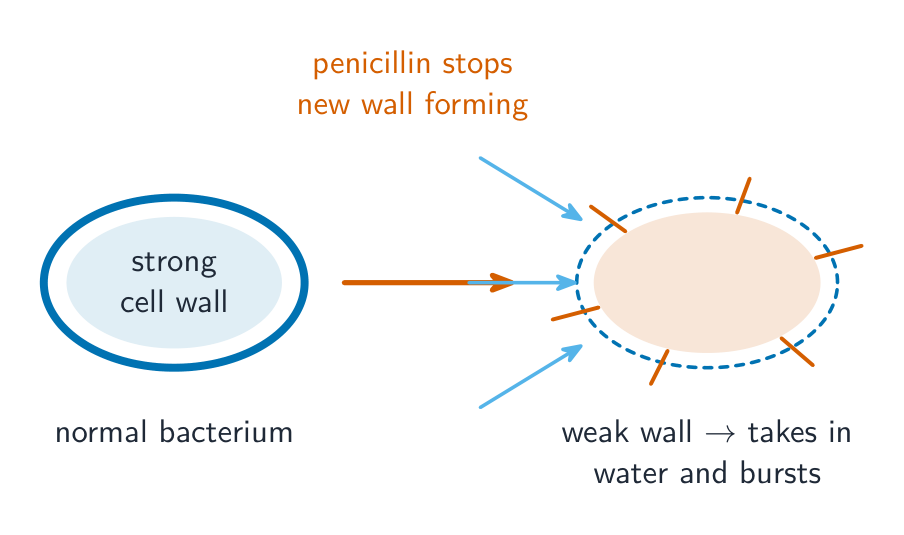
Penicillin kills bacteria by:
Difficulté 1/5 · 100 pièces + un petit bonus lors de la première réussite aujourd'hui
Penicillin prevents cell-wall synthesis; the growing cell cannot hold the water it absorbs, so it bursts.
Put the events in order for a growing bacterium exposed to penicillin.
Difficulté 3/5 · 200 pièces + un petit bonus lors de la première réussite aujourd'hui
Without cross-links, the wall cannot withstand the osmotic pressure.
Why antibiotics don't harm us, or viruses
- Human cells have no cell wall and no peptidoglycan, so penicillin has nothing to act on in them.
- A virus is not a cell: it has no cell wall, no ribosomes and no metabolism of its own. It uses the host cell's enzymes and ribosomes to copy itself. There is no target for the antibiotic.
- So antibiotics do not cure colds, flu or COVID-19. Taking them for a virus only gives bacteria in your body more chances to become resistant.
Why do antibiotics not work against viruses?
Difficulté 1/5 · 100 pièces + un petit bonus lors de la première réussite aujourd'hui
Antibiotics target bacterial structures/processes; a virus has none of these, using the host cell instead.
Antibiotics should be taken to treat a common cold.
Difficulté 1/5 · 100 pièces + un petit bonus lors de la première réussite aujourd'hui
Colds are caused by viruses, which antibiotics cannot kill — using them needlessly only drives resistance.
A person with a viral infection asks for penicillin. Why will penicillin not cure it?
No bacterial cell wall means no penicillin target.
Antibiotics will help a patient recover faster from a cold, which is caused by a virus.
Difficulté 1/5 · 100 pièces + un petit bonus lors de la première réussite aujourd'hui
Viruses have no cell wall or metabolism of their own for antibiotics to target.
Why does penicillin not damage human cells?
Difficulté 1/5 · 100 pièces + un petit bonus lors de la première réussite aujourd'hui
Penicillin blocks the cross-linking of peptidoglycan, which only bacterial cell walls contain.
Testing antibiotics on a plate
- Bacteria are spread evenly over agar to grow as a lawn. Paper discs, each soaked in a different antibiotic, are placed on top, and the plate is incubated.
- Each antibiotic diffuses out into the agar. Where it stops the bacteria growing, a clear zone of inhibition forms. A larger zone usually means the antibiotic works better against that bacterium. No zone means the bacteria are resistant.
- To compare zones, measure the diameter, halve it to get the radius, and calculate the area with $\pi r^2$.

A zone of inhibition has a diameter of 18 mm. Calculate its area in mm², to the nearest whole number.
Difficulté 2/5 · 140 pièces + un petit bonus lors de la première réussite aujourd'hui
Radius = 9 mm, so area = π × 9² = 254 mm².
How resistance arises and spreads
- Mutation: by chance, a mutation 突变 in one bacterium may give resistance. For example, the gene may code for an enzyme (penicillinase) that breaks down penicillin.
- Selection: when the antibiotic is used, susceptible bacteria die. The resistant ones survive, reproduce and pass on the allele, so the share of resistant bacteria rises. The antibiotic is the selection pressure (natural selection 自然选择).
- Spread between bacteria: resistance genes are often on plasmids 质粒, small circles of DNA that can be passed to other bacteria, even of other species. So resistance can spread faster than reproduction alone allows.
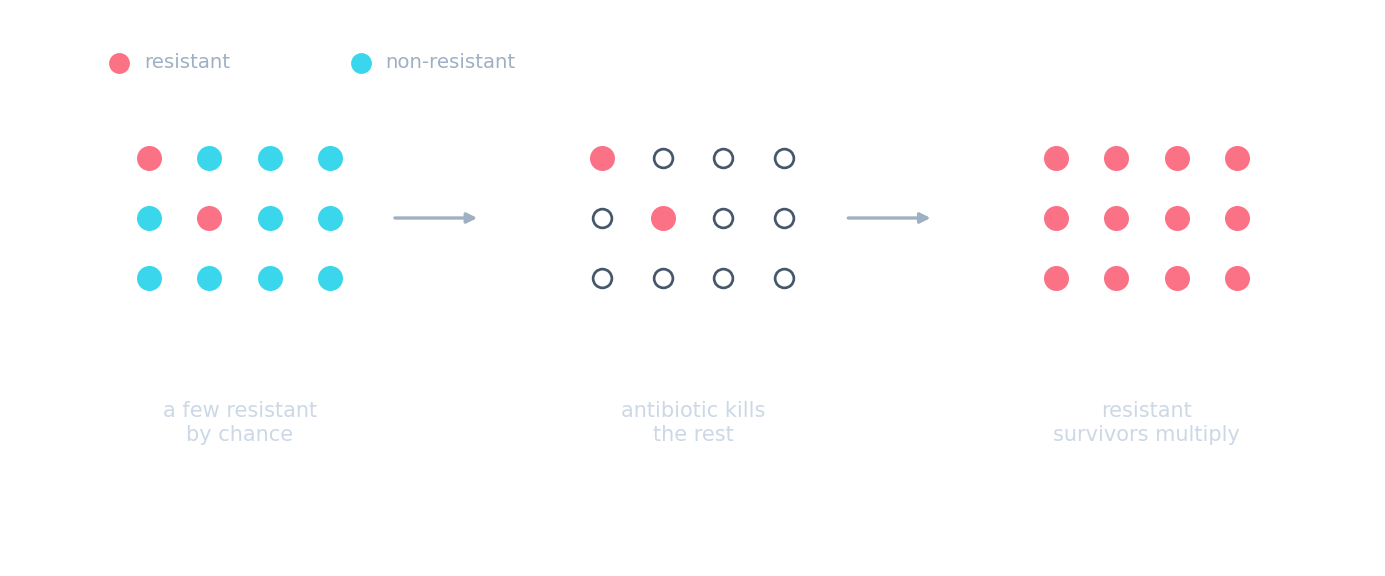
How resistance evolves
Step through natural selection in fast-forward. The antibiotic kills the rest, so only the resistant bacteria are left to breed.
Antibiotic resistance spreads because:
Difficulté 1/5 · 100 pièces + un petit bonus lors de la première réussite aujourd'hui
Resistant bacteria (from mutation) survive the antibiotic and reproduce, so resistance spreads by natural selection.
Put the evolution of antibiotic resistance in order.
Difficulté 3/5 · 200 pièces + un petit bonus lors de la première réussite aujourd'hui
Variation → the antibiotic selects → survivors breed → a resistant population. This is natural selection.
Antibiotic resistance spreads by natural ______ — resistant bacteria survive and reproduce.
Difficulté 1/5 · 100 pièces + un petit bonus lors de la première réussite aujourd'hui
The antibiotic is the selection pressure; only resistant bacteria survive to pass on their genes.
Resistance genes can spread between different bacteria on:
Difficulté 1/5 · 100 pièces + un petit bonus lors de la première réussite aujourd'hui
Plasmids can be passed from one bacterium to another.
Why it matters, and what to do
- Consequences: infections such as MRSA and multidrug-resistant TB are hard to treat. Patients stay ill longer and more die. Routine operations, cancer treatment and organ transplants become risky, because they rely on antibiotics to prevent infection.
- Reducing it: prescribe antibiotics only for bacterial infections; take the whole course as prescribed; choose the antibiotic that matches the bacterium; use good hygiene in hospitals (hand-washing, isolating infected patients); cut antibiotic use in farm animals; and develop new antibiotics.
Which action helps slow antibiotic resistance?
Difficulté 1/5 · 100 pièces + un petit bonus lors de la première réussite aujourd'hui
Finishing the course leaves no survivors; avoiding unnecessary use reduces the selection pressure for resistance.
Worked exam question: a resistant infection
Question (4 marks). A patient stops taking an antibiotic after 3 days instead of 7. The infection returns, and it is now resistant to that antibiotic. Explain how this happened.
- A random mutation had already given a few bacteria resistance, for example a gene for an enzyme that breaks down the antibiotic (1 mark).
- The antibiotic killed the susceptible bacteria first, so the survivors after 3 days were mostly resistant (1 mark).
- Stopping early let these survivors reproduce, passing on the resistance allele; they may also pass plasmids to other bacteria (1 mark).
- This is natural selection, with the antibiotic as the selection pressure (1 mark).
Why answers lose marks: "the bacteria got used to the antibiotic" or "the antibiotic caused the mutation". The mutation is random and was already there; the antibiotic only selects it.
Without looking back: explain how a population of bacteria becomes resistant to an antibiotic (4 marks).
The antibiotic selects; it does not cause the mutation.
Worked exam question: zones of inhibition
Question (3 marks). Use the plate above. The zone around disc A has a diameter of 24 mm and the zone around disc B has a diameter of 12 mm. Calculate the area of each zone, and state which antibiotic should be used for this infection.
- A: radius $= 12$ mm, so area $=\pi\times12^2=$ 452 mm² (1 mark).
- B: radius $= 6$ mm, so area $=\pi\times6^2=$ 113 mm² (1 mark). Doubling the diameter gives four times the area.
- Antibiotic A, because it stopped bacterial growth over the largest area. The bacteria are resistant to C (1 mark).
Trap: do not use the diameter in $\pi r^2$. Halve it first.
You've got it
- penicillin inhibits the enzymes that cross-link peptidoglycan in growing bacteria → weak wall → water enters by osmosis → the cell bursts
- antibiotics do not affect human cells (no cell wall) or viruses (no cell wall, no metabolism of their own)
- zone of inhibition: bigger zone = more effective; area $=\pi r^2$ with $r$ = half the diameter
- resistance: random mutation → antibiotic selects resistant bacteria → they reproduce; genes also spread on plasmids
- reduce it: use only when needed, finish the course, hospital hygiene, less farm use, new antibiotics
Why does penicillin fail against a virus?
Difficulté 1/5 · 100 pièces + un petit bonus lors de la première réussite aujourd'hui
The drug's target is absent.