Diagramas de frecuencia acumulada
Introducido| English | Significado |
|---|---|
| cumulative frequency/ˈkjuːmjʊlətɪv ˈfriːkwənsi/ | frecuencia acumulada |
| median/ˈmiːdiːən/ | mediana |
| quartile/ˈkwɔːtaɪl/ | cuartil |
The running total
- In a marathon, you don't just count runners per age group — you want to know "how many runners have finished by time $t$?"
- That's a cumulative frequency 累积频数: a running total that builds up from the lowest class to the highest.
Curva de frecuencia acumulada
Seguir los datos brutos hasta una curva de frecuencia acumulada y la lectura de percentiles.
Drawing the curve
- Plot cumulative frequency against the upper end of each class.
- Join the points with a smooth curve (or straight lines).
- The curve always goes up (or stays flat) — it never goes down, because you're adding.
Classes $0$–$10$ (freq $5$), $10$–$20$ (freq $8$), $20$–$30$ (freq $12$): cumulative frequencies are $5, 13, 25$. Plot at $10, 20, 30$.
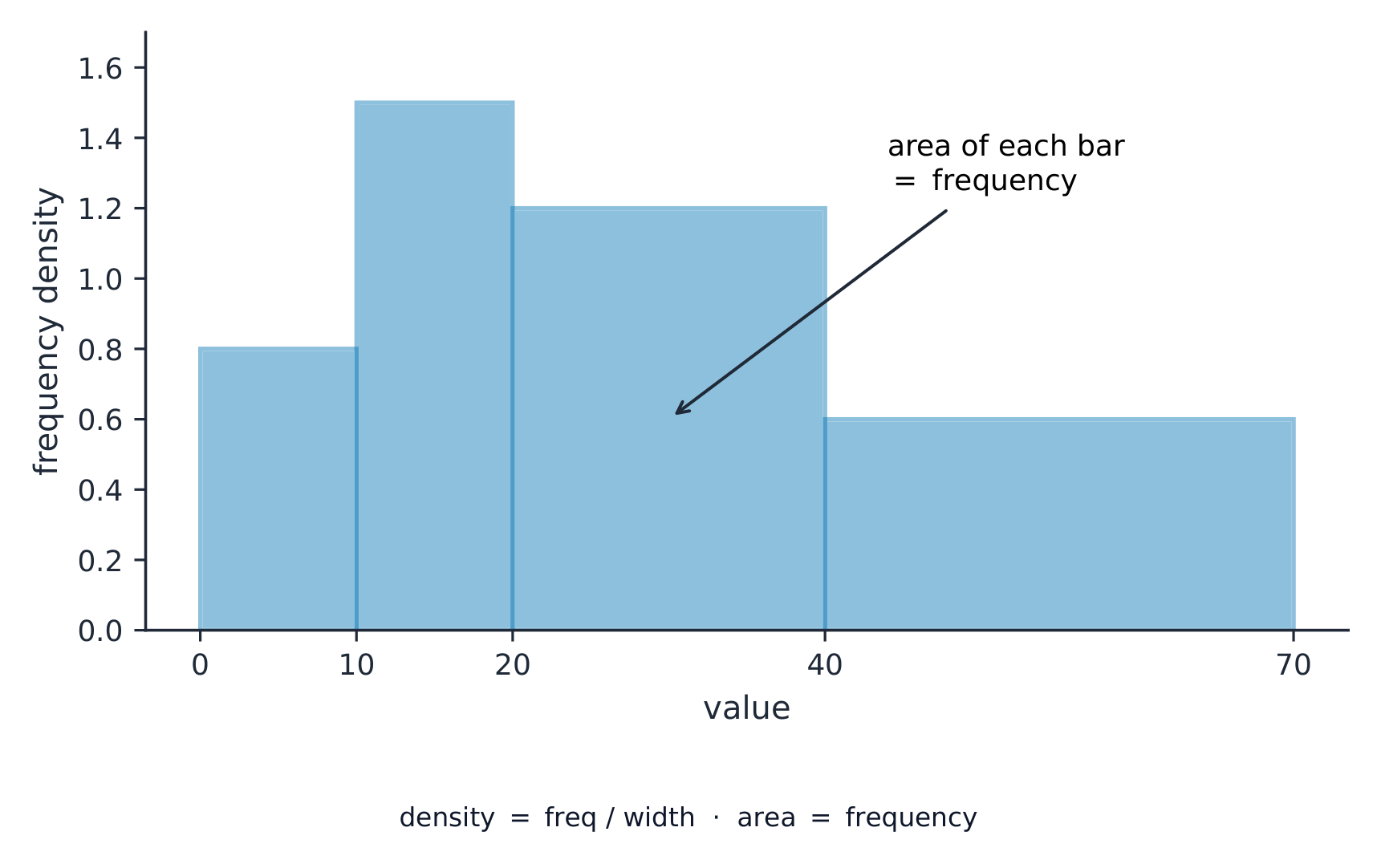
On a histogram with unequal class widths the bar AREA (not height) is the frequency, so the axis is frequency density
La frecuencia acumulada es:
Dificultad 1/5 · 100 monedas + un pequeño bono en el primer intento de hoy
Cada punto suma la siguiente frecuencia de clase al total acumulado hasta ese momento.
La frecuencia acumulada se representa contra el extremo superior de cada clase.
Dificultad 1/5 · 100 monedas + un pequeño bono en el primer intento de hoy
Siempre se representa el total acumulado en el límite superior de la clase.
Una curva de frecuencia acumulada puede descender.
Dificultad 1/5 · 100 monedas + un pequeño bono en el primer intento de hoy
La frecuencia acumulada es una suma progresiva — siempre aumenta o se mantiene constante, nunca disminuye.
Reading the curve
- Median 中位数: go across at half the total cumulative frequency, then down to the $x$-axis.
- Lower quartile 四分位数 (LQ): at $\dfrac{1}{4}$ of the total.
- Upper quartile (UQ): at $\dfrac{3}{4}$ of the total.
- IQR $=$ UQ $-$ LQ.
Across then down. To read a value from a cumulative frequency curve: go across from the $y$-axis to the curve, then down to the $x$-axis. Going the wrong way gives the wrong answer.
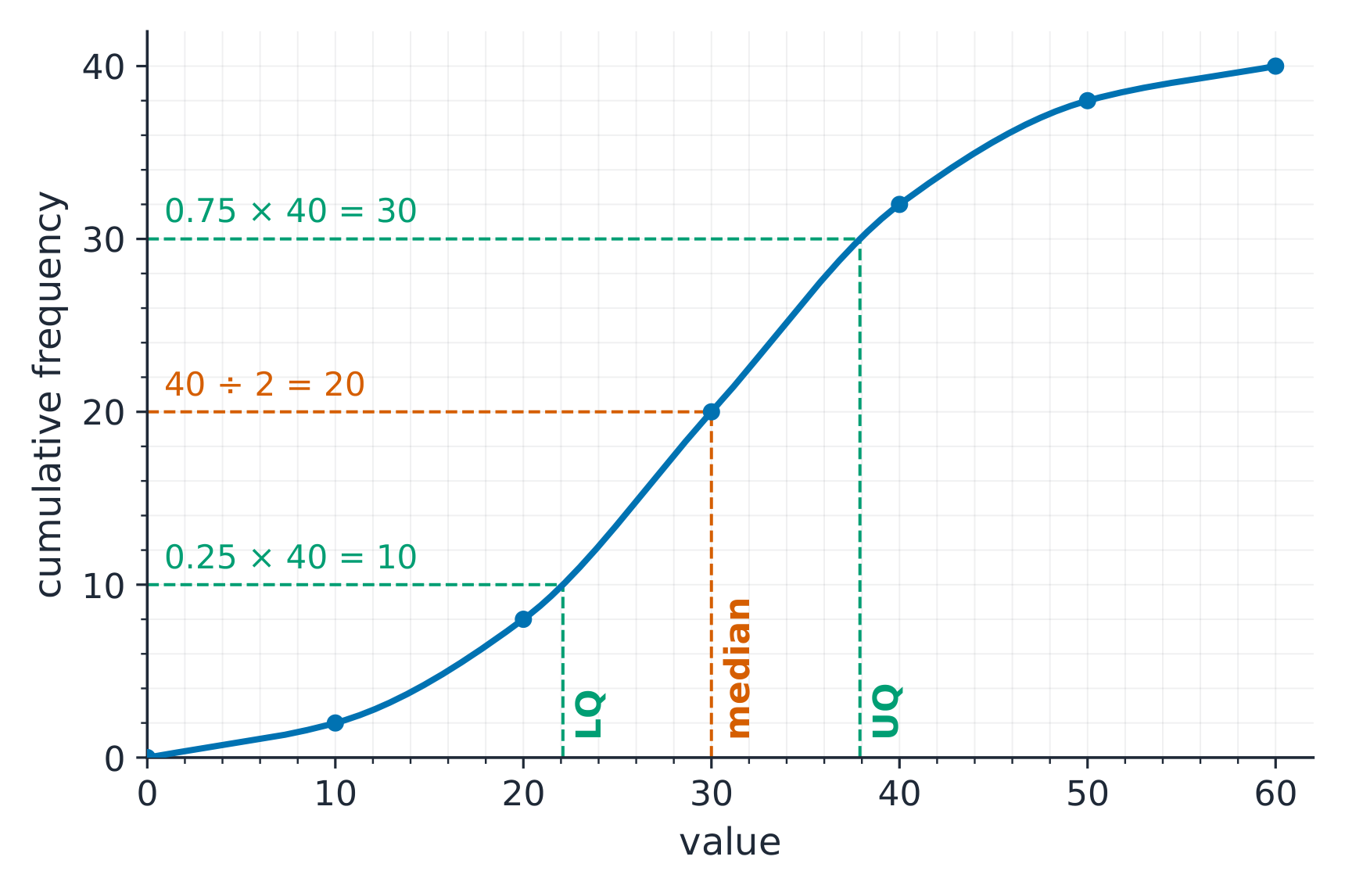
Read the median at half the total and the quartiles at one quarter and three quarters: go across to the curve, then down
Una curva de frecuencia acumulada tiene un total de 80. ¿En qué frecuencia acumulada se lee la mediana?
Dificultad 2/5 · 140 monedas + un pequeño bono en el primer intento de hoy
La mediana está a la mitad del total: 80 ÷ 2 = 40.
La frecuencia acumulada total es 120. ¿En qué frecuencia acumulada se lee el cuartil superior?
Dificultad 2/5 · 140 monedas + un pequeño bono en el primer intento de hoy
El CU está a 3/4 del total: (3/4) × 120 = 90.
Para leer la mediana de una curva de frecuencia acumulada, vaya ______ desde el eje y hacia la curva, luego baje al eje x.
Dificultad 1/5 · 100 monedas + un pequeño bono en el primer intento de hoy
Vaya horizontalmente desde el valor en el eje y hasta la curva, luego baje para leer el valor en el eje x.
Worked example
- Total cumulative frequency $= 80$. Median at $80 \div 2 = 40$. Read across at $40$ on the $y$-axis, then down — suppose it reads $24$. The median is $24$.

A cumulative frequency curve always rises — the shape is like an elongated S, steep where data is concentrated.
Hay 25 observaciones y frecuencia acumulada 13 en 20. ¿Cuántas son al menos 20?
Dificultad 2/5 · 140 monedas + un pequeño bono en el primer intento de hoy
Resta el conteo debajo de 20: 25 − 13 = 12.
Include the start and read a count
- For classes $0\le t<10,10\le t<20,20\le t<30$ with frequencies 5,8,12, plot $(0,0),(10,5),(20,13),(30,25)$. The first point states that none are below the lower starting boundary.
- At 20, cumulative frequency is 13, so $25-13=12$ observations are at least 20. Quartile positions are $25/4=6.25$ and $3(25)/4=18.75$ on the cumulative axis; read values from the drawn curve.
You've got it
- cumulative frequency $=$ running total, plotted at each class's upper end
- read the median at half the total; quartiles at $\dfrac{1}{4}$ and $\dfrac{3}{4}$
- across to the curve, then straight down to the value
Write from the data: find the median position
- A cumulative frequency curve has total 60.
- The median is at half the total.
Una curva de frecuencia acumulada tiene un total de 60. ¿En qué frecuencia acumulada se lee la mediana?
La mitad de 60 es 30.
¿En qué frecuencia acumulada se encuentra la mediana?
Dificultad 1/5 · 100 monedas + un pequeño bono en el primer intento de hoy
La mediana se sitúa a mitad de camino en la curva. Otras opciones — 40 (la posición de la lección de la mediana); 60 (el total).