Types of number
Introducido| English | Significado |
|---|---|
| rational/ˈræʃənl/ | número racional |
| irrational/ɪˈræʃənl/ | número irracional |
| natural numbers/ˈnætʃərəl ˈnʌmbəz/ | números naturales |
| integers/ˈɪntɪdʒəz/ | números enteros |
| factor/ˈfæktə/ | factor |
| multiple/ˈmʌltɪpl/ | múltiplo |
| prime/praɪm/ | número primo |
| prime factorisation/praɪm ˌfæktəraɪˈzeɪʃn/ | descomposición en factores primos |
| HCF/ˌeɪtʃ siː ˈef/ | MCD |
| LCM/ˌel siː ˈem/ | mínimo común múltiplo |
| reciprocal/rɪˈsɪprəkl/ | recíproco |
A question that stumped the ancient Greeks
- Is every number a fraction? The Greeks thought yes — until someone proved $\sqrt{2}$ cannot be written as $\dfrac{a}{b}$.
- Legend says the discoverer was thrown overboard for revealing this uncomfortable truth.
- Today we sort numbers into families, and that split — rational 有理数 vs irrational 无理数 — is still the big one.
The number families
- Natural numbers 自然数 $\mathbb{N} = \{1, 2, 3, \dots\}$ — the counting numbers (some definitions include $0$).
- Integers 整数 $\mathbb{Z} = \{\dots, -2, -1, 0, 1, 2, \dots\}$ — whole numbers, positive, negative and zero.
- Rational numbers $\mathbb{Q}$ — anything that can be written $\dfrac{a}{b}$ where $a, b$ are integers and $b \neq 0$.
- Irrational numbers — everything else ($\pi$, $\sqrt{2}$, $e$): they cannot be expressed as a fraction.

Natural → Integer → Rational, each a bigger family. Irrational numbers live outside.
Conjuntos de números
Every counting number is also an integer, every integer a rational — see how the number sets nest, and how union and intersection combine them.
Match each number to its smallest number family.
Dificultad 2/5 · 140 monedas + un pequeño bono en el primer intento de hoy
−5 and 0 are integers (whole numbers, including negatives). 3/7 is rational (a fraction of integers). √3 is irrational (cannot be written as a/b).
Factors 因数, multiples 倍数 and primes 质数
- A factor of $n$ divides into $n$ exactly. Factors of $12$: $1, 2, 3, 4, 6, 12$.
- A multiple of $n$ is $n \times$ an integer. Multiples of $5$: $5, 10, 15, 20, \dots$.
- A prime has exactly two factors: $1$ and itself.
- $2, 3, 5, 7, 11, 13, \dots$ are prime. $1$ is not prime (only one factor).
1 is NOT prime. A prime must have exactly two distinct factors. $1$ has only one factor (itself), so it fails the definition.
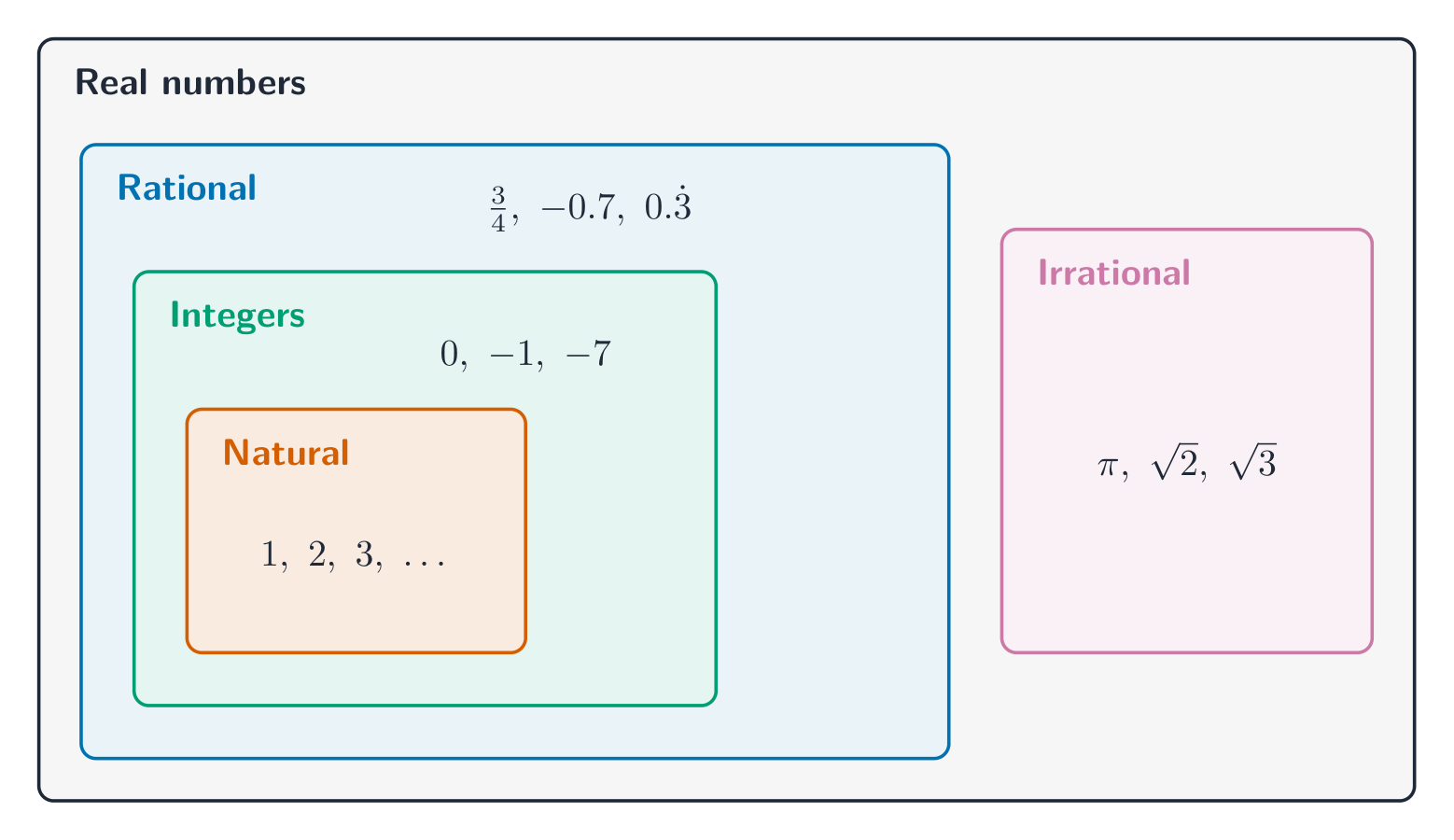
Every natural number is an integer, every integer is rational, and every rational is real; irrational numbers like $\pi$ and $\sqrt{2}$ are real but not rational
Which of these is a prime number?
Dificultad 1/5 · 100 monedas + un pequeño bono en el primer intento de hoy
13 has exactly two factors (1 and 13). 1 is not prime; 9 = 3×3; 15 = 3×5.
The number 1 is a prime number.
Dificultad 1/5 · 100 monedas + un pequeño bono en el primer intento de hoy
1 has only one factor (itself). A prime must have exactly two distinct factors.
The smallest prime number is ______.
Dificultad 1/5 · 100 monedas + un pequeño bono en el primer intento de hoy
2 is the smallest (and only even) prime number.
Prime factorisation 质因数分解, HCF 最大公因数 and LCM 最小公倍数
- Write any number as a product of primes: $72 = 2^3 \times 3^2$, $120 = 2^3 \times 3 \times 5$.
- HCF (highest common factor): take the lowest power of each shared prime.
- HCF of $72$ and $120$ $= 2^3 \times 3 = 24$.
- LCM (lowest common multiple): take the highest power of every prime that appears.
- LCM of $72$ and $120$ $= 2^3 \times 3^2 \times 5 = 360$.
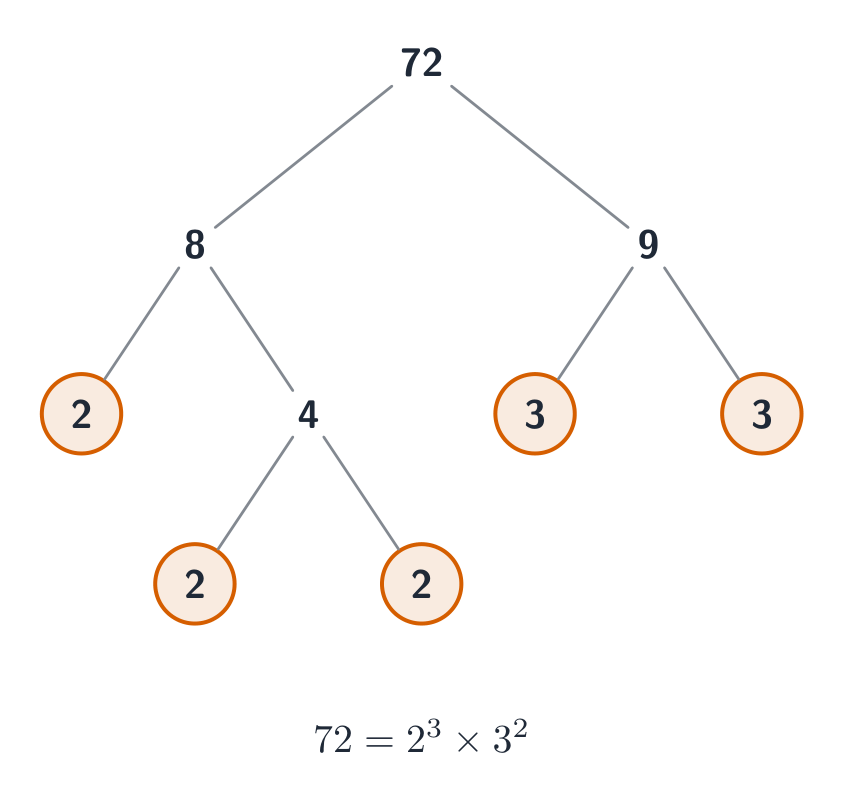
Keep splitting until every branch ends on a prime (circled); collecting them gives $72 = 2^3 \times 3^2$
Quick check. HCF × LCM should equal the product of the two numbers: $24 \times 360 = 8640$ and $72 \times 120 = 8640$. ✓
Find the HCF of 72 and 120. (72 = 2³×3², 120 = 2³×3×5)
Dificultad 2/5 · 140 monedas + un pequeño bono en el primer intento de hoy
Take the lowest shared powers: 2³ × 3 = 8 × 3 = 24.
Find the LCM of 72 and 120.
Dificultad 2/5 · 140 monedas + un pequeño bono en el primer intento de hoy
Take the highest powers: 2³ × 3² × 5 = 8 × 9 × 5 = 360.
Worked example: HCF and LCM in context
$84 = 2^2 \times 3 \times 7$ and $90 = 2 \times 3^2 \times 5$.
- HCF: take each prime they share, at the lower power: $2 \times 3 = 6$.
- LCM: take every prime, at the higher power: $2^2 \times 3^2 \times 5 \times 7 = 1260$.
Which one? Read the question:
- "Cut two ropes of 84 cm and 90 cm into equal pieces, as long as possible" → the pieces must divide both → HCF $= 6$ cm.
- "Bus A leaves every 12 min, bus B every 18 min. Both leave at 09:00. When do they next leave together?" → a time that both reach → LCM of 12 and 18 $= 36$ min, so at 09:36.
One light flashes every 8 seconds, another every 12 seconds. They flash together now. After how many seconds do they next flash together?
Dificultad 2/5 · 140 monedas + un pequeño bono en el primer intento de hoy
Both must reach the same time, so use the LCM: LCM(8, 12) = 24 seconds.
A teacher shares 48 pens and 60 pencils equally into packs with nothing left over. What is the largest number of packs she can make?
Dificultad 2/5 · 140 monedas + un pequeño bono en el primer intento de hoy
The number of packs must divide both 48 and 60, so use the HCF: HCF(48, 60) = 12.
Reciprocals and place value
- The reciprocal 倒数 of a nonzero number multiplies it to 1: for $3/7$ it is $7/3$, since $(3/7)(7/3)=1$. Zero has no reciprocal.
- Group large numbers into thousands: 6000042 is six million and forty-two. $6\,000\,042=6(1\,000\,000)+42$; the zeros hold the missing place values.

Find the reciprocal of 5/9.
Dificultad 2/5 · 140 monedas + un pequeño bono en el primer intento de hoy
The reciprocal is 9/5 = 1.8; multiplying by 5/9 gives 1.
You've got it
- natural $\mathbb{N}$ → integer $\mathbb{Z}$ → rational $\mathbb{Q}$; irrational numbers live outside
- prime = exactly two factors ($1$ is not prime)
- HCF = lowest shared prime powers; LCM = highest prime powers of every prime
- $72 = 2^3 \times 3^2$, $120 = 2^3 \times 3 \times 5$ → HCF $24$, LCM $360$
Write from an HCF of 16
- Find the HCF of 48 and 80.
- 48 is 16 times 3 and 80 is 16 times 5.
What is the HCF of 48 and 80?
16 times 3 is 48 and 16 times 5 is 80.
What is the HCF?
Dificultad 1/5 · 100 monedas + un pequeño bono en el primer intento de hoy
The greatest shared factor is 16. Other options — 24 (the lesson example's HCF); 240 (the LCM of 48 and 80).