Sets · Conjuntos
| English | Español |
|---|---|
| set/set/ | conjunto |
| elements/ˈelɪmənts/ | elementos |
| universal set/ˌjuːnɪˈvɜːsl set/ | conjunto universal |
| empty set/ˈempti set/ | conjunto vacío |
| intersection/ˌɪntəˈsekʃn/ | intersección |
| union/ˈjuːnɪən/ | sindicato |
| complement/ˈkɒmplɪmənt/ | complemento |
| Venn diagram/ven ˈdaɪəɡræm/ | diagrama de Venn |
The class of 2024
- A school has 30 students. 18 study French, 12 study Spanish, and 5 study both · ambas.
- How many study neither · ninguno? You can't just add — you need sets 集合.
- Sets are the language of grouping, and they power everything from databases to probability.
What is a set?
- A set · conjunto is a collection of distinct objects (the elements 元素 or members).
- Written with curly braces: $A = \{1, 2, 3, 4, 5\}$.
- $3 \in A$ means "$3$ is an element of $A$"; $7 \notin A$ means "$7$ is not".
- The · El universal set 全集 $\xi$ contains everything under discussion. The empty set 空集 $\emptyset$ has no elements.

$A\cap B=\{6\}$ is the only number in both circles; $A\cup B$ is everything inside either circle
Set operations on a Venn diagram · Operaciones de conjuntos en un diagrama de Venn
A Venn diagram shows two sets. Slide through the operations to see which region union, intersection and complement shade in. · Un diagrama de Venn muestra dos conjuntos. Desliza por las operaciones para ver qué región sombrea la unión, intersección y complemento.
The empty set ∅ is a subset of every set. · El conjunto vacío ∅ es subconjunto de todo conjunto.
The empty set has no elements, so it is trivially contained in every set. · El conjunto vacío no tiene elementos, por lo que está trivialmente contenido en todo conjunto.
Intersection 交集 and union 并集
- Intersection $A \cap B$: elements in both · ambas $A$ and · y $B$.
- Union $A \cup B$: elements in $A$ or $B$ (or both).
- Complement 补集 $A'$: everything in the universal set that is not · no in · hacia adentro $A$.
$A = \{1, 2, 3, 4\}$, $B = \{3, 4, 5, 6\}$. Then $A \cap B = \{3, 4\}$ and · y $A \cup B = \{1, 2, 3, 4, 5, 6\}$.
A = {2,4,6,8,10} and B = {3,6,9}. How many elements are in A ∩ B? · A = {2,4,6,8,10} y B = {3,6,9}. ¿Cuántos elementos hay en A ∩ B?
Only 6 is in both sets, so A ∩ B = {6}, which has 1 element. · Solo el 6 está en ambos conjuntos, por lo que A ∩ B = {6}, lo cual tiene 1 elemento.
For the same A and B, how many elements are in A ∪ B? · Para los mismos A y B, ¿cuántos elementos hay en A B?
A ∪ B = {2,3,4,6,8,9,10}, which has 7 elements. · A ∪ B = {2,3,4,6,8,9,10}, lo cual tiene 7 elementos.
The symbol ∩ means: · El símbolo ∩ significa:
∩ is intersection (elements in both A and B); ∪ is union. · ∩ es intersección (elementos en ambos A y B); ∪ es unión.
Venn diagrams 维恩图
- A Venn diagram draws sets as overlapping circles inside a rectangle (the universal set).
- Overlapping region = intersection; everything inside a circle = that set's members.
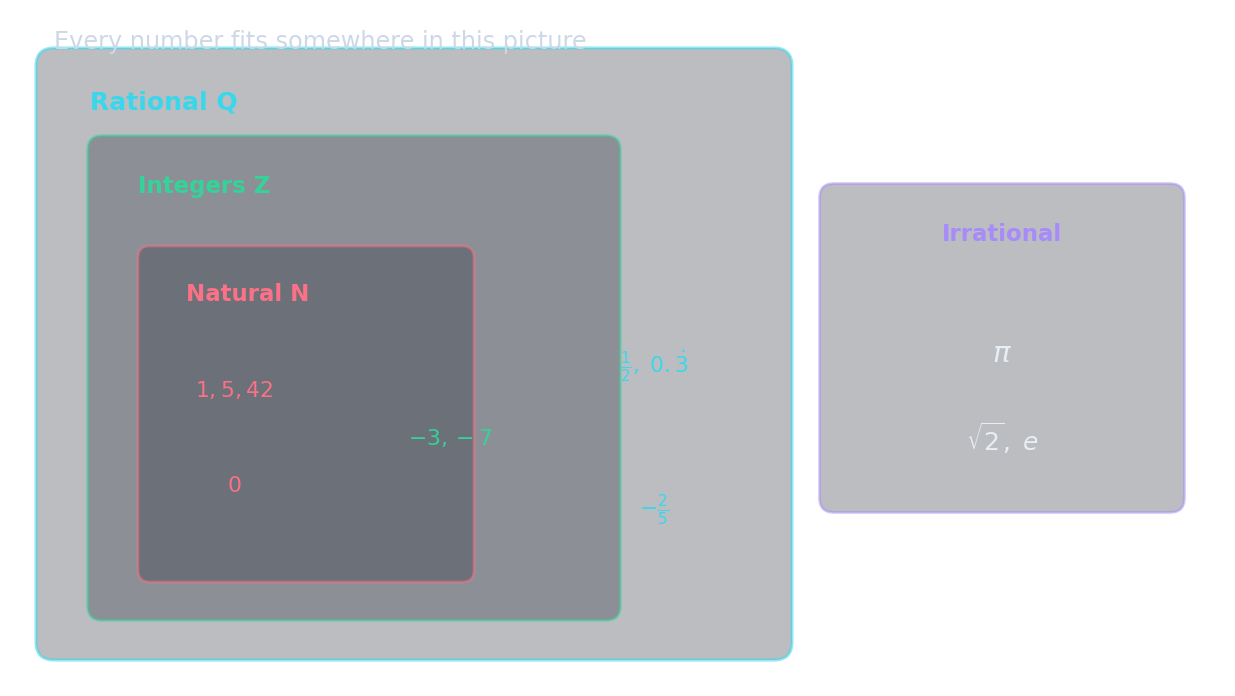
Venn diagrams show how sets relate — here, every natural number is also an integer and a rational.
Don't double-count. When finding $n(A \cup B)$, use $n(A) + n(B) - n(A \cap B)$. The intersection is counted once in each set, so subtract it once.
Worked example · Ejemplo resuelto
- 30 students, $F =$ French (18), $S =$ Spanish (12), $F \cap S = 5$.
- $n(F \cup S) = 18 + 12 - 5 = 25$.
- Neither $= 30 - 25 = 5$ students study neither language.
n(A) = 5, n(B) = 3, n(A ∩ B) = 1. Find n(A ∪ B). · n(A) = 5, n(B) = 3, n(A ∩ B) = 1. Encuentra n(A ∪ B).
n(A ∪ B) = n(A) + n(B) − n(A ∩ B) = 5 + 3 − 1 = 7.
In a class of 30, 18 study French, 12 study Spanish, and 5 study both. How many study neither? · En una clase de 30 estudiantes, 18 estudian francés, 12 estudian español y 5 estudian ambos. ¿Cuántos no estudian ninguno?
n(F ∪ S) = 18 + 12 − 5 = 25. Neither = 30 − 25 = 5. · n(F ∪ S) = 18 + 12 − 5 = 25. Ninguno = 30 − 25 = 5.
Three sets (Extended)
- In a three-set Venn diagram, fill the triple overlap first, then the parts belonging to exactly two sets, then the single-set regions. If $n(A\cap B)=7$ includes 2 in all three, the AB-only region is $7-2=5$.
- For · A favor $n(A)=12,n(B)=10,n(C)=9$, pair intersections AB=4, AC=3, BC=2 and triple=1, the union is $n(A\cup B\cup C)=12+10+9-4-3-2+1=23$. The triple is added back because the three pair subtractions removed it too often.
Set sizes are 12,10,9; pair intersections 4,3,2; triple intersection 1. Find the union size. · Los tamaños de los conjuntos son 12,10,9; las intersecciones de pares 4,3,2; la intersección triple 1. Encontrar el tamaño de la unión.
Add singles, subtract all pairs, add triple: 31−9+1 = 23. · Sumar los individuales, restar todos los pares, sumar el triple: 31−9+1 = 23.
You've got it
- $A \cap B$ = intersection (both · ambas); $A \cup B$ = union (either or both); $A'$ = complement
- $n(A \cup B) = n(A) + n(B) - n(A \cap B)$ — subtract the overlap
- Venn diagrams show set relationships visually; the rectangle is the universal set
- $\emptyset$ = empty set; $\xi$ = universal set