Writing an article · Escribir un artículo
What an article is for
- An article is for a magazine, a newspaper or a website.
- It informs or entertains a general reader.
- You usually give your own view, with reasons.
An article title is a front door, not the whole building.
Para qué sirve un artículo
- Un artículo se escribe para una revista, un periódico o un sitio web.
- Informa o entretiene a un lector general.
- Generalmente das tu propia opinión, con argumentos.
El título de un artículo es la puerta de entrada, no todo el edificio.
Who reads an article?
An article is written for many general readers.
Catch the reader
- A strong title and first line catch the reader's interest.
- Ask a question, or start with a surprising fact.
- Keep the reader wanting to read more.
Three ways to catch the reader's interest in your first lines
Captar al lector
- Un título fuerte y la primera línea captan el interés del lector.
- Haz una pregunta o comienza con un dato sorprendente.
- Mantén al lector con ganas de seguir leyendo.
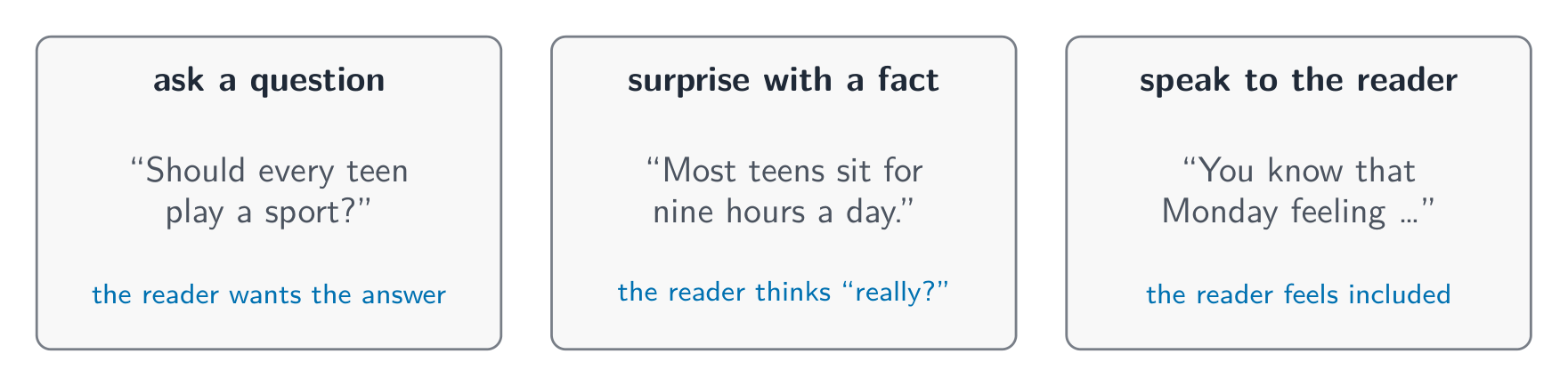
Tres formas de captar el interés del lector en tus primeras líneas
Hook or snooze? · ¿Gancho o aburrimiento?
A hook makes the reader need line two; a snooze announces the topic and loses them.
A dull title is fine for an article.
A catchy title is needed to grab interest.
Write a catchy first line for an article about your favourite hobby.
Example: 'Could one small hobby change your whole week?'
Lively language
- Shape: introduction → middle → short conclusion.
- Use varied words and sentence lengths.
- You can speak to the reader directly with 'you'.
Lenguaje dinámico
- Estructura: introducción → desarrollo → conclusión breve.
- Usa vocabulario variado y diferentes longitudes de oraciones.
- Puedes dirigirte directamente al lector usando 'tú'.
Put the parts of an article in order.
Title and opening first, then the points, then a conclusion.
An article has an introduction, a developed middle and a short ____.
The conclusion draws the ideas together and leaves the reader with a clear final thought.
Hook, then deliver
- Task: an article for the school magazine about learning an instrument.
- Headline: "The Ten-Minute Musician" — short, curious, no full stop.
- Hook: "Did you know ten minutes of practice a day beats a two-hour cram on Sunday?"
- Then deliver: your view plus reasons, and an ending that echoes the hook: "Ten minutes. Every day. That's the whole secret."
Gancho, luego contenido
- Tarea: un artículo para la revista escolar sobre aprender un instrumento musical.
- Titular: "El Músico de Diez Minutos" — corto, curioso, sin punto final.
- Gancho: "¿Sabías que diez minutos de práctica al día superan a un maratón de estudio de dos horas el domingo?"
- Luego el contenido: tu opinión más razones, y un cierre que haga eco al gancho: "Diez minutos. Cada día. Ese es todo el secreto."
Match the hook technique to its example.
Four reliable hooks — pick the one that fits your topic and audience.
An article for a school magazine argues for a quiet reading room. Which sentence best addresses its readers?
Direct address suits a magazine article for students. The alternatives belong to a formal letter or report.
An interesting opening is enough; the article does not need reasons or development.
The opening attracts attention, but the middle must deliver useful ideas and supporting reasons.
- An article is for many readers; it informs or entertains.
- A catchy title and opening grab interest.
- Lively, varied language keeps energy up.
- Un artículo va dirigido a muchos lectores; informa o entretiene.
- Un título llamativo y una apertura atractiva captan el interés.
- Un lenguaje dinámico y variado mantiene la energía alta.