Structure and lively language · Estructura y lenguaje vivo
A clear shape
- Begin with an introduction that names the topic.
- Develop your points in the middle.
- End with a short conclusion that leaves the reader thinking.
A surprising fact should surprise the reader, not the writer who forgot to check it.
Una forma clara
- Comienza con una introducción que nome el tema.
- Desarrolla tus puntos en la parte central.
- Termina con una breve conclusión que deje al lector pensando.
Un dato sorprendente debe sorprender al lector, no al escritor que olvidó verificarlo.
Build an article, top to bottom · Construye un artículo, de arriba hacia abajo
Title hooks, opening promises, points deliver, the ending echoes the start.
Put the parts of an article in order.
Title and opening first, then points, then a conclusion.
Catch the reader
- A strong title and first line catch interest.
- Ask a question, or start with a surprising fact.
- Keep the reader wanting to read more.
The shape of a lively article: hook the reader, keep them, leave them thinking
Captar la atención del lector
- Un título fuerte y la primera línea captan el interés.
- Haz una pregunta o comienza con un dato sorprendente.
- Mantén al lector con ganas de seguir leyendo.
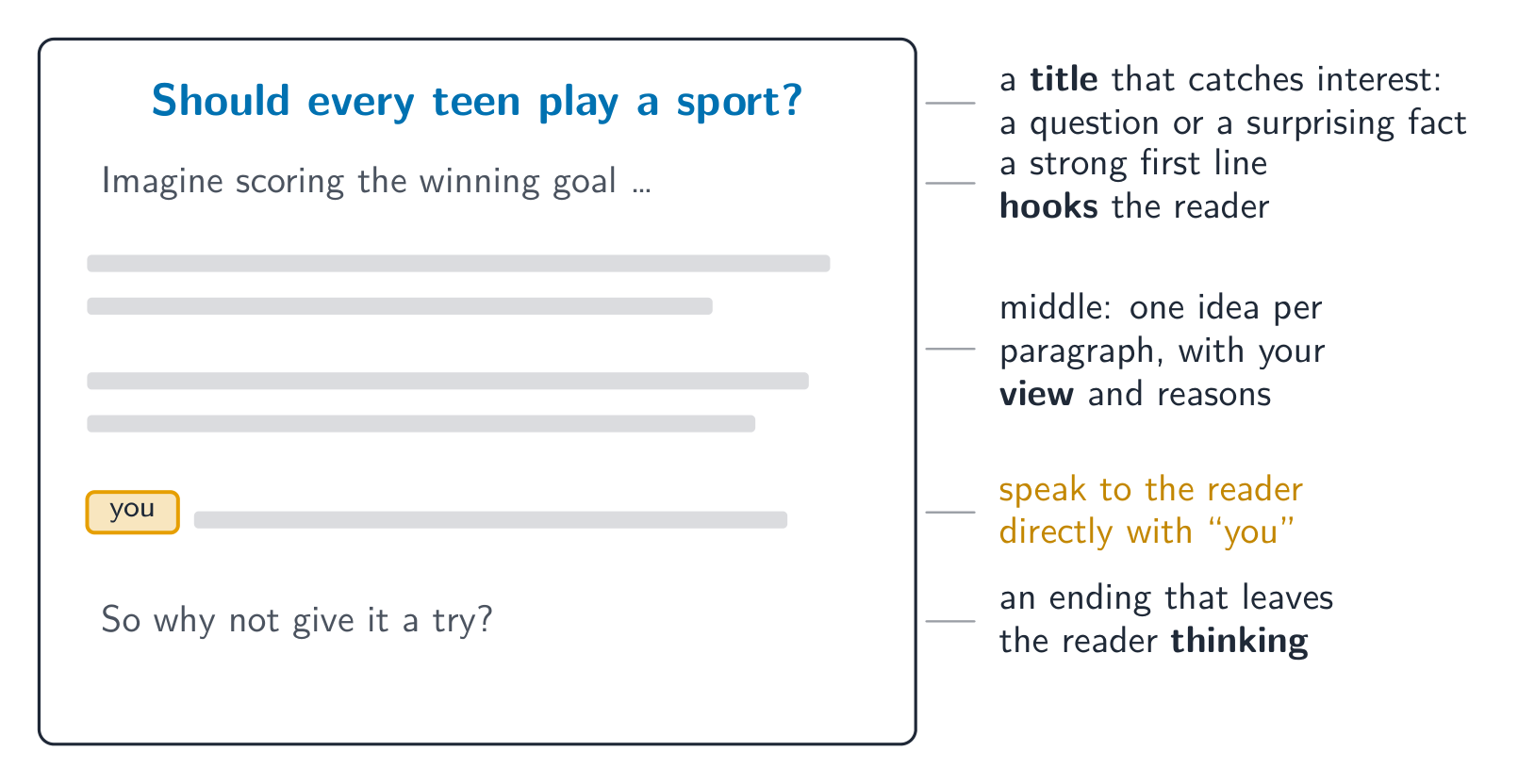
La estructura de un artículo dinámico: enganchar al lector, mantenerlo, dejarlo pensando
A dull title is fine for an article.
A catchy title is needed to grab interest.
Write a catchy first line for an article about your town.
Example: 'Think nothing happens in a small town? Think again!'
Lively language
- Use varied words and sentence lengths.
- You can speak to the reader directly with 'you'.
- Keep the tone friendly, but not too casual.
Lenguaje vivo
- Usa palabras variadas y diferentes longitudes de oraciones.
- Puedes dirigirte directamente al lector usando "tú".
- Mantén un tono amable, pero sin ser demasiado informal.
Lively language for an article means…
Variety keeps the writing lively.
Lively lines, dissected
- "Street food in our town is not just cheap. It's theatre. You watch the cook toss noodles through fire, and suddenly dinner has a soundtrack."
- Sentence lengths: long → two-word punch (It's theatre.) → long again. That rhythm is the energy.
- Direct address (you watch) pulls the reader onto the street.
- One tiny metaphor (a soundtrack) beats three adjectives.
Líneas vivas, analizadas
- "La comida callejera en nuestra ciudad no es solo barata. Es teatro. Ves al cocinero lanzar fideos a través del fuego y, de repente, la cena tiene banda sonora."
- Longitud de las oraciones: larga → golpe de dos palabras (Es teatro.) → larga de nuevo. Ese ritmo es la energía.
- El trato directo (ves al cocinero) sumerge al lector en la calle.
- Una pequeña metáfora (banda sonora) vale más que tres adjetivos.
Read this article opening: “Feeling hungry? You can find fresh noodles, warm bread and sizzling vegetables at the night market.” Which TWO techniques does it use?
“Feeling hungry?” is a two-word punch sentence; “you” addresses the reader directly. The passage uses varied food descriptions rather than repeating “nice”.
- Introduction → middle → short conclusion.
- A catchy title and opening grab interest.
- Lively, varied language keeps the energy up.
- Introducción → desarrollo → breve conclusión.
- Un título llamativo y una apertura atractiva captan el interés.
- Un lenguaje vivo y variado mantiene la energía alta.