Structure and formal language · Estructura y lenguaje formal
Opening and closing
- Open with Dear Mr Lee, or Dear Sir/Madam,
- With a name → close Yours sincerely,; with Sir/Madam → Yours faithfully,
- Match the closing to the opening.
A formal opening and a casual sign-off are like a suit worn with beach sandals: the mismatch gets noticed first.
Apertura y cierre
- Inicia con Dear Mr Lee, o Dear Sir/Madam,
- Si mencionas un nombre → cierra con Yours sincerely,; si usas Sir/Madam → Yours faithfully,
- Alinea el cierre con la apertura.
Una apertura formal y una despedida informal son como llevar un traje con sandalias de playa: la incongruencia se nota de inmediato.
You begin 'Dear Sir/Madam,'. How should you end? · Usted comienza con 'Estimados señores,'. ¿Cómo debería terminar?
No name in the greeting → 'Yours faithfully,'. · Sin nombre en el saludo → 'Leal saludación,'.
Clear paragraphs
- First paragraph: say why you are writing.
- Middle: your points, one idea each.
- Last paragraph: say what you would like to happen next.
Turning friendly phrases into formal ones
Párrafos claros
- Primer párrafo: explica por qué escribes.
- Cuerpo: tus puntos, una idea por párrafo.
- Último párrafo: indica lo que esperas que ocurra a continuación.
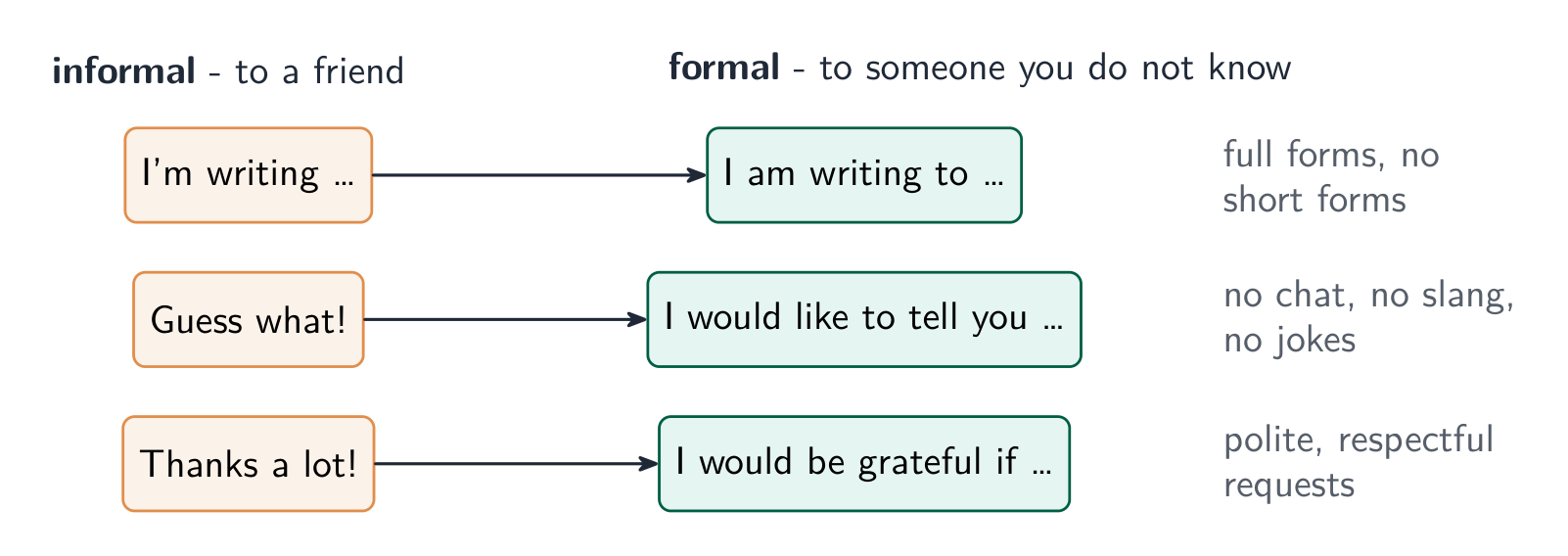
Transformar frases informales en formales
Layout of a formal letter · Diseño de una carta formal
Five zones, top to bottom: greeting, reason, points, request, matching sign-off. · Cinco zonas, de arriba hacia abajo: saludo, motivo, puntos, solicitud, despedida correspondiente.
Formal language
- No short forms: write I am, not I'm.
- Use polite phrases: I would like to…, I am writing to…
- Keep sentences clear and complete.
Lenguaje formal
- No uses contracciones: escribe I am, no I'm.
- Utiliza frases corteses: I would like to…, I am writing to…
- Mantén las oraciones claras y completas.
In a formal letter you can write 'I'm' and 'don't'. · En una carta formal se puede escribir 'I'm' y 'don't'.
No — use full forms: 'I am', 'do not'. · No — use las formas completas: 'I am', 'do not'.
Make it formal: 'I ___ writing to ask about the job.' · Hágalo formal: 'I ___ writing to ask about the job.'
Formal writing uses the full form 'am'. · La escritura formal utiliza la forma completa 'am'.
Write a polite opening line for a formal email asking for information. · Escriba una línea de apertura educada para un correo formal solicitando información.
Example: 'I am writing to ask for more information about the course.' · Ejemplo: 'I am writing to ask for more information about the course.'
First and last paragraphs do the heavy lifting
- First: "Dear Mrs Chen, I am writing to suggest a recycling scheme for our school." — the reason, in one line.
- The middle carries your points, one paragraph each.
- Last: "I would be grateful if you could consider this plan at the next meeting." — the action you want.
- Close the frame: a named reader → Yours sincerely, + your full name.
Los primeros y últimos párrafos son clave
- Inicio: "Dear Mrs Chen, I am writing to suggest a recycling scheme for our school." — la razón, en una línea.
- El cuerpo expone tus puntos, uno por párrafo.
- Final: "I would be grateful if you could consider this plan at the next meeting." — la acción que deseas.
- Cierra el marco: destinatario con nombre → Yours sincerely, + tu nombre completo.
Put the parts of a formal letter in order. · Ordene las partes de una carta formal.
Greeting → reason → points → request → matching sign-off. · Saludo → motivo → puntos → solicitud → despedida correspondiente.
- Match the closing to the opening.
- Clear paragraphs: why → points → what next.
- Formal = full forms, polite phrases, no slang.
- Alinea el cierre con la apertura.
- Párrafos claros: motivo → puntos → acciones siguientes.
- Formal = formas completas, frases corteses, sin jerga.