Supply-side policy
Introducido| English | Significado |
|---|---|
| supply-side policy/səˈplaɪ saɪd ˈpɒlɪsi/ | política de oferta |
| capacity/kəˈpæsɪti/ | Capacidad productiva |
| productivity/ˌprɒdəkˈtɪvɪti/ | productividad |
| investment/ɪnˈvestmənt/ | Inversión |
| infrastructure/ˈɪnfrəstrʌktʃə/ | Infraestructura |
Growing the economy's engine
- Fiscal and monetary policy push demand up or down. Supply-side policy 供给侧政策 does something deeper.
- It tries to raise what the economy can produce — its productive capacity 产能.
Laboratorio de casos de economía
Classify real examples by the economic idea they show.
Supply-side policy aims mainly to:
Dificultad 1/5 · 100 monedas + un pequeño bono en el primer intento de hoy
It increases what the economy can produce.
Supply-side policy raises the economy's productive ______.
Dificultad 1/5 · 100 monedas + un pequeño bono en el primer intento de hoy
It shifts the production possibility outward.
What supply-side policy is
- Supply-side policy = measures to raise productivity 生产率 and output capacity.
- It shifts the economy's whole production possibility outward over time.
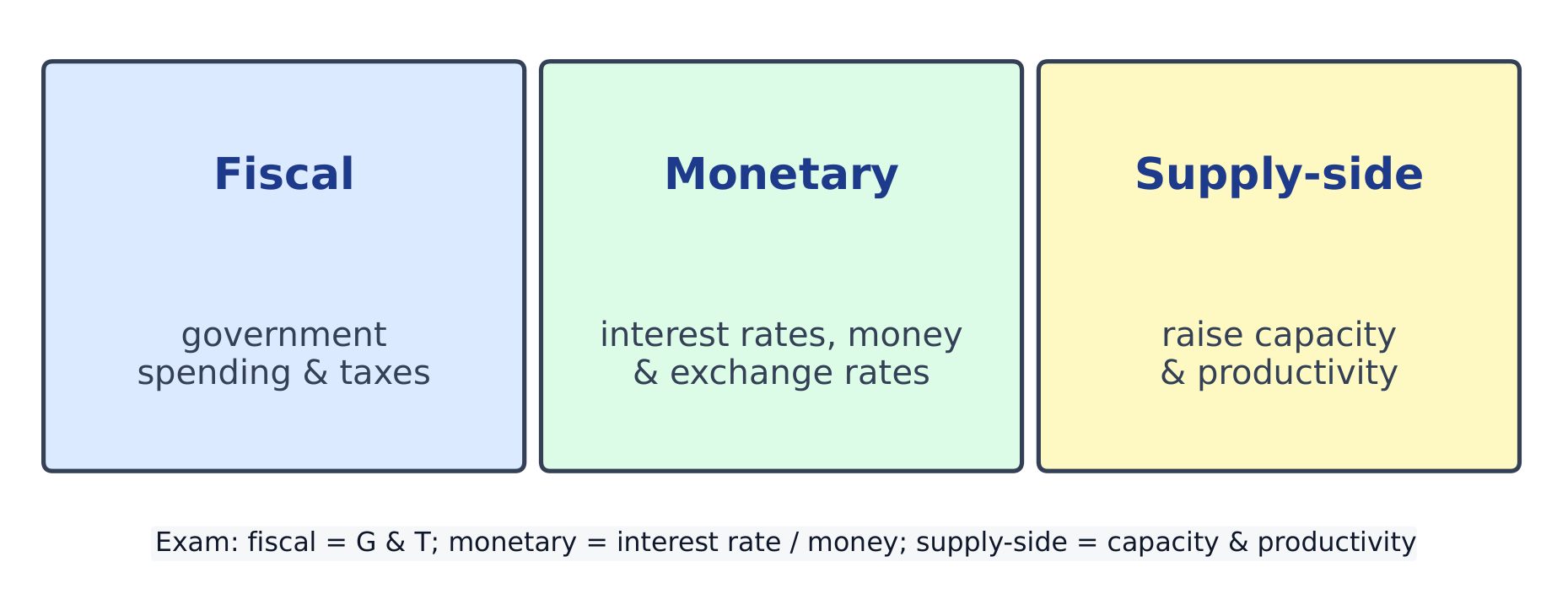
Supply-side policy aims to raise the economy's productive capacity
Which are supply-side measures? (Select all that apply.)
Dificultad 2/5 · 140 monedas + un pequeño bono en el primer intento de hoy
Interest rates are monetary policy; the rest raise capacity.
The main measures
- Education and training → a more skilled, productive workforce.
- Lower business taxes and less red tape → more investment 投资.
- Infrastructure 基础设施 and competition policy → a more efficient economy.
A key advantage of supply-side policy is that it can:
Dificultad 1/5 · 100 monedas + un pequeño bono en el primer intento de hoy
Raising capacity grows output without the inflation of demand boosts.
Supply-side policies such as training usually take effect within a few weeks.
Dificultad 1/5 · 100 monedas + un pequeño bono en el primer intento de hoy
False. Training, education and infrastructure pay off only over years, so supply-side policies usually take a long time to work.
Strengths and limits
- It can raise growth without causing inflation — the supply side, not just demand.
- But it is slow to work and can be expensive.
Supply-side ≠ demand-side. Fiscal and monetary policy manage demand; supply-side policy raises the economy's capacity to produce. They tackle different sides of the economy.
Worked example: too few engineers
A country's factories cannot expand because there are too few skilled engineers. Suggest a supply-side policy and judge it.
- Policy: fund engineering courses and apprenticeships. More skilled workers raise productivity and let firms produce more, shifting the economy's capacity (its PPC) outwards.
- Judgement: it tackles the real cause, and output can grow without pushing up prices. But it is slow (training takes years) and costly for the government, and trained engineers may move abroad.
Which is a supply-side policy?
Dificultad 1/5 · 100 monedas + un pequeño bono en el primer intento de hoy
Better infrastructure raises productive capacity; the others mainly change demand.
Supply-side policies usually work quickly.
Dificultad 1/5 · 100 monedas + un pequeño bono en el primer intento de hoy
Education, training and infrastructure take years to raise output.
You've got it
- supply-side policy raises productivity and productive capacity
- tools: education/training, lower business taxes, infrastructure, competition
- it grows the economy without inflation, but works slowly
Write from training for 1000 workers
- A scheme trains 1000 workers in skills factories are short of.
- Say which kind of policy this is.
A government scheme trains 1000 workers in skills that factories lack. Is this fiscal demand policy or supply-side policy, and what should it do to potential output?
More skilled workers increase what the economy can produce.
What kind of policy trains the 1000 workers?
Dificultad 1/5 · 100 monedas + un pequeño bono en el primer intento de hoy
Skills raise capacity, which is the supply side.