Experimental design
Introducido| English | Significado |
|---|---|
| fair test/feə test/ | prueba justa |
| independent variable/ˌɪndɪˈpendənt ˈveərɪəbl/ | variable independiente |
| dependent variable/dɪˈpendənt ˈveərɪəbl/ | variable dependiente |
| control variables/kənˈtrəʊl ˈveərɪəblz/ | variables de control |
| anomalies/əˈnɒməliz/ | anomalías |
Weighing a sealed flask, 1770s
- In the 1770s the French chemist Antoine Lavoisier heated tin in sealed glass flasks. Before opening them he weighed each flask again: the mass had not changed. When he opened them, air rushed in and the mass rose. Careful control and measurement showed that mass is conserved in a reaction.
- Good experiments change one thing, measure another and keep the rest the same: a fair test 公平测试.
Experiment design route
Follow a fair test from question to reliable conclusion.
Lavoisier's sealed flask had the same mass before and after heating.
Dificultad 1/5 · 100 monedas + un pequeño bono en el primer intento de hoy
Mass is conserved.
Three kinds of variable
- The independent variable 自变量 is the one you change. The dependent variable 因变量 is the one you measure.
- Control variables 控制变量 are kept the same, so only the independent variable can cause a change.
In an experiment on temperature and the rate of dissolving, match each variable.
Dificultad 2/5 · 140 monedas + un pequeño bono en el primer intento de hoy
Change one, measure one, keep the rest.
Choosing apparatus
- Time: stop-watch. Temperature: thermometer. Mass: balance. Gas volume: gas syringe. Liquid volume: measuring cylinder, or a burette or volumetric pipette for more accuracy.
- Each piece of apparatus is chosen for its job — in distillation, the thermometer bulb sits at the side arm, where the vapour leaves.
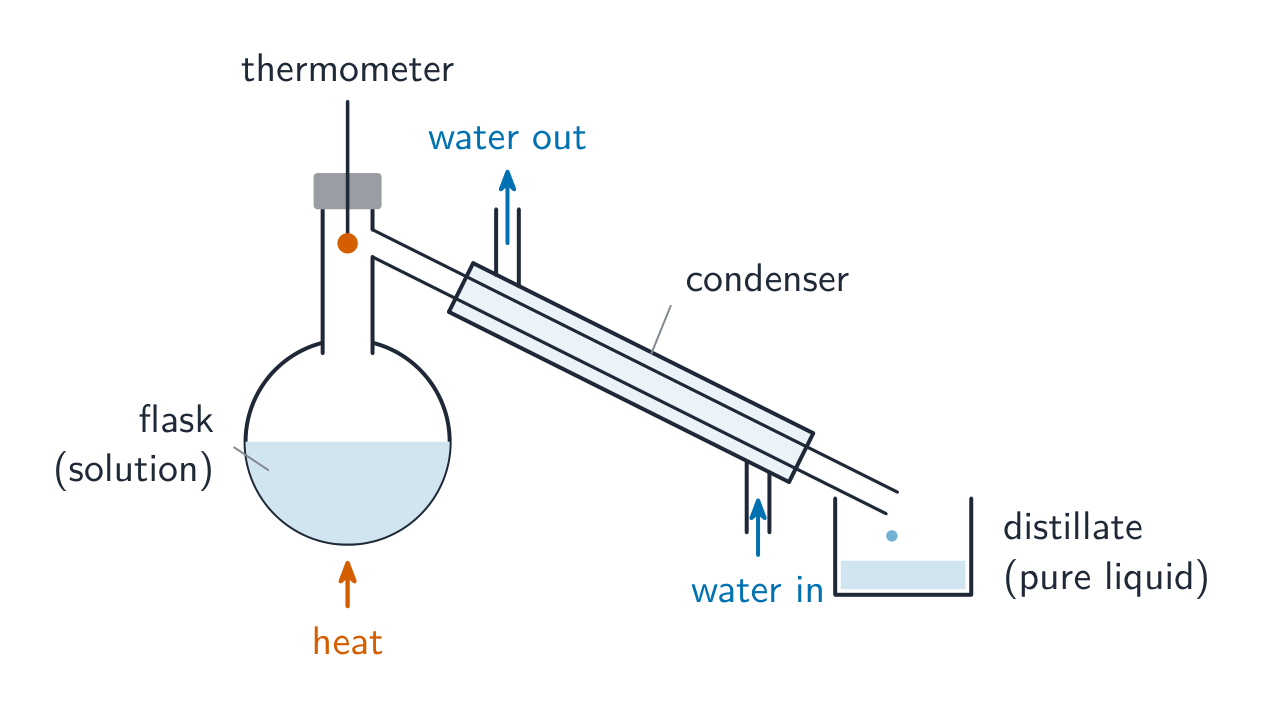
Match each measurement to the apparatus.
Dificultad 2/5 · 140 monedas + un pequeño bono en el primer intento de hoy
Choose for the job.
Which measures exactly 25.0 cm³ of a solution most accurately?
Dificultad 1/5 · 100 monedas + un pequeño bono en el primer intento de hoy
Pipettes and burettes are most accurate.
Repeats and anomalies
- Repeat each measurement (usually three times) and calculate a mean.
- Anomalies 异常值 are results that do not fit the pattern. Check them, repeat if possible, and leave them out of the mean with a reason.
An anomaly should be left out of the mean, with a reason.
Dificultad 1/5 · 100 monedas + un pequeño bono en el primer intento de hoy
It does not fit the pattern.
Worked example: plan a rate experiment
Question: does acid concentration affect how fast magnesium reacts?
- Independent: concentration of hydrochloric acid (0.5, 1.0, 1.5, 2.0 mol/dm³).
- Dependent: volume of hydrogen in 60 s, measured with a gas syringe and stop-watch.
- Controls: same length of magnesium ribbon, same volume of acid (25 cm³ from a measuring cylinder), same temperature. Repeat each concentration three times.
Working with repeat results
- Volumes 42, 44 and 61 cm³: 61 is an anomaly. Mean of the rest = $(42 + 44) \div 2 = 43$ cm³.
- Report the mean with the same precision as the readings.
Times of 30, 32 and 52 s; 52 is an anomaly. What is the mean of the other two, in s?
Dificultad 2/5 · 140 monedas + un pequeño bono en el primer intento de hoy
(30 + 32) ÷ 2.
Do not change two things at once. If both concentration and temperature change, you cannot tell which one caused the faster reaction.
Changing concentration and temperature together is a fair test.
Dificultad 1/5 · 100 monedas + un pequeño bono en el primer intento de hoy
You cannot tell which caused the change.
Change one independent variable, measure a dependent variable, and keep control variables the same. Choose apparatus for each measurement, repeat, find a mean and deal openly with anomalies.
Plan a fair test of whether the surface area of marble chips affects the rate of reaction with acid. Name the variables and apparatus.
A full plan.