Electrolysis
Introducido| English | Significado |
|---|---|
| electrolysis/ɪlekˈtrɒləsɪs/ | electrólisis |
| electrolyte/ɪˈlektrəlaɪt/ | electrolito |
| electrodes/ɪˈlektrəʊdz/ | electrodos |
| cathode/ˈkæθəʊd/ | cátodo |
| anode/ˈænəʊd/ | ánodo |
| reduction/rɪˈdʌkʃn/ | reducción |
| oxidation/ˌɒksɪˈdeɪʃn/ | oxidación |
Splitting compounds with electricity
- Some compounds are so stable that heat alone won't break them — but electricity can.
- Electrolysis 电解 uses an electric current to break down an ionic compound.
Electrolysis is the breaking down of a compound using:
Dificultad 1/5 · 100 monedas + un pequeño bono en el primer intento de hoy
An electric current decomposes the electrolyte.
The molten or dissolved ionic compound being broken down is called the ______.
Dificultad 1/5 · 100 monedas + un pequeño bono en el primer intento de hoy
The electrolyte supplies the free-moving ions.
The set-up
- The compound (molten or dissolved) is the electrolyte 电解质, holding free-moving ions.
- Two electrodes 电极 dip in: the cathode 阴极 (negative) and the anode 阳极 (positive), connected to a power supply.
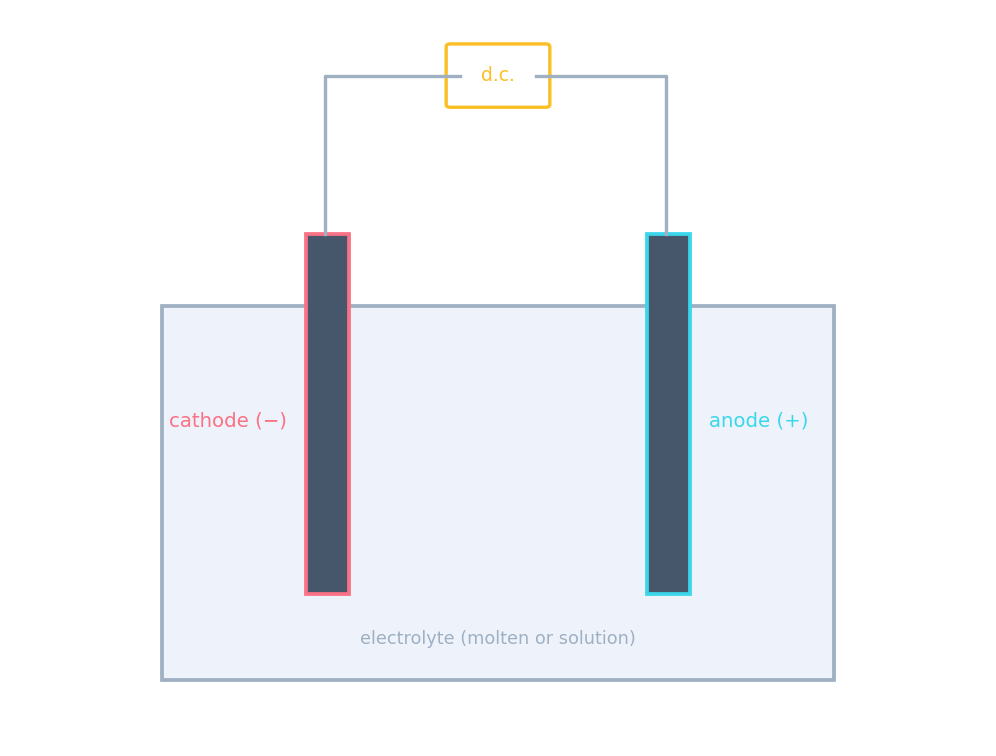
Positive ions move to the cathode; negative ions move to the anode.
Positive ions move towards the:
Dificultad 1/5 · 100 monedas + un pequeño bono en el primer intento de hoy
Opposite charges attract: positive ions → negative cathode.
Negative ions move towards the negative cathode.
Dificultad 1/5 · 100 monedas + un pequeño bono en el primer intento de hoy
False. Opposite charges attract, so negative ions (anions) move to the positive anode, and positive ions move to the cathode.
Where the ions go
- Positive ions (cations) move to the negative cathode.
- Negative ions (anions) move to the positive anode.
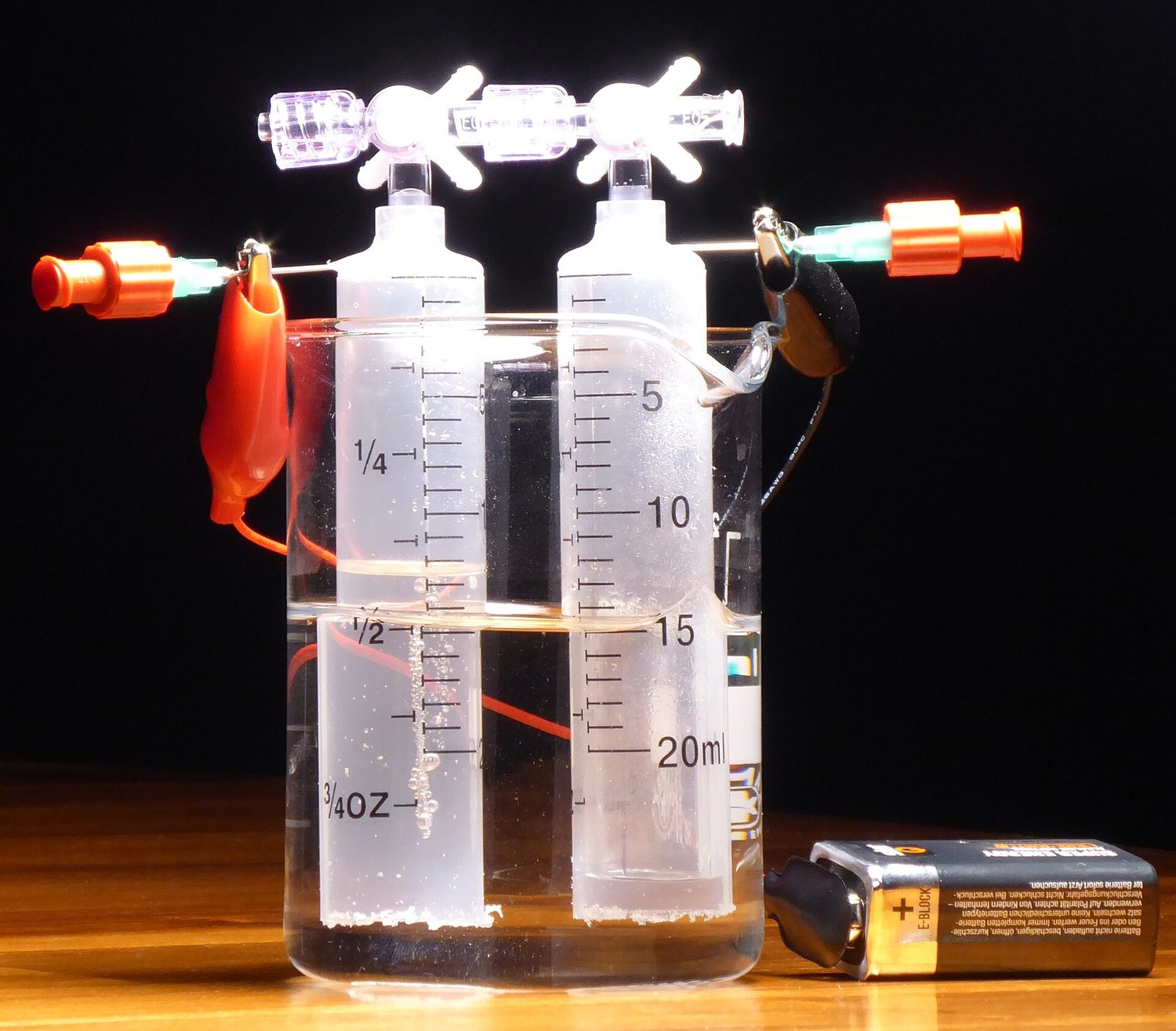
Electrolysis of water: gas bubbles off at each electrode and collects in the tubes above
Follow the ions through the cell
Step through it: the molten compound's free ions drift to the oppositely-charged electrode, then are discharged into the two elements — lead at the cathode, bromine at the anode.
For electrolysis to work, the electrolyte must be:
Dificultad 1/5 · 100 monedas + un pequeño bono en el primer intento de hoy
Free-moving ions are essential.
What happens there
- At the cathode, positive ions gain electrons (reduction 还原).
- At the anode, negative ions lose electrons (oxidation 氧化), and elements are released.
Electrolysis needs free-moving ions. A solid ionic compound won't work — its ions are locked in place. It must be molten or dissolved so the ions can move to the electrodes.
Worked example: molten lead(II) bromide
Molten lead(II) bromide, $\text{PbBr}_2$, is electrolysed. Predict the product at each electrode and write the half-equations.
- Cathode (−): $\text{Pb}^{2+}$ ions are attracted and gain electrons: $\text{Pb}^{2+} + 2\text{e}^- \rightarrow \text{Pb}$. Silvery molten lead collects underneath.
- Anode (+): $\text{Br}^-$ ions are attracted and lose electrons: $2\text{Br}^- \rightarrow \text{Br}_2 + 2\text{e}^-$. Brown bromine vapour is given off (use a fume cupboard).
Molten sodium chloride is electrolysed. What forms at the cathode and at the anode?
Dificultad 1/5 · 100 monedas + un pequeño bono en el primer intento de hoy
positivo $\text{Na}^{+}$ goes to the negative cathode and becomes Na; negative $\text{Cl}^-$ goes to the anode and becomes $\text{Cl}_2$.
How many electrons does each $\text{Pb}^{2+}$ ion gain at the cathode?
Dificultad 2/5 · 140 monedas + un pequeño bono en el primer intento de hoy
Its charge is 2+, so it needs 2 electrons to become a neutral Pb atom.
You've got it
- electrolysis breaks down a compound using electricity; the compound is the electrolyte
- positive ions → cathode (−); negative ions → anode (+)
- it needs the electrolyte molten or dissolved so ions can move
Write from this case
- Molten lead bromide is electrolysed.
- Lead ions are positive and bromide ions are negative.
Which element forms at the anode?
Negative ions go to the anode and are discharged.
What forms at the anode?
Dificultad 1/5 · 100 monedas + un pequeño bono en el primer intento de hoy
Bromide ions are discharged at the positive electrode.