Ley de Gauss
Introducido| English | Significado |
|---|---|
| Gauss's law/ˈɡaʊsɪz lɔː/ | ley de Gauss |
| permittivity/ˌpɜːmɪˈtɪvəti/ | permitividad |
| Gaussian surface/ˈɡaʊʃn ˈsɜːfɪs/ | superficie gaussiana |
Turn a nasty integral into one line
- Finding $E$ from a big charged object by integrating is hard work.
- Gauss's law 高斯定律 offers a shortcut — when the shape is symmetric.
- It links the flux through a closed surface to the charge trapped inside.
- With the right surface, you read $E$ off in a single step.
The law itself
- For any closed surface: $\oint \vec E \cdot d\vec A = \dfrac{Q_{\text{enc}}}{\varepsilon_0}$.
- The left side is the total flux; the right is the enclosed charge over $\varepsilon_0$.
- $\varepsilon_0 = 8.85\times10^{-12}$ is the permittivity 介电常数 of free space.
- Only charge inside the surface counts.
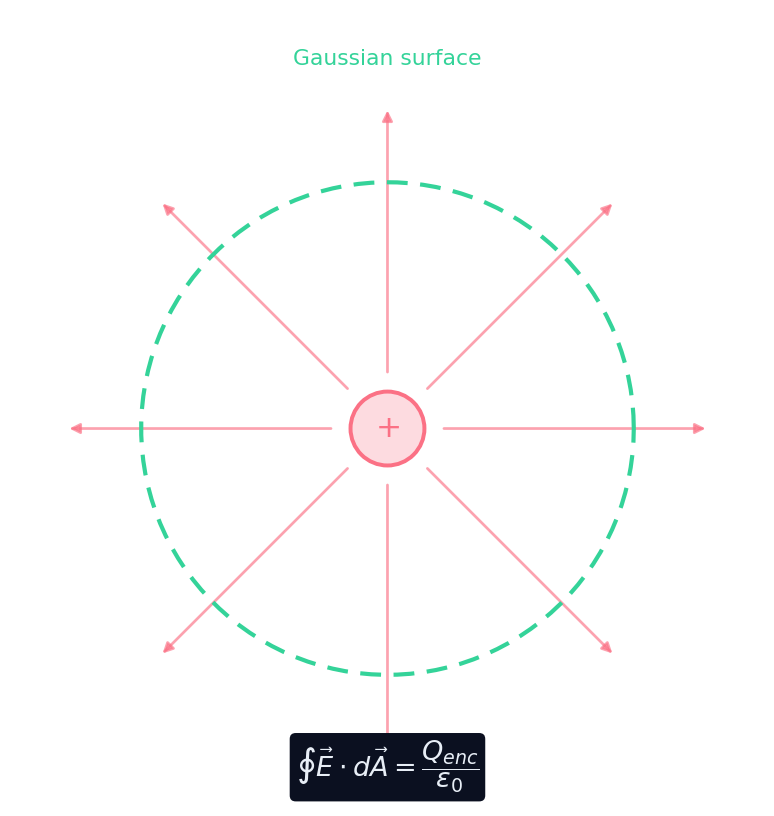
Flux from a charge
Watch the field lines from a charge spread out and cross any surface around it.
In Gauss's law, the flux through a closed surface equals:
Dificultad 1/5 · 100 monedas + un pequeño bono en el primer intento de hoy
$\oint \vec E \cdot d\vec A = Q_{\text{enc}}/\varepsilon_0$.
Outside charge cancels
- A charge outside the surface sends as much flux in as out.
- So its net contribution to the closed-surface flux is zero.
- This is why only $Q_{\text{enc}}$ appears on the right.
- The field on the surface still feels outside charge — but the flux doesn't.
A charge outside a closed surface adds to the net flux through it.
Dificultad 1/5 · 100 monedas + un pequeño bono en el primer intento de hoy
False. Field lines from an outside charge enter and leave the surface equally, so the net flux is zero; only enclosed charge counts (Gauss's law).
A surface encloses $+6\ \text{nC}$ y $-2\ \text{nC}$. What net charge (in nC) sets its flux?
Dificultad 2/5 · 140 monedas + un pequeño bono en el primer intento de hoy
Only enclosed charge counts: $6 + (-2) = 4\ \text{nC}$.
Pick a surface that matches the symmetry
- Spherically symmetric charge → use a concentric spherical Gaussian surface 高斯面.
- Infinite uniformly charged line → use a coaxial cylinder.
- Infinite uniformly charged plane → use a box (pillbox) through it.
- Choose patches where the field is perpendicular with constant normal component, or tangent so the flux is zero.
The imaginary closed surface you integrate over is called a ____ surface.
Dificultad 1/5 · 100 monedas + un pequeño bono en el primer intento de hoy
It is a Gaussian surface, chosen to match the symmetry.
Select todos true statements about Gauss's law.
Dificultad 2/5 · 140 monedas + un pequeño bono en el primer intento de hoy
Always true, best with symmetry, driven by enclosed charge — over a closed surface.
Powerful results, fast
- Outside an isolated spherically symmetric charge distribution: $E = \dfrac{kQ}{r^2}$ — exactly like a point charge.
- Around an infinite line: $E = \dfrac{\lambda}{2\pi\varepsilon_0 r}$.
- Near an infinite plane: $E = \dfrac{\sigma}{2\varepsilon_0}$ (constant).
- Each drops out of Gauss's law in a couple of lines.
Outside a uniformly charged sphere of charge $Q$, the field is:
Dificultad 1/5 · 100 monedas + un pequeño bono en el primer intento de hoy
Gauss's law gives $E = kQ/r^2$ outside — identical to a point charge.
Find the outward radial field $E$ a distance $r$ outside an isolated spherically symmetric charge distribution of total charge $Q$.
- A spherical Gaussian surface gives $\oint E\,dA = E(4\pi r^2)$.
- Set it equal to $Q/\varepsilon_0$: $E = \dfrac{Q}{4\pi\varepsilon_0 r^2} = \dfrac{kQ}{r^2}$.
Gauss's law is always true, but only useful when symmetry makes $E$ constant on your surface. For a lopsided charge you can still write $\oint \vec E \cdot d\vec A = Q_{\text{enc}}/\varepsilon_0$, but you can't pull $E$ out of the integral.
Gauss's law says $\oint \vec E \cdot d\vec A = Q_{\text{enc}}/\varepsilon_0$ — flux through a closed surface depends only on the enclosed charge. Choose a Gaussian surface matching the symmetry (sphere, cylinder, plane) to read $E$ off in one step.
Write from the data: find the shell field
- An isolated uniformly charged spherical shell holds +6 microcoulomb; no other charges are present. A point outside is 0.30 m from the centre. Use k = 9 times 10 to the 9.
- Find the outside field. Say the field inside the empty shell.
An isolated uniformly charged spherical shell holds +6 microcoulomb, with no other charges present. Find the field 0.30 m from the centre outside it, using k = 9 times 10 to the 9. What is the field inside its empty cavity?
Outside, E = kQ/r squared = 54000/0.09 = 600000 N/C, outward. Inside, spherical symmetry and zero enclosed charge together imply E = 0.
An isolated uniformly charged spherical shell holds +6 microcoulomb with no other charges present. Using k = 9 times 10 to the 9, what is the field 0.30 m from its centre outside it, and inside its empty cavity?
Dificultad 1/5 · 100 monedas + un pequeño bono en el primer intento de hoy
Outside, E = kQ/r squared = 54000/0.09 = 600000 N/C, outward. Inside, spherical symmetry and zero enclosed charge give E = 0.