Electric Flux
Introducido| English | Significado |
|---|---|
| electric flux/ɪˈlektrɪk flʌks/ | flujo eléctrico |
| area vector/ˈeərɪə ˈvektə/ | vector de área |
| normal/ˈnɔːml/ | normal |
How many field lines pierce this net?
- Hold a net in a stream: the flow through it depends on its size and tilt.
- Do the same with an electric field and a surface.
- Electric flux 电通量 counts how much field pierces an area.
- It is the idea that makes Gauss's law possible in the next lesson.
Flux is a dot product
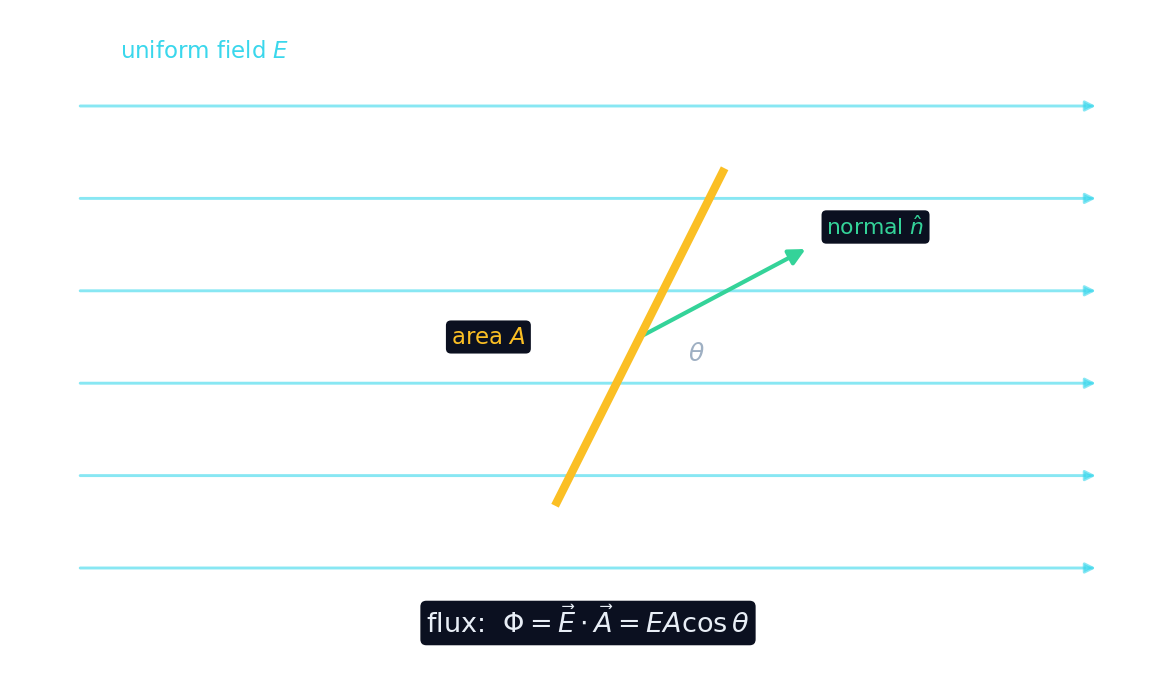
- Give the area an area vector 面积矢量 $\vec A$: length $=$ the area, direction $=$ the normal 法线.
- For a flat surface in a uniform field, flux is $\Phi = \vec E \cdot \vec A = EA\cos\theta$.
- $\theta$ is the angle between the field and the area's normal.
- The dot product automatically counts only the field that goes through.
Electric flux through a flat area is:
Dificultad 1/5 · 100 monedas + un pequeño bono en el primer intento de hoy
$\Phi = \vec E \cdot \vec A = EA\cos\theta$, with $\theta$ from the normal.
The area vector points along the ____ to the surface.
Dificultad 1/5 · 100 monedas + un pequeño bono en el primer intento de hoy
The area vector is perpendicular to the surface — its normal.
The tilt decides everything
- Face-on ($\theta = 0$): all the field pierces it, $\Phi = EA$ (maximum).
- Edge-on ($\theta = 90^\circ$): the field skims past, $\Phi = 0$.
- In between, only the $\cos\theta$ part counts.
- Tilting a surface changes its flux without changing the field.
A field $E = 100\ \text{N/C}$ passes straight through ($\theta = 0$) an area of $2\ \text{m}^2$. Find the flux (N·m²/C).
Dificultad 2/5 · 140 monedas + un pequeño bono en el primer intento de hoy
$\Phi = EA\cos 0 = 100 \times 2 \times 1 = 200$.
A field parallel to a surface gives the maximum flux through it.
Dificultad 1/5 · 100 monedas + un pequeño bono en el primer intento de hoy
False. Parallel to the surface means the field makes $90^\circ$ with the area vector, so $\cos\theta = 0$ and the flux is zero. Flux is largest when the field is perpendicular to the surface.
Curved or changing surfaces need an integral
- If $E$ varies or the surface curves, split it into patches $d\vec A$.
- Each patch has flux $d\Phi = \vec E \cdot d\vec A$.
- Add them all: $\Phi = \displaystyle\int \vec E \cdot d\vec A$.
- Over a closed surface we write $\oint \vec E \cdot d\vec A$.
When is the flux greatest?
Electric flux measures how many field lines cross a surface. Sort each case.
Select todos true statements about electric flux.
Dificultad 2/5 · 140 monedas + un pequeño bono en el primer intento de hoy
Flux is a dot product, peaks face-on, and integrates over curves. The angle always matters.
Sign and units
- Flux out of a closed surface is positive; flux in is negative.
- Units are N·m²/C.
- A closed surface with no charge inside has zero net flux — as much goes in as out.
- That last fact is the seed of Gauss's law.
A closed surface has no charge inside. Its net flux is:
Dificultad 1/5 · 100 monedas + un pequeño bono en el primer intento de hoy
With no enclosed charge, as much flux enters as leaves — net zero.
A field $E = 200\ \text{N/C}$ hits a $0.5\ \text{m}^2$ flat area whose normal is at $\theta = 60^\circ$ to the field.
- $\Phi = EA\cos\theta = 200 \times 0.5 \times \cos 60^\circ$.
- $\Phi = 200 \times 0.5 \times 0.5 = 50\ \text{N}\cdot\text{m}^2/\text{C}$.
Worked examples: a non-uniform field and a cube
1. A field that varies with $x$. $\vec E=(3x)\,\hat\imath$ N/C crosses a square in the plane $x=2$ m, with sides $0.5$ m and normal along $+x$.
- On that square $E=3(2)=6$ N/C everywhere, so $\Phi=EA=6\times0.25=1.5\ \text{N}\cdot\text{m}^2/\text{C}$.
- If $E$ changed across the surface, you would split it into strips, $d\Phi=E(y)\,dA$, and integrate.
2. A charge at the centre of a cube. A charge $q$ sits at the centre of a cube. Find the flux through one face.
- The total flux out of any closed surface around $q$ is $q/\varepsilon_0$.
- The six faces are identical by symmetry, so each face gets $\dfrac{q}{6\varepsilon_0}$. No integral is needed.
A 6.0 nC charge sits at the centre of a cube. Find the flux through one face, in N·m²/C. Use ε₀ = 8.85 × 10⁻¹² C²/(N·m²).
Dificultad 2/5 · 140 monedas + un pequeño bono en el primer intento de hoy
Total flux = q/ε₀ = 6.0 × 10⁻⁹ / 8.85 × 10⁻¹² = 678 N·m²/C. One face of six: 678/6 = 113 N·m²/C.
E = (5x) î N/C. Find the flux through a 0.20 m × 0.20 m square in the plane x = 3.0 m whose normal points along +x.
Dificultad 2/5 · 140 monedas + un pequeño bono en el primer intento de hoy
At x = 3.0 m, E = 15 N/C over the whole square, so Φ = 15 × 0.04 = 0.60 N·m²/C.
The angle $\theta$ is measured from the normal, not from the surface itself. A field parallel to a surface has $\theta = 90^\circ$ and gives zero flux — a common sign-and-angle trap.
Electric flux is the field piercing an area: $\Phi = \vec E \cdot \vec A = EA\cos\theta$, with $\theta$ from the area vector (normal). Face-on gives maximum flux, edge-on gives zero. For curved surfaces, $\Phi = \int \vec E \cdot d\vec A$.
Write from the data: find the flux
- A field of 80 newtons per coulomb meets a 0.40 square metre area face-on.
- Find the flux. Say what the flux becomes when that area is edge-on.
A field of 80 newtons per coulomb passes through a 0.40 square metre area face-on. What is the flux, and what is it when the area is edge-on?
80 times 0.40 is 32. At 90 degrees the cosine is 0, so no field pierces the area.
A uniform field of 80 newtons per coulomb passes through a flat area of 0.40 square metres with its normal along the field. What is the flux?
Dificultad 1/5 · 100 monedas + un pequeño bono en el primer intento de hoy
80 times 0.40 times 1 is 32. Other options — 50 (the lesson flux for 200 newtons per coulomb through 0.5 square metres at 60 degrees); 0 (as if this face-on area were edge-on).