Transitional Elements
Introducido| English | Significado |
|---|---|
| transition/trænˈsɪʃn/ | A word, phrase or passage linking ideas and helping a reader follow a change in topic or argument. |
| relationship/rɪˈleɪʃənʃɪp/ | An association between entities or tables, often represented with keys and foreign-key references. |
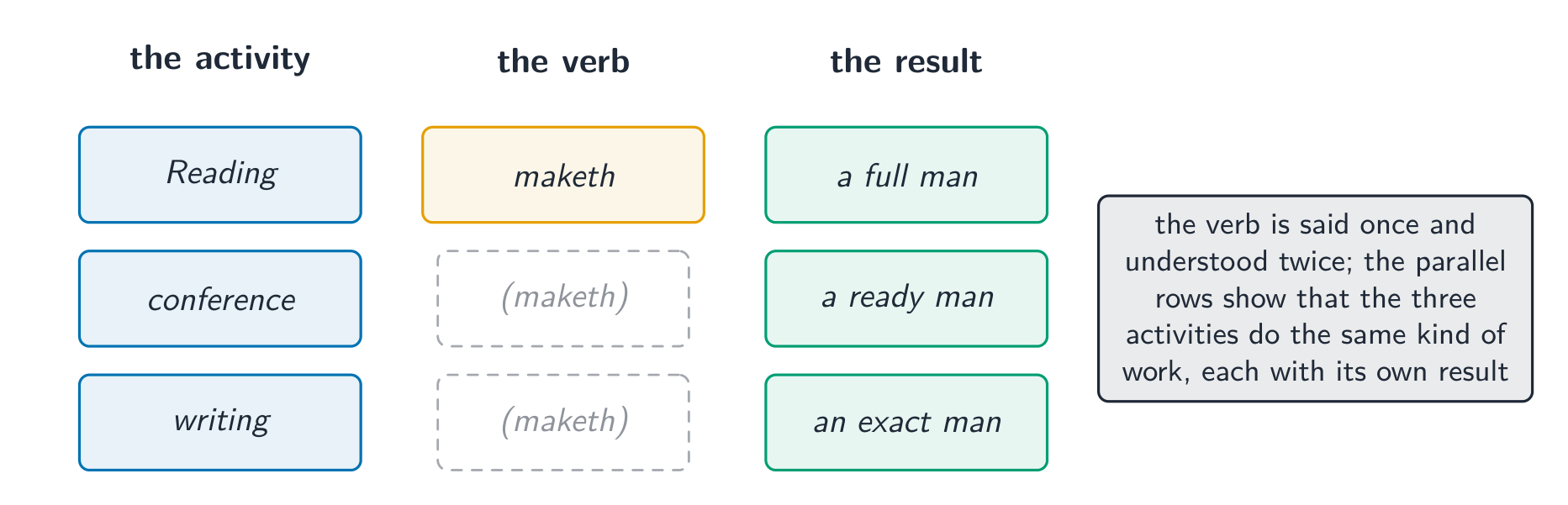
"Reading maketh a full man", 1625
- Francis Bacon's essay "Of Studies" (1625) links ideas almost without connecting words: "Reading maketh a full man; conference a ready man; and writing an exact man." Parallel structure joins the three ideas and shows how they relate.
- A transition 过渡 is the link between ideas. It shows a relationship 关系 — addition, contrast, cause, example — not just that a new paragraph has started.
What links Bacon's three ideas in "Reading maketh a full man..."?
Dificultad 1/5 · 100 monedas + un pequeño bono en el primer intento de hoy
Structure can be a transition.
A transition is not only a word
- Transitions include words (however, therefore), phrases, repeated key terms and sentence structure.
- A whole sentence can be a transition: "Shelley's sympathy for the creature does not last, however."
Which can act as transitions?
Dificultad 2/5 · 140 monedas + un pequeño bono en el primer intento de hoy
A transition shows a relationship.
Size the transition to the distance
- A small step (another example) needs a word; a large shift (from character to theme) needs a full sentence.
- Using "Furthermore" for a big turn hides the turn.
What does a large shift from character to theme need?
Dificultad 1/5 · 100 monedas + un pequeño bono en el primer intento de hoy
Size the transition to the distance.
Worked example: repairing a seam
- Weak: "Victor abandons the creature. Also, the creature reads Paradise Lost."
- Problem: "Also" marks addition, but the second idea explains the first's result.
- Repair: "Abandoned by Victor, the creature finds a substitute father in books: reading Paradise Lost, he compares himself to Adam, yet notes that Adam was not left alone." The transition now shows cause and contrast.
Does this transition show a relationship?
Sort each by whether it names the move between ideas.
Why is "Also" weak in the Frankenstein example?
Dificultad 1/5 · 100 monedas + un pequeño bono en el primer intento de hoy
Name the real relationship.
Show the relationship
- Before writing a transition, ask: is the next idea more of the same, a contrast, a cause, a result, or an example?
- Choose words that name that relationship exactly.
Which relationships can a transition show?
Dificultad 2/5 · 140 monedas + un pequeño bono en el primer intento de hoy
Ask what the next idea does.
Cutting a bad transition
- A vague "Moreover" or "In addition" stuck on every paragraph adds noise. If you cannot name the relationship, rethink the order of ideas.
If you cannot name the relationship between ideas, rethink the order.
Dificultad 1/5 · 100 monedas + un pequeño bono en el primer intento de hoy
Vague transitions add noise.
"Firstly, secondly, thirdly" is a list, not a line of reasoning. Show how each point builds on the last, not just that it comes next.
"Firstly, secondly, thirdly" shows a line of reasoning.
Dificultad 1/5 · 100 monedas + un pequeño bono en el primer intento de hoy
It is a list.
A transition shows the relationship between ideas — addition, contrast, cause, example. It can be a word, a repeated term or a whole sentence. Size it to the distance between ideas, and cut transitions that name no real relationship.
Write a transitional sentence between two paragraphs of an essay on a text you know.
Relationship, sentence, size.