Coupled Reactions
Introducido| English | Significado |
|---|---|
| coupled reactions/ˈkʌpld rɪˈækʃnz/ | reacciones acopladas |
Powering the impossible
- Some useful reactions simply will not run on their own.
- But hitch them to a strongly favourable one, and they go.
- The favourable partner supplies the extra push.
- Life runs almost entirely on this trick.
Linking two reactions
- Coupled reactions 偶联反应 let a favourable one drive an unfavourable one.
- Add their free energies: the total must be negative.
- The favourable reaction "pays for" the unfavourable one.
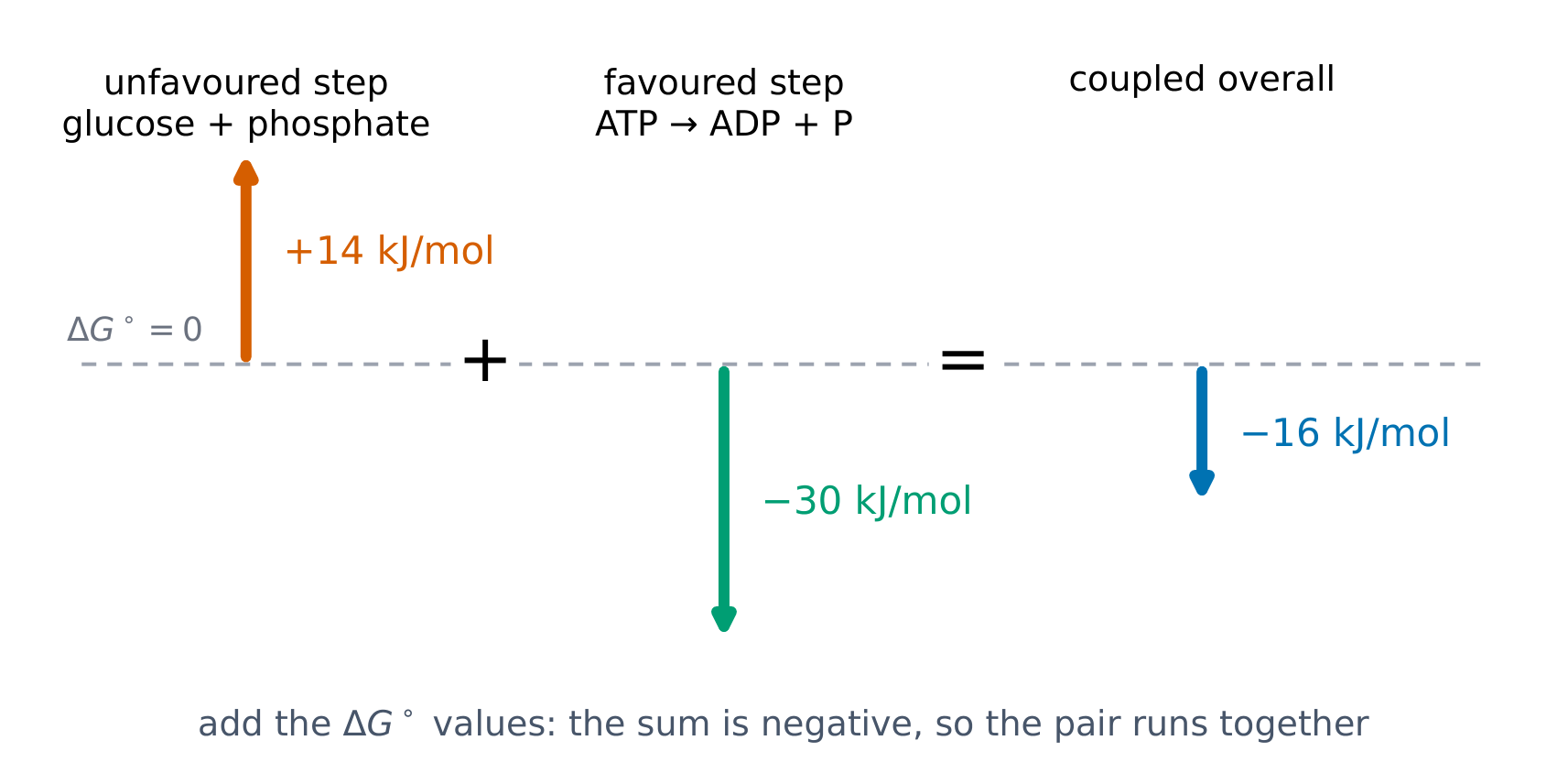
Coupling an unfavourable reaction to a favourable one makes the total ΔG° negative
Coupling lets a favourable reaction drive one that is...
Dificultad 1/5 · 100 monedas + un pequeño bono en el primer intento de hoy
A favourable partner supplies the free energy to drive an unfavourable one.
The free energies add
- Coupled reactions share an intermediate, so they combine.
- $\Delta G_{total} = \Delta G_1 + \Delta G_2$.
- A negative sum makes the linked process thermodynamically favourable; a workable mechanism is also required.
The free energies of coupled reactions add together.
Dificultad 1/5 · 100 monedas + un pequeño bono en el primer intento de hoy
$\Delta G_{total} = \Delta G_1 + \Delta G_2$.
A coupled pair proceeds only if the ____ free energy is negative.
Dificultad 1/5 · 100 monedas + un pequeño bono en el primer intento de hoy
The sum of the two free energies must be negative.
ATP powers the cell
- Cells couple unfavourable reactions to breaking down ATP.
- ATP hydrolysis can supply negative $\Delta G$; its actual value depends on concentrations and conditions.
- This is how bodies build molecules against the odds.
Coupled reactions
A favourable reaction can drive an unfavourable one if they share an intermediate.
Cells couple unfavourable reactions to the breakdown of ATP.
Dificultad 1/5 · 100 monedas + un pequeño bono en el primer intento de hoy
ATP's large negative $\Delta G$ drives many cellular reactions.
For compatible amounts and conditions, linked reaction A has $\Delta G=+20\ \text{kJ}$ and B has $\Delta G=-50\ \text{kJ}$. Is their sum favourable?
- Total: $+20+(-50)=-30\ \text{kJ}$.
- Negative overall, so the coupled process is favourable; this does not determine its rate.
For compatible amounts and conditions, linked reaction A has $\Delta G=+15\ \text{kJ}$ and B has $\Delta G=-40\ \text{kJ}$. Find the total in kJ.
Dificultad 2/5 · 140 monedas + un pequeño bono en el primer intento de hoy
Add the values for the linked equations: $\Delta G_{total}=15+(-40)=-25\ \text{kJ}$, so the overall process is favourable.
For two reactions to be coupled, they must share a...
Dificultad 1/5 · 100 monedas + un pequeño bono en el primer intento de hoy
A shared intermediate links the two reactions.
Coupling works only when the reactions share a common intermediate — you cannot just add any two. The favourable reaction's $\Delta G$ must be negative enough to outweigh the unfavourable one. And the total $\Delta G$, not each piece, decides whether the coupled pair runs.
Coupled reactions let a strongly favourable reaction drive an unfavourable one through a shared intermediate. Their free energies add: as long as $\Delta G_{total} = \Delta G_1 + \Delta G_2 < 0$, the pair proceeds. Cells use ATP breakdown to power reactions this way.