Reading an Energy Profile
Introducido| English | Significado |
|---|---|
| energy profile/ˈenədʒi ˈprəʊfaɪl/ | perfil energético |
| activation energy/ˌæktɪˈveɪʃn ˈenədʒi/ | energía de activación |
| transition state/trænˈsɪʃn steɪt/ | estado de transición |
A hill the reaction must climb
- Every reaction has a hill to get over before it can finish.
- A graph draws that hill as the atoms rearrange.
- Its height tells you how hard the reaction is to start.
- Its two ends tell you whether heat is released or absorbed.
The reaction-coordinate diagram
- An energy profile 能量图 plots energy along the reaction's progress.
- Reactants sit on the left and products on the right.
- A hill rises between them.
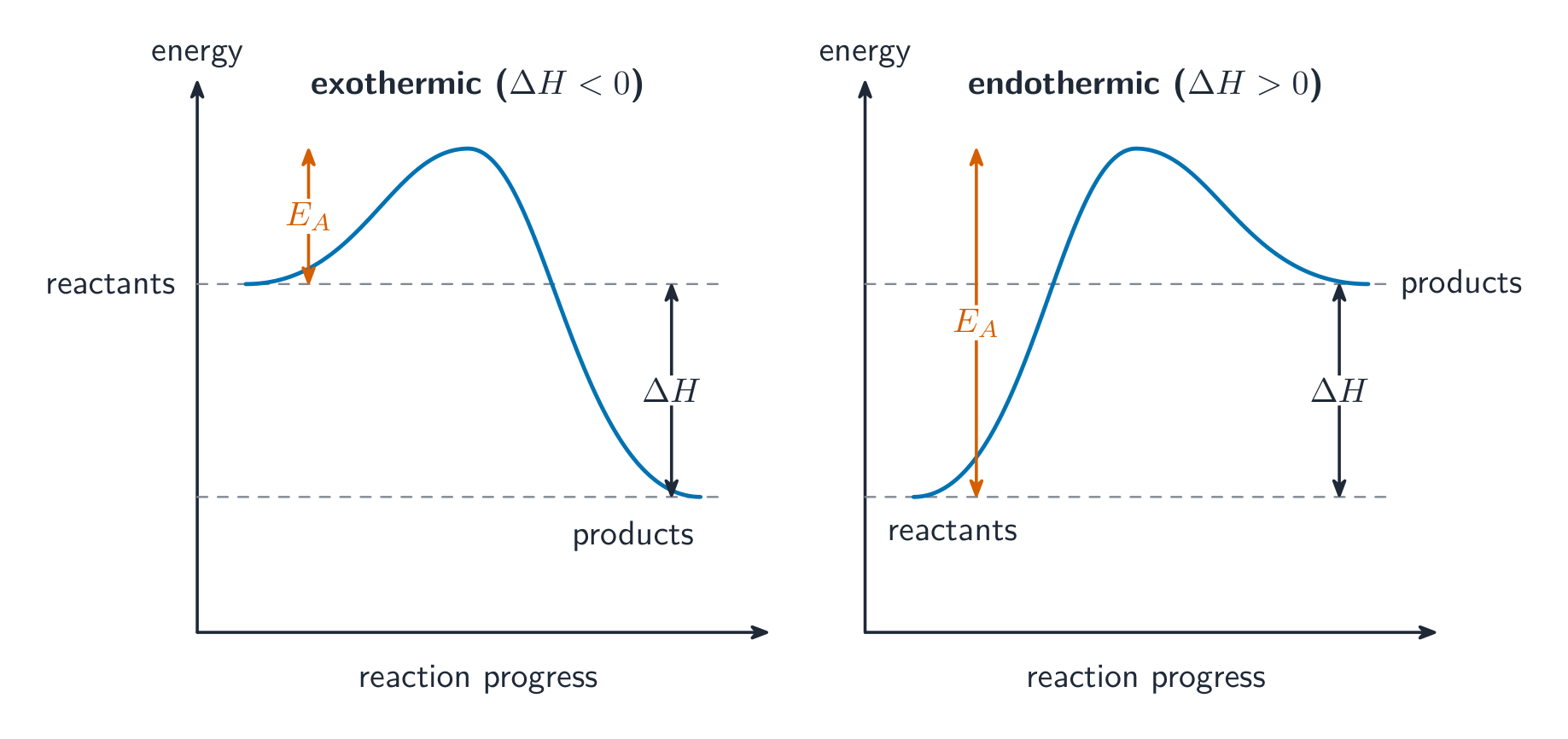
Exothermic reactions end lower than the reactants; endothermic end higher
The peak is the barrier
- The peak height above the reactants is the activation energy 活化能.
- At the very top sits the transition state 过渡态.
- At the same temperature and comparable collision factors, a larger barrier above the starting level means a smaller rate constant; absolute peak height is not enough.
The transition state is located at the...
Dificultad 1/5 · 100 monedas + un pequeño bono en el primer intento de hoy
The transition state sits at the very top of the barrier.
A higher activation energy makes a reaction faster.
Dificultad 1/5 · 100 monedas + un pequeño bono en el primer intento de hoy
False. Fewer collisions have enough energy to clear a taller barrier, so a higher activation energy makes the reaction slower.
Uphill or downhill overall
- If products sit lower than reactants, energy is released (exothermic).
- If products sit higher, energy is absorbed (endothermic).
- For an enthalpy profile, $\Delta H=H_{\mathrm{products}}-H_{\mathrm{reactants}}$; the horizontal axis is reaction progress, not elapsed time.
Leer el perfil energético
Find the activation energy, the enthalpy change, and how the reactants climb to the transition state.
Reactants at $40\ \text{kJ}$, products at $25\ \text{kJ}$. The value of $\Delta H$ (in kJ)?
Dificultad 2/5 · 140 monedas + un pequeño bono en el primer intento de hoy
On this enthalpy profile, $\Delta H=H_{\mathrm{products}}-H_{\mathrm{reactants}}=25-40=-15\ \text{kJ}$. Products are lower, so the reaction releases 15 kJ for the stated reaction amount.
If the products are lower in energy than the reactants, the reaction is...
Dificultad 1/5 · 100 monedas + un pequeño bono en el primer intento de hoy
Lower products mean net energy is released -- exothermic.
Reactants at $50\ \text{kJ}$, peak at $120\ \text{kJ}$, products at $30\ \text{kJ}$.
- Forward activation energy: $E_{a,f}=H_{\mathrm{peak}}-H_{\mathrm{reactants}}=120-50=70\ \text{kJ}$. Reverse activation energy: $E_{a,r}=120-30=90\ \text{kJ}$.
- $\Delta H = 30 - 50 = -20\ \text{kJ}$, so it is exothermic.
Reactants at $40\ \text{kJ}$, peak at $100\ \text{kJ}$. The activation energy (in kJ)?
Dificultad 2/5 · 140 monedas + un pequeño bono en el primer intento de hoy
Use $E_a=H_{\mathrm{peak}}-H_{\mathrm{reactants}}$. Thus $E_a=100-40=60\ \text{kJ}$; the zero of the vertical axis is irrelevant.
Activation energy is measured from the reactants up to the ____.
Dificultad 1/5 · 100 monedas + un pequeño bono en el primer intento de hoy
It is the height of the peak above the reactants.
Activation energy is measured from the reactants up to the peak, not from zero. $\Delta H$ is the difference between products and reactants (the two ends), independent of the peak height. And a large activation energy makes a reaction slow even if it is strongly exothermic.
An energy profile plots energy along a reaction. The peak above the reactants is the activation energy, with the transition state at the top. Whether products end lower (exothermic) or higher (endothermic) than reactants gives $\Delta H$. Barrier height sets speed; the end difference sets $\Delta H$.