Why Collisions Do or Do Not React
Introducido| English | Significado |
|---|---|
| collision theory/kəˈlɪʒn ˈθɪəri/ | teoría de colisiones |
| activation energy/ˌæktɪˈveɪʃn ˈenədʒi/ | energía de activación |
Not every bump makes a bond
- Particles bump constantly, but most bounce off unchanged.
- Only a few hits actually trigger a change.
- A successful hit needs enough energy and the right angle.
- Miss either and nothing happens.
Collision theory
- Collision theory 碰撞理论 says particles must collide to react.
- But a collision only works if two conditions are met.
- Enough energy, and the correct orientation.
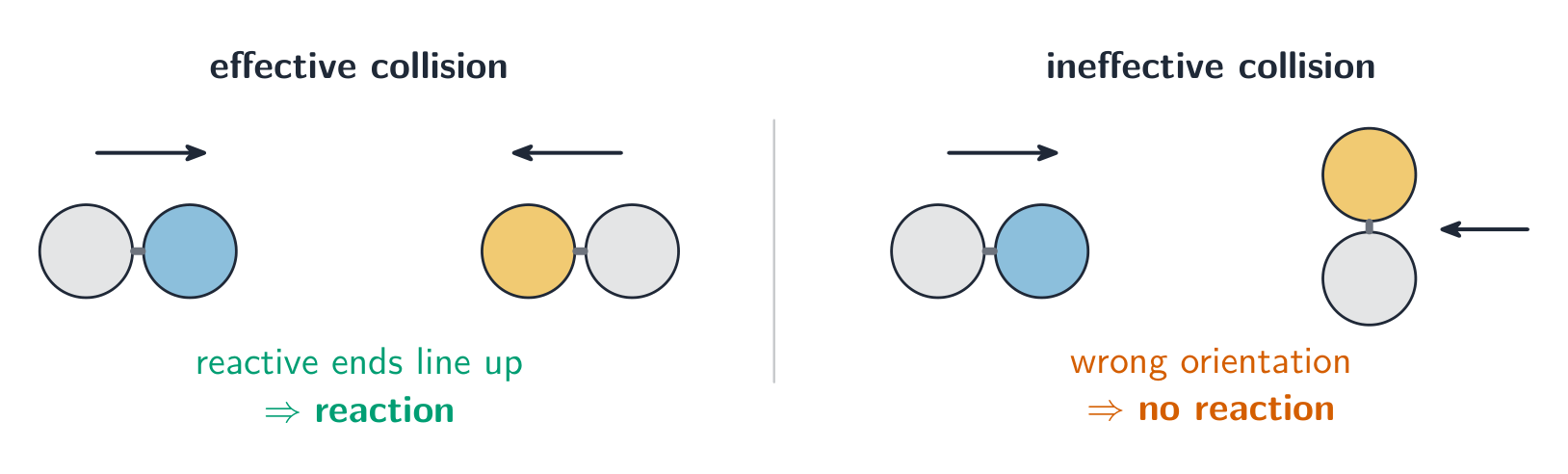
A collision only reacts with the right orientation and enough energy
Select ambas conditions a collision needs to cause a reaction.
Dificultad 2/5 · 140 monedas + un pequeño bono en el primer intento de hoy
A successful collision needs both sufficient energy and the right orientation.
The energy barrier
- A reaction needs a minimum energy, the activation energy 活化能.
- Collisions below it just bounce apart.
- A collision needs sufficient relative kinetic energy and suitable orientation; one particle being fast is not enough by itself.
The minimum energy a collision needs to react is the...
Dificultad 1/5 · 100 monedas + un pequeño bono en el primer intento de hoy
The activation energy is the barrier every reaction must clear.
Collisions with energy below the activation energy simply ____ apart.
Dificultad 1/5 · 100 monedas + un pequeño bono en el primer intento de hoy
Too little energy means the particles just bounce off.
The right angle
- Even an energetic collision fails if the particles are aimed wrong.
- The reacting parts must line up on impact.
- Both energy and orientation must be right.
Enough energy to react?
Only collisions above the activation energy react. Heat the gas and watch more particles cross that threshold.
A collision with plenty of energy but the wrong orientation can still fail.
Dificultad 1/5 · 100 monedas + un pequeño bono en el primer intento de hoy
Both energy and orientation must be right for success.
Why does raising the temperature speed a reaction so much?
- Hotter particles collide more often and with more energy.
- A far larger fraction now clears the activation energy.
Raising temperature speeds a reaction mainly by...
Dificultad 1/5 · 100 monedas + un pequeño bono en el primer intento de hoy
At higher temperature, a larger fraction of collisions has enough relative kinetic energy to cross the activation barrier. The barrier itself is not lowered by heating; a suitable catalyst provides a different pathway.
Most collisions between particles actually lead to a reaction.
Dificultad 1/5 · 100 monedas + un pequeño bono en el primer intento de hoy
Most collisions fail; only the effective ones react.
Both conditions must hold — enough energy and the correct orientation; a hard collision at the wrong angle still fails. Temperature mainly boosts the energy condition, letting more particles clear the barrier. And most collisions do nothing; only the effective ones count.
Collision theory says a reaction needs collisions with two things at once: enough energy to clear the activation energy barrier, and the correct orientation. Most collisions fail on one or the other. Raising temperature works mainly by pushing more particles over the energy barrier.