Acid-Base Reactions
Introducido| English | Significado |
|---|---|
| acid/ˈæsɪd/ | ácido |
| base/beɪs/ | base |
| neutralization/ˌnjuːtrəlaɪˈzeɪʃn/ | neutralización |
The great proton handoff
- Lemon juice stings; soap feels slippery.
- One eagerly gives away a tiny particle; the other grabs it.
- Mix them and they cancel each other out.
- A single proton passed along explains it all.
Donors and acceptors
- An acid 酸 donates a hydrogen ion ($\text{H}^+$, a proton).
- A base 碱 accepts that hydrogen ion.
- This is the Bronsted-Lowry picture.
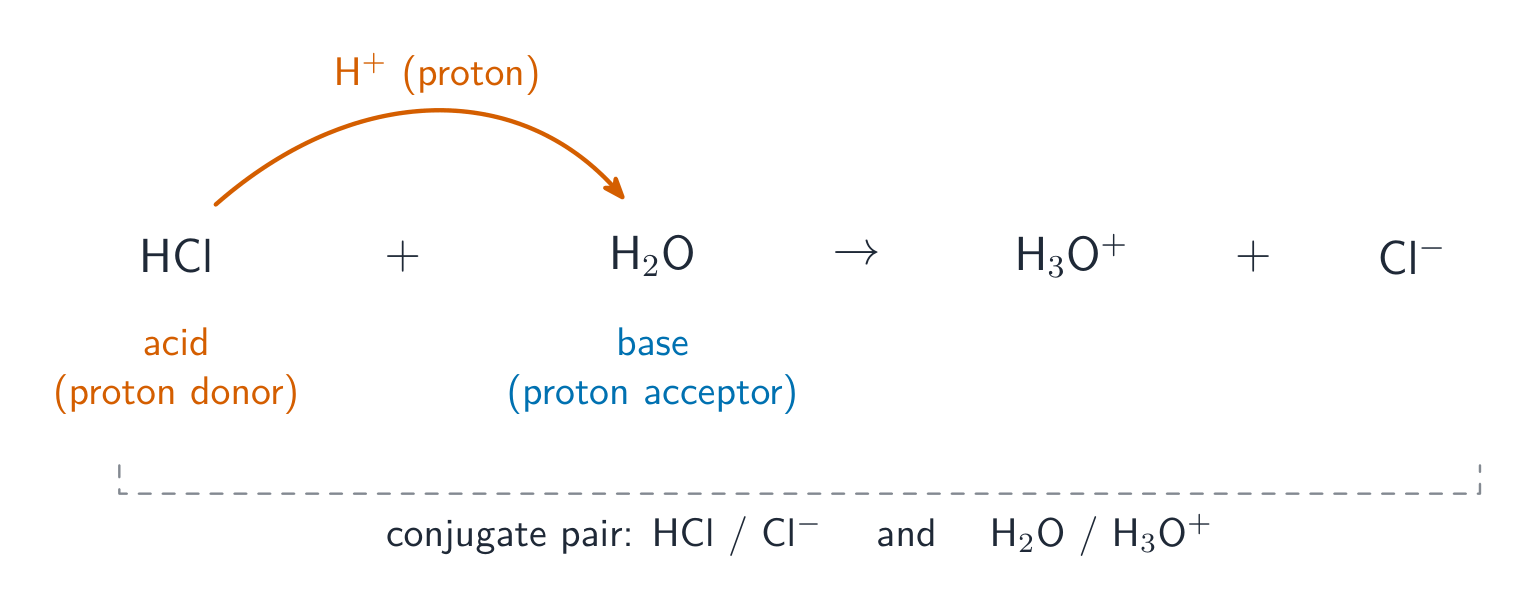
Bronsted-Lowry: an acid donates a proton to a base, forming two conjugate pairs
In the Bronsted-Lowry model, an acid is a substance that...
Dificultad 1/5 · 100 monedas + un pequeño bono en el primer intento de hoy
An acid is a proton donor; a base is a proton acceptor.
A base is a proton ____.
Dificultad 1/5 · 100 monedas + un pequeño bono en el primer intento de hoy
A base accepts the proton the acid donates.
Neutralization
- Neutralization 中和 is an acid reacting with a base.
- An acid reacting with a hydroxide base gives salt and water; other bases need not form water, as in $\text{HCl}+\text{NH}_3\to\text{NH}_4\text{Cl}$.
- $\text{HCl} + \text{NaOH} \to \text{NaCl} + \text{H}_2\text{O}$.
Neutralizing aqueous hydrochloric acid with aqueous sodium hydroxide produces...
Dificultad 1/5 · 100 monedas + un pequeño bono en el primer intento de hoy
For this acid–hydroxide reaction, $\text{H}^++\text{OH}^-\to\text{H}_2\text{O}$; sodium and chloride remain as aqueous spectator ions. Other bases, such as ammonia, do not require water as a product.
Strong and weak
- A strong acid or base ionizes completely in water.
- A weak one only partly ionizes.
- Strength is about how fully it dissociates, not how concentrated it is.
Acid or base?
In each reaction, decide which species donates a proton (acid) and which accepts one (base).
A strong acid is always more concentrated than a weak acid.
Dificultad 1/5 · 100 monedas + un pequeño bono en el primer intento de hoy
Strength (ionization) is independent of concentration.
A strong acid only partly ionizes in water.
Dificultad 1/5 · 100 monedas + un pequeño bono en el primer intento de hoy
False. A strong acid ionizes completely; partial ionization is what makes an acid weak.
What forms when $\text{HCl}$ reacts with $\text{NaOH}$?
- The $\text{H}^+$ and $\text{OH}^-$ join to make water.
- $\text{Na}^+(aq)$ and $\text{Cl}^-(aq)$ remain hydrated spectator ions; NaCl crystals form only if enough water is removed.
When $\text{H}^+$ se encuentra con $\text{OH}^-$ in neutralization, they form...
Dificultad 1/5 · 100 monedas + un pequeño bono en el primer intento de hoy
$\text{H}^+ + \text{OH}^- \to \text{H}_2\text{O}$.
Do not confuse strength with concentration — a strong acid can be dilute, and a weak acid can be concentrated. Strong means fully ionized. Neutralization with a hydroxide base forms water; proton transfer to ammonia forms ammonium instead. The equivalence solution need not have pH 7. And the acid donates the proton while the base accepts it.
An acid donates a proton ($\text{H}^+$) and a base accepts one. Their neutralization transfers a proton; with a hydroxide base it produces salt and water, as in $\text{HCl} + \text{NaOH} \to \text{NaCl} + \text{H}_2\text{O}$. Strength (fully vs partly ionized) is separate from concentration.